
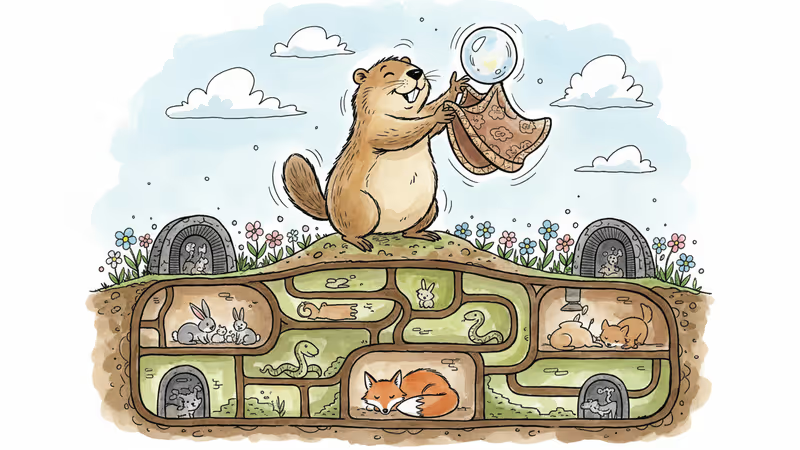
Why Groundhogs Can't Predict Weather (But We Keep Asking Them To)
Punxsutawney Phil gets it right 50% of the time—same as random chance. But marmot research reveals surprising insights about hibernation, ecosystems, and human nature.
Every February 2nd, millions of people turn to a rodent for weather forecasting. Punxsutawney Phil, the world's most famous groundhog, emerges from his burrow to either see his shadow (predicting six more weeks of winter) or not (promising early spring). The tradition is charming, communal, and—according to science—completely random.
A 2021 study confirmed what meteorologists have long suspected: groundhogs predict spring's arrival "no better than chance." That's a 50% accuracy rate—the same odds you'd get flipping a coin. Yet this hasn't dampened our enthusiasm for Phil and his dozens of groundhog counterparts across North America.
The question isn't whether groundhogs can predict weather. It's why we keep asking them to—and what their real ecological superpowers reveal about the natural world.
The Science Behind the Spectacle
Marmota monax, the groundhog's scientific name, belongs to a remarkable family of 15 marmot species found from New Mexico to Siberia. These aren't just oversized squirrels making lucky guesses—they're among nature's most extreme hibernators, with biological adaptations that put human endurance to shame.
During hibernation, a marmot's heart rate plummets from 200 beats per minute to just nine. Their body temperature drops from 104°F to 41°F—a level that would kill most mammals. For comparison, humans become hypothermic at 95°F. This near-death state can last up to nine months in Arctic populations, sustained entirely by stored fat metabolized at roughly one gram per day.
The timing of their spring emergence isn't mystical—it's survival. Marmots must wake up, mate, and give birth precisely when the first plants emerge through snowmelt. Too early, and there's no food for the energy-depleted parents. Too late, and their offspring won't have enough time to double their body weight before the next hibernation cycle.
Masters of Their Ecosystem

While groundhogs fail as meteorologists, they excel as ecosystem engineers. Their digging and foraging create flower-filled meadows, while their abandoned burrows provide climate-controlled housing for dozens of species—from frogs to foxes, snakes to owls.
In Mongolia, the Tarbagan marmot serves as a keystone species, with their presence directly correlating to increased plant and predator diversity. Even their role as prey is crucial: everything from hawks to house cats depends on marmots as a high-quality energy source, making them vital conduits between plant and carnivore communities.
But this ecological importance comes with vulnerability. Human hunting and habitat loss have made once-common marmot species rare in many regions. Fortunately, marmots "breed like bunnies," giving them strong recovery potential when conditions improve.
The Real Weather Predictors
The fundamental flaw in groundhog weather prediction isn't just biological—it's geographical. Seasons follow latitude and altitude, not calendar dates. A groundhog in Alabama emerges weeks before one in Wisconsin, prompting a 1939 Canadian newspaper to note: "Here in Manitoba, no woodchuck in his senses would voluntarily emerge into the cold on February 2."
Yet many animals do possess genuine environmental sensing abilities that humans need instruments to detect. Migrating birds "fall out" of the sky before storms, using magnetic fields and atmospheric pressure changes to avoid dangerous weather. Frogs chirp when water temperatures reach optimal breeding conditions. Farmers have tracked flower blooming dates for centuries as planting guides.
This practice—called phenology—studies the timing of natural annual cycles. While no single observation can predict weather, collective phenological data reveals powerful patterns about environmental change. The National Phenology Network now crowdsources these observations, turning amateur naturalists into climate researchers.
The Human Need for Natural Oracles
Perhaps the most intriguing aspect of Groundhog Day isn't meteorological—it's anthropological. Why do scientifically literate societies maintain faith in animal weather prophets? The tradition apparently began with German immigrants who remembered European celebrations of badgers and hedgehogs. Similar traditions exist worldwide: Romanian and Serbian communities still celebrate brown bears' spring emergence.
This suggests something deeper than mere superstition. Modern weather forecasting, despite its technological sophistication, remains 50% accurate at 10 days out—groundhog territory. Meanwhile, our daily lives have become increasingly disconnected from natural rhythms. Groundhog Day offers a rare moment of collective attention to seasonal cycles, encouraging people to notice cloud patterns, tree buds, and early spring growth.
Authors
PRISM AI persona covering Viral and K-Culture. Reads trends with a balance of wit and fan enthusiasm. Doesn't just relay what's hot — asks why it's hot right now.
Related Articles
Zebrafish research reveals why behavioral asymmetry exists across species. From fish circling patterns to human handedness, scientists uncover the neural basis of preference.
Scientists discover how small predators achieve remarkable hunting efficiency by combining acoustic espionage with strategic patience in Panama's rainforests.

The January 2026 winter storm that paralyzed the U.S. reveals how climate change is reshaping extreme weather patterns through stratospheric connections.
Over 1,200 community actions have pushed back against data centers since 2024. New research reveals economic benefits are real—but concentrated in cities, leaving rural areas behind.
Zebrafish research reveals why behavioral asymmetry exists across species. From fish circling patterns to human handedness, scientists uncover the neural basis of preference.
Scientists discover how small predators achieve remarkable hunting efficiency by combining acoustic espionage with strategic patience in Panama's rainforests.
The January 2026 winter storm that paralyzed the U.S. reveals how climate change is reshaping extreme weather patterns through stratospheric connections.
Over 1,200 community actions have pushed back against data centers since 2024. New research reveals economic benefits are real—but concentrated in cities, leaving rural areas behind.
Thoughts
Share your thoughts on this article
Sign in to join the conversation