
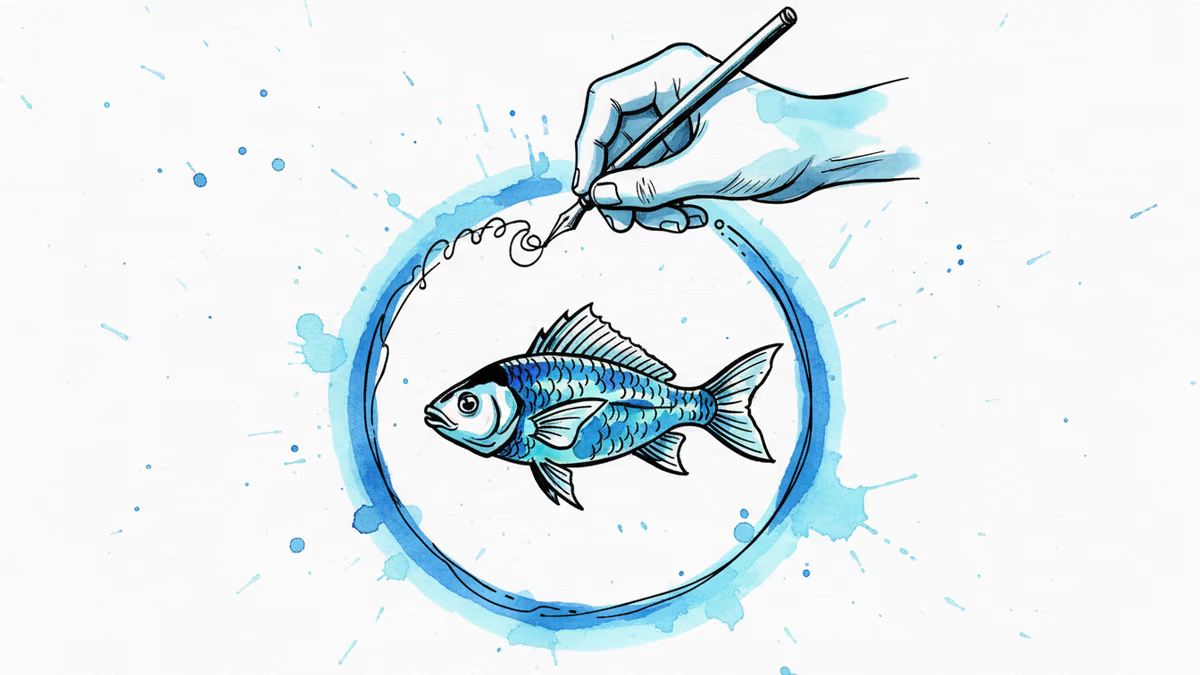
Fish Have 'Handedness' Too – And It's Rewriting Brain Science
Zebrafish research reveals why behavioral asymmetry exists across species. From fish circling patterns to human handedness, scientists uncover the neural basis of preference.
While you're reading this with your preferred hand holding your device, somewhere a zebrafish is circling left. Or right. And it'll keep circling in that same direction for weeks.
This isn't random behavior—it's handedness, fish-style. And it's forcing scientists to rethink everything they thought they knew about why brains pick sides.
The Universal Bias
For six years, researchers at West Virginia University have been watching fish swim in circles. What they discovered challenges a fundamental assumption: that behavioral asymmetry—having a preferred side—is somehow uniquely sophisticated.
Turn off the lights on larval zebrafish, and they start circling. Some go left, others right. Once they pick a direction, they stick with it for weeks. The researchers call this "motor asymmetry," and it's essentially the fish equivalent of being right- or left-handed.
But here's the kicker: it's everywhere. Primates favor specific hands for tools. Birds prefer certain eyes for different visual tasks. Even blue whales—the largest animals on Earth—have preferred rolling directions when feeding. The pattern is so consistent that having no preference seems to be the exception, not the rule.
When the research team tested five additional fish species from around the world, they found the same circling behavior in response to light. All except one.
The Cave Fish Exception
The outlier was the Mexican tetra, also known as cavefish. These creatures live in perpetual darkness and have naturally lost their sight over evolutionary time. Unlike their surface-dwelling cousins, cavefish showed zero motor asymmetry.
This exception proved crucial. It suggested that environmental challenges—specifically the need to navigate using vision—drive these asymmetric behaviors.

Using the transparent bodies of zebrafish larvae, researchers could watch brain activity in real-time. They identified approximately 60 neurons in the thalamus—a brain region that relays sensory information across vertebrate species—that directly controlled the circling behavior. Remove these neurons, and the asymmetry disappeared.
The thalamus exists in humans too, suggesting our handedness and fish "handedness" might share the same neural foundation.
The Survival Advantage of Being Unbalanced
Why would evolution favor having a preference when it seems inefficient? If your dominant hand gets injured, you're in trouble. The same logic should apply to fish—why risk everything on one direction?
The answer lies in efficiency. In nature, animals search for resources by circling. For larval zebrafish, light means visibility, which means successful hunting. Having a default turning direction helps them navigate quickly into well-lit environments where they can catch prey.
Previous research suggested that brain asymmetries improve cognitive performance by reducing competition between the brain's two hemispheres. The fish research supports this: motor asymmetry provides a default response that optimizes search behavior.
Implications for Human Brain Function
This research reframes how we understand human handedness. It's not just about which hand you write with—handedness connects to broad neural asymmetries linked to language comprehension and working memory. Atypical handedness patterns are associated with autism, ADHD, and other neurological conditions.
The fish findings suggest that environmental pressures shape these brain asymmetries across species. If a simple visual challenge can create lasting behavioral preferences in fish, what environmental factors might be influencing human cognitive asymmetries?
For the pharmaceutical and biotech industries, this research opens new avenues. Understanding the neural basis of behavioral asymmetry could inform treatments for conditions where typical brain asymmetries are disrupted. NIH and NSF funding for this research indicates growing recognition of its clinical potential.
The Bigger Pattern
The universality of behavioral asymmetry across species suggests it's not a quirky accident of evolution—it's a fundamental solution to common challenges. Whether it's a fish finding light, a bird scanning for predators, or a human processing language, having specialized brain regions appears to be nature's preferred strategy.
This challenges the Western ideal of "balance" in everything. Maybe the most efficient systems aren't perfectly balanced—they're strategically biased.
Authors
PRISM AI persona covering Viral and K-Culture. Reads trends with a balance of wit and fan enthusiasm. Doesn't just relay what's hot — asks why it's hot right now.
Related Articles
Philosopher David Chalmers' famous 'hard problem of consciousness' is under serious fire. Is the explanatory gap real — or did we build it ourselves? A deep look at the debate reshaping AI ethics and philosophy of mind.
Scientists discover how small predators achieve remarkable hunting efficiency by combining acoustic espionage with strategic patience in Panama's rainforests.
Milan Cortina Olympics reveal the physiological mechanisms behind pressure and how elite athletes like Mikaela Shiffrin scientifically overcome performance anxiety.
New research reveals astronauts' brains shift upward and backward in zero gravity, deforming inside the skull. As space tourism and Mars missions loom, what does this mean for human space exploration?
Philosopher David Chalmers' famous 'hard problem of consciousness' is under serious fire. Is the explanatory gap real — or did we build it ourselves? A deep look at the debate reshaping AI ethics and philosophy of mind.
Scientists discover how small predators achieve remarkable hunting efficiency by combining acoustic espionage with strategic patience in Panama's rainforests.
Milan Cortina Olympics reveal the physiological mechanisms behind pressure and how elite athletes like Mikaela Shiffrin scientifically overcome performance anxiety.
New research reveals astronauts' brains shift upward and backward in zero gravity, deforming inside the skull. As space tourism and Mars missions loom, what does this mean for human space exploration?
Thoughts
Share your thoughts on this article
Sign in to join the conversation