
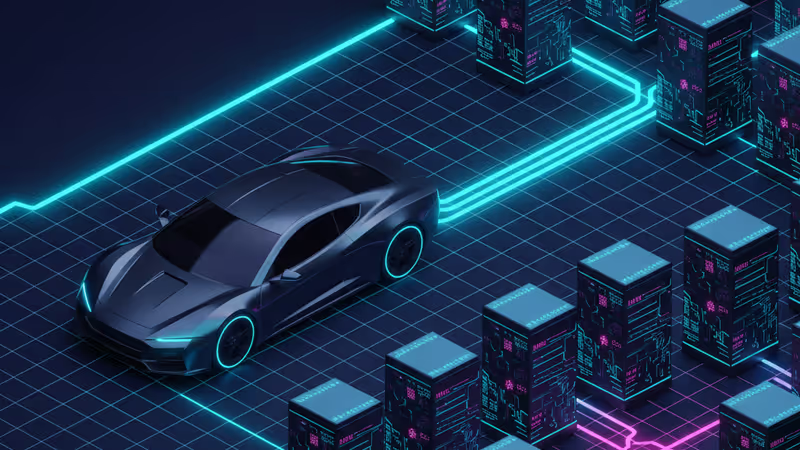
Ford's EV Pivot Isn't About Cars—It's a $2B Bet on Powering the AI Boom
Ford's $2B pivot to battery storage is more than a retreat from EVs. Our analysis shows it's a strategic move to power the AI boom and data center economy.
The Lede: A Strategic Power Play, Not a Retreat
Ford's announcement to divert planned EV battery capacity into a new $2 billion energy storage business is being widely reported as a response to slowing large EV demand. This is only half the story. The real story isn't about Ford retreating from EVs; it's about the automaker making a shrewd, offensive move into one of the most explosive growth markets of the next decade: providing the power infrastructure for the artificial intelligence revolution.
Why This Is More Than an EV Pivot
While the EV market faces cyclical headwinds and charging infrastructure challenges, the demand for energy from data centers is non-negotiable and growing exponentially. By repurposing its Kentucky factory to build grid-scale battery systems, Ford is transforming a potential manufacturing overcapacity problem into a strategic asset. This isn't just a side hustle; it's a fundamental diversification that positions Ford as a key supplier for the 'picks and shovels' of the AI gold rush.
The Second-Order Effects:

- De-Risking the EV Transition: Ford is creating a hedge. If EV adoption surges, the battery tech and supply chains are ready. If it remains uneven, a massive, power-hungry market (data centers and utilities) is waiting to absorb that capacity. This reduces the company's exposure to the volatile consumer auto market.
- Redefining the 'Automaker': This move accelerates the blurring of lines between automotive manufacturers and energy companies. Ford is following a path forged by Tesla, but with the potential to leverage its century-old industrial manufacturing scale in a way few others can.
- A New Pressure Point for Rivals: Automakers globally have invested hundreds of billions in battery giga-factories. Ford's pivot creates a new competitive benchmark. Rivals like GM, Volkswagen, and Hyundai will now be judged on their ability to monetize their battery investments beyond just putting them in cars.
The New Competitive Landscape
Ford is entering a space with established players, but its approach has unique strengths and weaknesses. Tesla's energy division has a decade-long head start and deploys roughly 10GWh per quarter—double Ford's entire planned annual capacity for 2027. Tesla's Megapack is the incumbent product to beat.
However, Ford's focus on cheaper, more durable Lithium Iron Phosphate (LFP) batteries, using licensed technology from the world's largest battery maker, CATL, is a strategically sound choice for stationary storage where energy density is less critical than cost and longevity. The company's statement that LFP prismatic systems are the "technology of choice" for grid customers shows they've done their homework. This isn't a speculative bet; it's a response to clear market demand.
The reliance on a Chinese technology license while manufacturing in the U.S. is a delicate geopolitical dance, but it's also a pragmatic shortcut, allowing Ford to bypass years of R&D and get to market faster.
PRISM's Take
This is one of the smartest strategic pivots from a legacy automaker in years. Instead of being held captive by the unpredictable pace of EV adoption, Ford has identified a parallel, more predictable, and arguably more urgent market for its core battery technology. By leveraging its manufacturing expertise to build the power foundation for the AI economy, Ford is ensuring its relevance for the next century. This isn't about saving a struggling EV plan; it's about building a second, potentially more lucrative, business on top of it.
Authors
Related Articles
Google is committing up to $40 billion to Anthropic, a direct AI competitor. The deal reveals how the real AI arms race isn't about models — it's about who controls the infrastructure beneath them.
SpaceX wants to launch a million orbital data centers to power AI without draining Earth. The vision is compelling. The physics, economics, and debris math are not.

Ford's new generative AI tool for commercial fleets turns vehicle data into plain-English recommendations. It's convenient—but who's really in control?
Amazon, Google, Meta and others pledge to pay for their data centers' power infrastructure, but the agreement lacks enforcement and ignores basic economics
Google is committing up to $40 billion to Anthropic, a direct AI competitor. The deal reveals how the real AI arms race isn't about models — it's about who controls the infrastructure beneath them.
SpaceX wants to launch a million orbital data centers to power AI without draining Earth. The vision is compelling. The physics, economics, and debris math are not.
Ford's new generative AI tool for commercial fleets turns vehicle data into plain-English recommendations. It's convenient—but who's really in control?
Amazon, Google, Meta and others pledge to pay for their data centers' power infrastructure, but the agreement lacks enforcement and ignores basic economics
Thoughts
Share your thoughts on this article
Sign in to join the conversation