
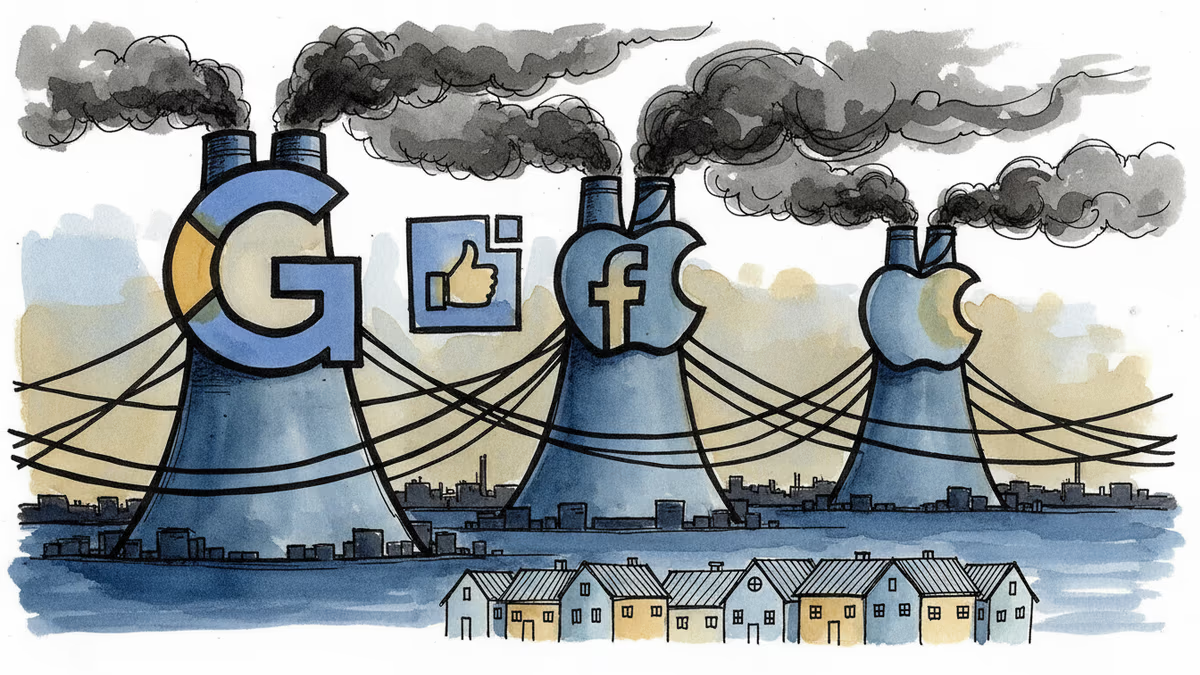
Big Tech's $50B Power Promise Has a Problem
Amazon, Google, Meta and others pledge to pay for their data centers' power infrastructure, but the agreement lacks enforcement and ignores basic economics
Seven companies just promised to shoulder a $50 billion infrastructure burden. Amazon, Google, Meta, Microsoft, OpenAI, Oracle, and xAI signed Trump's "Ratepayer Protection Pledge," agreeing to pay for the power generation and transmission needed for their new data centers.
There's just one catch: nobody's enforcing it.
The Promise: We'll Pay for What We Use
The pledge is straightforward. Companies building data centers will cover the cost of new power generation—either by building plants themselves or paying for expansions. They'll also fund transmission infrastructure to connect their facilities to the grid. Most surprisingly, they'll pay even if they don't end up using all that power.
This flips the traditional model on its head. Until now, data centers tapped existing grid capacity, and when supply fell short, ratepayers—ordinary consumers—absorbed the infrastructure costs through higher bills.
With each ChatGPT query consuming 10 times more electricity than a Google search, the AI boom has created an unprecedented power crunch. The pledge sounds like corporate responsibility in action.
Reality Check: Three Major Hurdles
Hardware Bottlenecks
Power infrastructure isn't built overnight. Large transformers, transmission lines, and generation equipment require 2-3 year lead times from order to installation. Global supply chains are already stretched thin.
Utility companies are competing for the same specialized equipment that tech companies would need. Even with unlimited budgets, physics and manufacturing capacity impose hard limits on how quickly new infrastructure can come online.

Economics 101
The pledge defies a fundamental principle: economies of scale. Power generation and transmission are textbook examples of natural monopolies precisely because centralized systems are vastly more efficient than distributed ones.
Asking each tech company to build its own power infrastructure is like asking every neighborhood to dig its own water wells instead of sharing a municipal system. Tesla's Supercharger network succeeded, but automotive charging stations are far simpler than power plants.
The Enforcement Gap
Without legal mechanisms to ensure compliance, the pledge relies entirely on corporate goodwill. When power demand spikes faster than expected—and it will—companies could cite "unforeseen circumstances" to justify delays or modifications.
History suggests voluntary corporate commitments often bend under financial pressure. Remember when tech companies promised not to use facial recognition? Or when they pledged carbon neutrality by 2030?
Market Implications
Investors are already pricing in the costs. Data center REITs have seen mixed reactions, with some viewing the pledge as removing regulatory uncertainty while others worry about margin compression.
The real winners might be infrastructure contractors and equipment manufacturers. Companies like General Electric, Siemens, and specialized transmission builders could see a windfall—if they can scale production fast enough.
For consumers, the immediate impact is unclear. While the pledge aims to protect ratepayers from data center costs, it doesn't address existing grid strain or the broader challenge of aging power infrastructure.
Global Ripple Effects
Other governments are watching closely. The EU's Digital Services Act already imposes infrastructure requirements on tech platforms. Could power self-sufficiency become the next regulatory export?
In Asia, where data center growth is exploding, governments might adopt similar frameworks. Alibaba, Tencent, and other regional players would face the same economic contradictions that make this pledge problematic.
Authors
Related Articles
Samsung and SK unveiled a chip and AI investment package worth thousands of trillions of won on June 29. The headline number swings wildly by outlet, but the real contest isn't capital — it's water and power.
Viral videos show 2026 graduates jeering executives who praise AI at commencement ceremonies. It's not just rudeness — it's a signal about who pays for technological optimism.
Filipino virtual assistants using AI to ghost-manage LinkedIn profiles for executives is now a structured industry. 30 comments a day, fake engagement rings, and a platform struggling to tell real from fabricated.
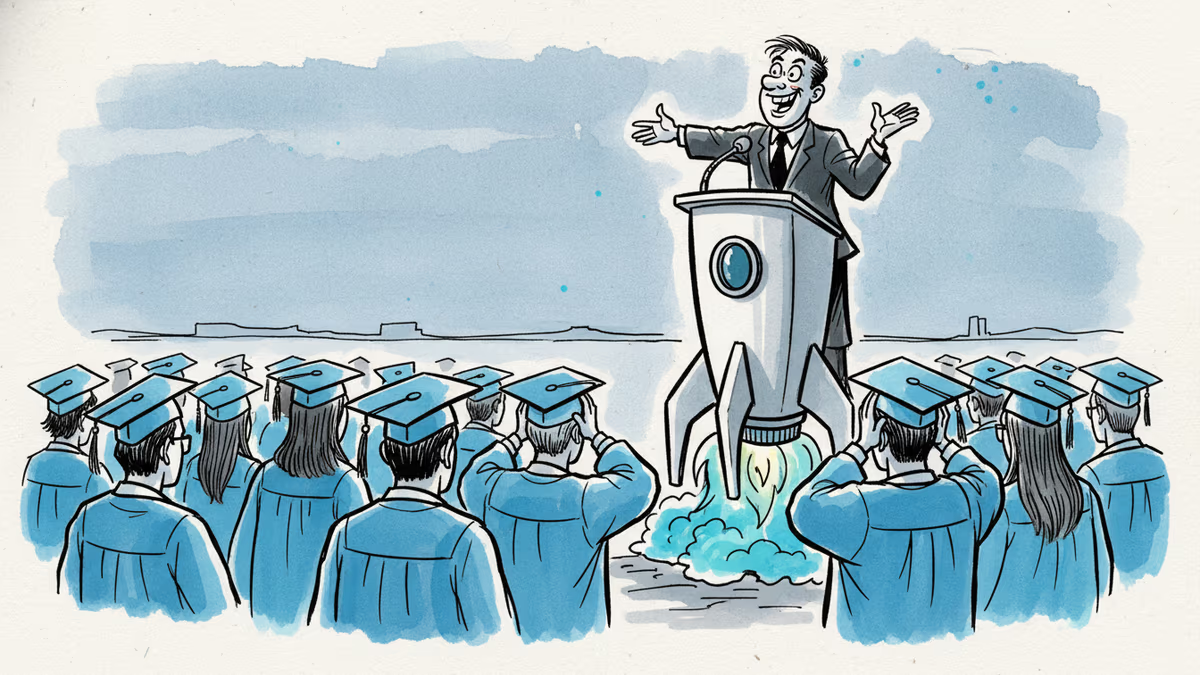
Two commencement speakers learned the hard way that AI enthusiasm doesn't land well with today's graduates. The backlash reveals a widening gap between tech optimism and Gen Z's economic reality.
Samsung and SK unveiled a chip and AI investment package worth thousands of trillions of won on June 29. The headline number swings wildly by outlet, but the real contest isn't capital — it's water and power.
Viral videos show 2026 graduates jeering executives who praise AI at commencement ceremonies. It's not just rudeness — it's a signal about who pays for technological optimism.
Filipino virtual assistants using AI to ghost-manage LinkedIn profiles for executives is now a structured industry. 30 comments a day, fake engagement rings, and a platform struggling to tell real from fabricated.
Two commencement speakers learned the hard way that AI enthusiasm doesn't land well with today's graduates. The backlash reveals a widening gap between tech optimism and Gen Z's economic reality.
Thoughts
Share your thoughts on this article
Sign in to join the conversation