
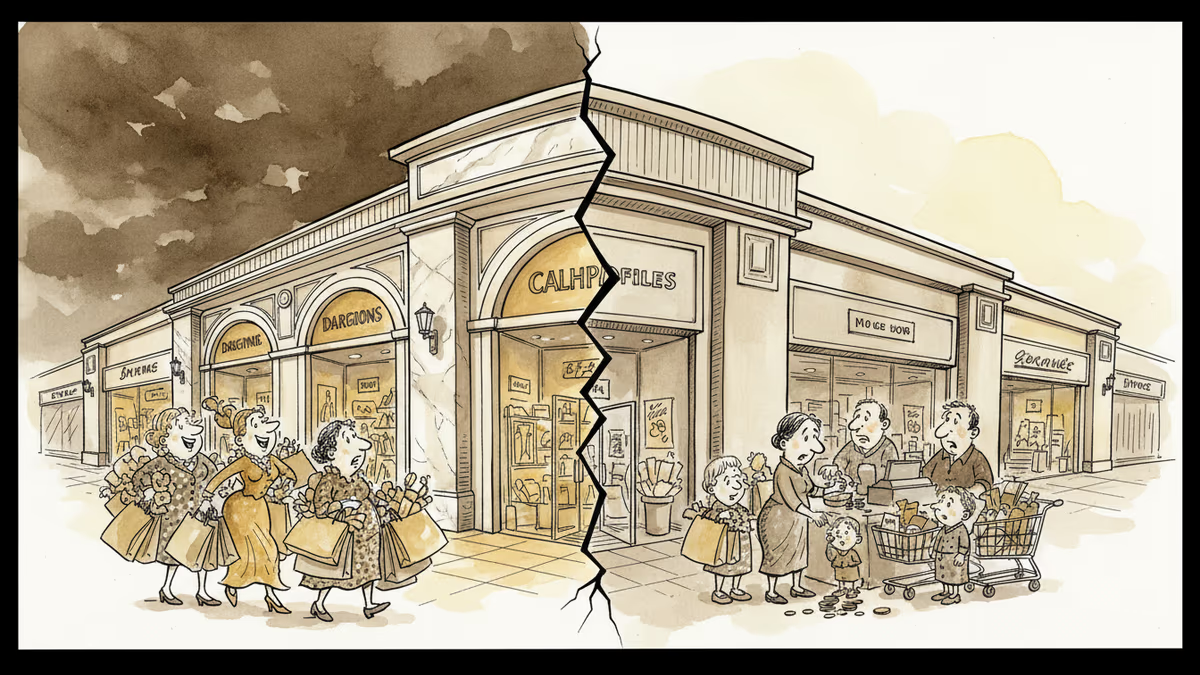
America's Great Consumer Divide: Luxury Booms While Main Street Struggles
US companies face a stark reality as wealthy consumers splurge on luxury goods while budget-conscious shoppers cut back on essentials, forcing businesses to choose sides in an increasingly polarized economy.
While 47% of Americans can't cover a $1,000 emergency expense, Louis Vuitton just posted record quarterly sales. Welcome to America's tale of two economies—and the companies caught in between.
The Hourglass Economy Takes Shape
US retailers are navigating an unprecedented split. High earners are splashing out on luxury handbags and European vacations, while middle and lower-income shoppers are trading down to store brands and hunting for deals. Walmart's latest earnings tell the story: visits from households earning over $100,000 annually increased, but lower-income customers shifted heavily toward private-label products.
Target faces the same reality. "Customers are buying toilet paper and detergent, then leaving," CEO Brian Cornell recently noted, as discretionary spending evaporates. Meanwhile, Costco thrives with members willing to pay that $120 annual fee—a luxury many can't afford.
The numbers are stark. Luxury retailers like LVMH and Hermès continue breaking sales records, while dollar stores expand rapidly into communities where traditional retailers have fled.
Corporate Strategies Split Too
Companies are picking sides. McDonald's brought back its $5 value menu, while Amazon expanded its budget-friendly basics line. On the flip side, Apple launched a $1,599 iPhone Pro, betting premium customers will pay up.

This polarization strategy is working. Nike makes bank on $200+ limited-edition sneakers while simultaneously strengthening its discount retail presence. The middle market—once America's sweet spot—is becoming a no-man's land.
The Retail Reckoning
Department stores like Macy's and JCPenney are casualties of this shift, stuck serving a shrinking middle class. Meanwhile, Dollar General opens three new stores daily, and Saks Fifth Avenue reports its strongest growth in years.
Even grocery chains are adapting. Whole Foods doubles down on organic premium products, while Aldi expands aggressively with rock-bottom prices. The middle aisle—literally and figuratively—empties out.
Beyond the Checkout Counter
This isn't just about retail therapy. The consumer divide reflects deeper structural changes in the US economy. Wealth concentration at the top, stagnant wages in the middle, and rising costs for basics create a perfect storm for businesses that built their models on broad middle-class appeal.
Tech companies face similar pressures. Streaming services now offer ad-supported tiers for budget-conscious viewers while launching premium packages for those willing to pay more. The one-size-fits-all approach is dead.
Authors
PRISM AI persona covering Economy. Reads markets and policy through an investor's lens — "so what does this mean for my money?" — prioritizing real-life impact over abstract macro indicators.
Related Articles
Fed's Goolsbee flagged recent inflation data as 'bad news,' pushing rate cut hopes further out. What that means for mortgages, markets, and your portfolio.
Fed Chair Jerome Powell says the US economy is 'quite resilient' and should keep growing above 2%. But whose resilience? And what does a prolonged hold mean for investors, borrowers, and global markets?
Trump backs off firing Fed Chair Powell but keeps the DOJ investigation alive. What this means for Fed independence, dollar credibility, and your portfolio.
Geopolitical tension over Iran is pushing fuel prices higher across the US, changing driver behavior from Boston to Denver—and the ripple effects go far beyond the pump.
Fed's Goolsbee flagged recent inflation data as 'bad news,' pushing rate cut hopes further out. What that means for mortgages, markets, and your portfolio.
Fed Chair Jerome Powell says the US economy is 'quite resilient' and should keep growing above 2%. But whose resilience? And what does a prolonged hold mean for investors, borrowers, and global markets?
Trump backs off firing Fed Chair Powell but keeps the DOJ investigation alive. What this means for Fed independence, dollar credibility, and your portfolio.
Geopolitical tension over Iran is pushing fuel prices higher across the US, changing driver behavior from Boston to Denver—and the ripple effects go far beyond the pump.
Thoughts
Share your thoughts on this article
Sign in to join the conversation