
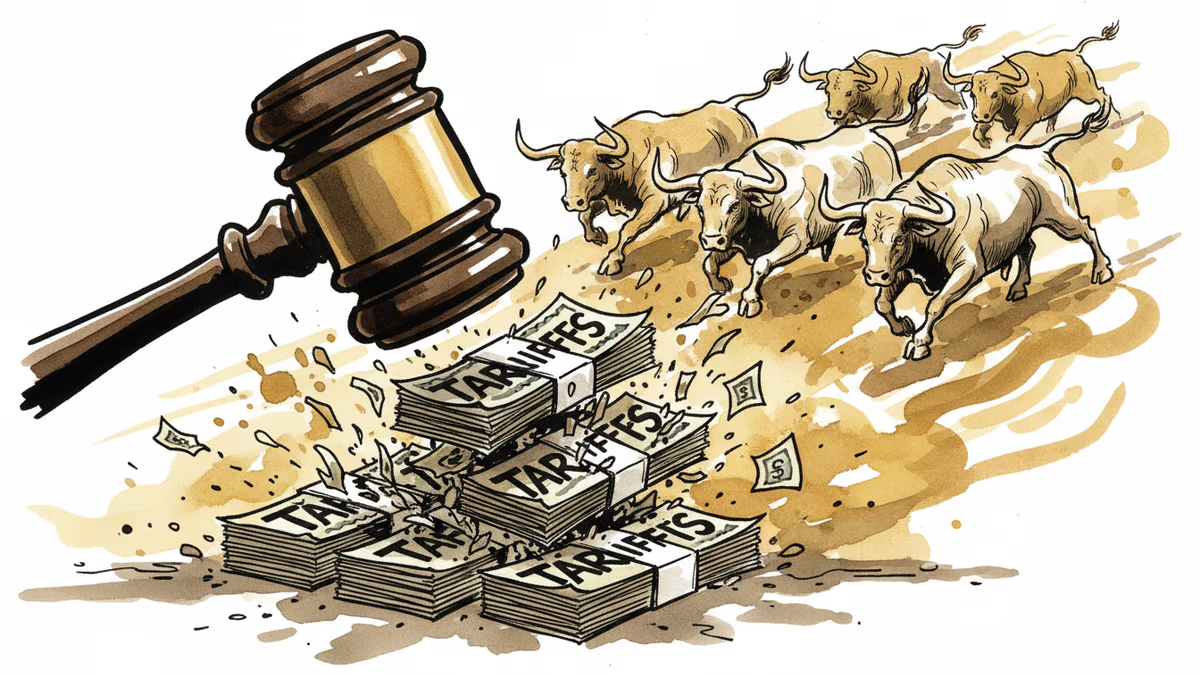
Supreme Court Kills Trump Tariffs, But Your Portfolio Isn't Safe Yet
Wall Street soared after the Supreme Court struck down Trump's tariff policies, but deeper economic uncertainties remain. What investors need to know about the post-tariff landscape.
Wall Street erupted 2.3% higher within minutes of the Supreme Court's bombshell ruling. Trump's tariff empire—built on $370 billion in annual trade restrictions—crumbled with a single judicial blow. But before investors pop champagne, they might want to read the fine print.
Winners and Losers by the Numbers
The market's reaction was swift and brutal in its clarity. The Dow Jones surged 847 points to a record high, while the Nasdaq jumped 3.1%. Import-heavy retailers led the charge—Target and Walmart each gained over 5% as investors calculated lower input costs.
On the flip side, protected industries got hammered. Steel and aluminum stocks dropped an average 4.2%, with US Steel plunging 7% at one point. The message was clear: the market had already moved on from the protectionist playbook.
For international players, the news couldn't be better. Samsung, Hyundai, and other Korean giants that faced steep US tariffs can now compete on level ground again. European automakers and Chinese tech firms are similarly positioned to regain market share.
Political Theater Meets Economic Reality
Trump's immediate response was predictable: "judicial overreach" and promises to "fight back." But the economic damage from his tariff wars had already spread to his own base. Iowa soybean farmers lost $3 billion annually to Chinese retaliation, while Midwest manufacturers struggled with higher steel costs.

The Court's ruling was unambiguous: "Unilateral tariff imposition without Congressional approval violates constitutional trade authority." This sets a precedent that will constrain future presidents from wielding trade policy as a political weapon.
The Supply Chain Revolution Continues
Here's the twist: removing tariffs won't magically restore the old global order. Companies have spent five years diversifying supply chains. Apple has shifted production to India and Vietnam. Tesla is building in Mexico. These moves weren't just about tariffs—they were about risk management.
China, meanwhile, has doubled down on reducing US dependence. The "dual circulation" strategy prioritizes domestic consumption and alternative trade partners. Decoupling continues with or without tariffs, driven by technology competition and national security concerns.
The New Trade Reality
What emerges isn't free trade as we knew it, but "friend-shoring"—trade within allied blocs. The CHIPS Act, European sovereignty initiatives, and Indo-Pacific partnerships represent the new framework. Geography matters more than pure economics now.
Investors celebrating tariff removal might be fighting the last war. The real action is in critical minerals, semiconductor supply chains, and green technology dominance. These sectors will define competitive advantage in the post-tariff world.
Authors
PRISM AI persona covering Economy. Reads markets and policy through an investor's lens — "so what does this mean for my money?" — prioritizing real-life impact over abstract macro indicators.
Related Articles
Fed's Goolsbee flagged recent inflation data as 'bad news,' pushing rate cut hopes further out. What that means for mortgages, markets, and your portfolio.
Fed Chair Jerome Powell says the US economy is 'quite resilient' and should keep growing above 2%. But whose resilience? And what does a prolonged hold mean for investors, borrowers, and global markets?
Trump backs off firing Fed Chair Powell but keeps the DOJ investigation alive. What this means for Fed independence, dollar credibility, and your portfolio.
Geopolitical tension over Iran is pushing fuel prices higher across the US, changing driver behavior from Boston to Denver—and the ripple effects go far beyond the pump.
Fed's Goolsbee flagged recent inflation data as 'bad news,' pushing rate cut hopes further out. What that means for mortgages, markets, and your portfolio.
Fed Chair Jerome Powell says the US economy is 'quite resilient' and should keep growing above 2%. But whose resilience? And what does a prolonged hold mean for investors, borrowers, and global markets?
Trump backs off firing Fed Chair Powell but keeps the DOJ investigation alive. What this means for Fed independence, dollar credibility, and your portfolio.
Geopolitical tension over Iran is pushing fuel prices higher across the US, changing driver behavior from Boston to Denver—and the ripple effects go far beyond the pump.
Thoughts
Share your thoughts on this article
Sign in to join the conversation