

When AI Decides Who Gets Bombed First
The US Pentagon has revealed plans to use generative AI—potentially ChatGPT and Grok—to rank and prioritize military targets. What changes when algorithms enter the kill chain?
Someone has to decide which target gets hit first. The Pentagon is now asking whether that someone should be an AI.
This isn't a research proposal or a think-tank thought experiment. A US Defense Department official has publicly described how generative AI systems could be used to rank targets and recommend strike priorities—with OpenAI's ChatGPT and xAI's Grok potentially at the center of those decisions.
What's Actually Being Proposed
The mechanism, as described, has a certain procedural tidiness to it. A list of possible targets gets fed into a generative AI system built for classified environments. The system analyzes the data and produces a prioritized list. Human operators then review, evaluate, and—officially—make the final call.
The Pentagon frames this as AI-assisted decision-making, not autonomous targeting. The distinction matters enormously on paper. How much it matters in practice is a different question.
Also notable: the same week this came to light, the Pentagon's CTO publicly claimed that Anthropic's Claude would "pollute" the defense supply chain due to a "policy preference" baked into the model. Translation: Claude's safety guardrails are inconvenient. While OpenAI has quietly expanded its cooperation with defense and intelligence agencies—rolling back earlier restrictions—Anthropic finds itself effectively sidelined for holding the line. The market signal this sends to the rest of the AI industry is hard to miss.
How We Got Here
The US military's interest in AI-assisted warfare didn't start with ChatGPT. DARPA has funded autonomous systems research for decades. But the war in Ukraine changed the pace and the stakes.
Ukraine is now offering its battlefield data—real engagements, real terrain, real outcomes—to allies for training drones and UAVs. A Latvian startup called Global Wolf Motors pitched a military scooter before the full-scale invasion and got laughed out of procurement meetings. Within weeks of February 2022, those scooters were on the front line running reconnaissance missions. The lesson wasn't lost on anyone: in active conflict, the barrier between civilian technology and military application collapses fast.

Generative AI is the latest civilian technology crossing that threshold. The question is no longer whether AI enters the kill chain. It's how deep it goes—and who's accountable when it gets something wrong.
The Fault Lines
The Pentagon's logic is operationally coherent. A modern battlefield generates more target data than any human team can process in real time. AI that filters and prioritizes that information could, in theory, reduce cognitive overload and improve decision quality. If a human still signs off, the argument goes, the ethical and legal framework stays intact.
AI ethics researchers push back on exactly that framing. The problem isn't whether a human is nominally in the loop—it's whether that human is meaningfully in the loop. Automation bias, the well-documented tendency to defer to machine outputs, means that an AI-generated ranking is rarely treated as a starting point for independent analysis. It becomes the default. Overriding a system's recommendation requires active effort, cognitive confidence, and time—three things that are scarce in combat conditions. "Human oversight" can quietly become "human rubber stamp."
International law specialists add another layer. The laws of armed conflict require distinction between combatants and civilians, and proportionality in the use of force. These aren't checkbox determinations—they involve contextual judgment that changes by the minute. When an AI system gets that judgment wrong and civilians die, the question of legal accountability becomes genuinely unresolved. The algorithm can't be prosecuted. Can the developer? The commander who approved the strike? The official who procured the system?
Within the AI industry itself, the split is becoming visible. OpenAI and xAI are leaning into defense contracts as a growth market. Anthropic is being penalized for its caution. If the companies that maintain ethical constraints get locked out of government procurement while those that don't get rewarded with contracts, the incentive structure for the entire industry shifts—not toward safety, but away from it.
Why the Timing Matters
Sam Altman told investors at a BlackRock event this week that he sees a future where "intelligence is a utility, like electricity or water, and people buy it from us on a meter." It's a striking pitch—and it reveals something about how AI's largest players are thinking about their product. Electricity doesn't deliberate. It doesn't recommend. It doesn't tell you which house to demolish.
The utility metaphor works for many AI applications. It starts to break down when the output of that utility is a ranked list of human targets.
Meanwhile, Meta postponed its latest AI model launch after it fell short of rivals from Google, OpenAI, and Anthropic on performance benchmarks. The defense market may be where the real differentiation happens next—not on consumer features, but on willingness to operate in classified environments with minimal constraints.
Authors
Related Articles

Google's Gmail Live lets you ask your inbox questions out loud. Announced at I/O 2026, it's AI's pitch to skeptics — and a reminder of how much Google already knows about you.
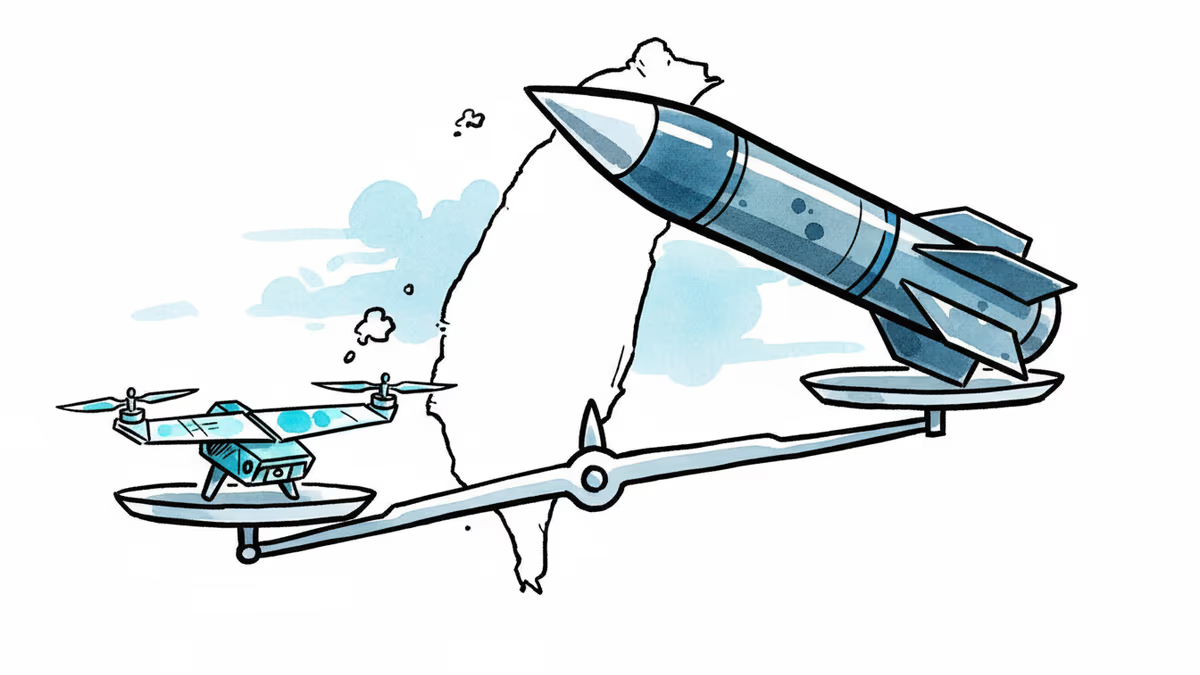
Taiwan's Thunder Tiger became the first Asian firm to win US military drone clearance with a China-free supply chain. As Trump meets Xi, the drone arithmetic reshapes defense strategy.
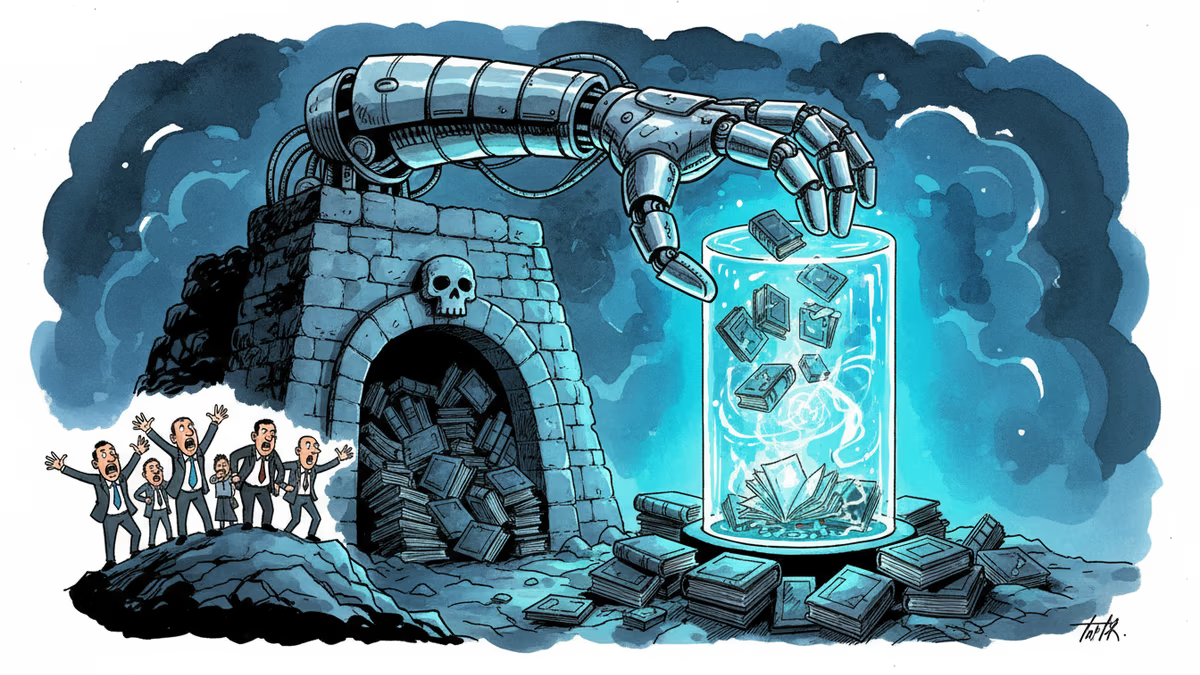
Five major publishers and author Scott Turow have filed a class action lawsuit against Meta, alleging the company used illegal pirate sites like LibGen to train its Llama AI models without permission.
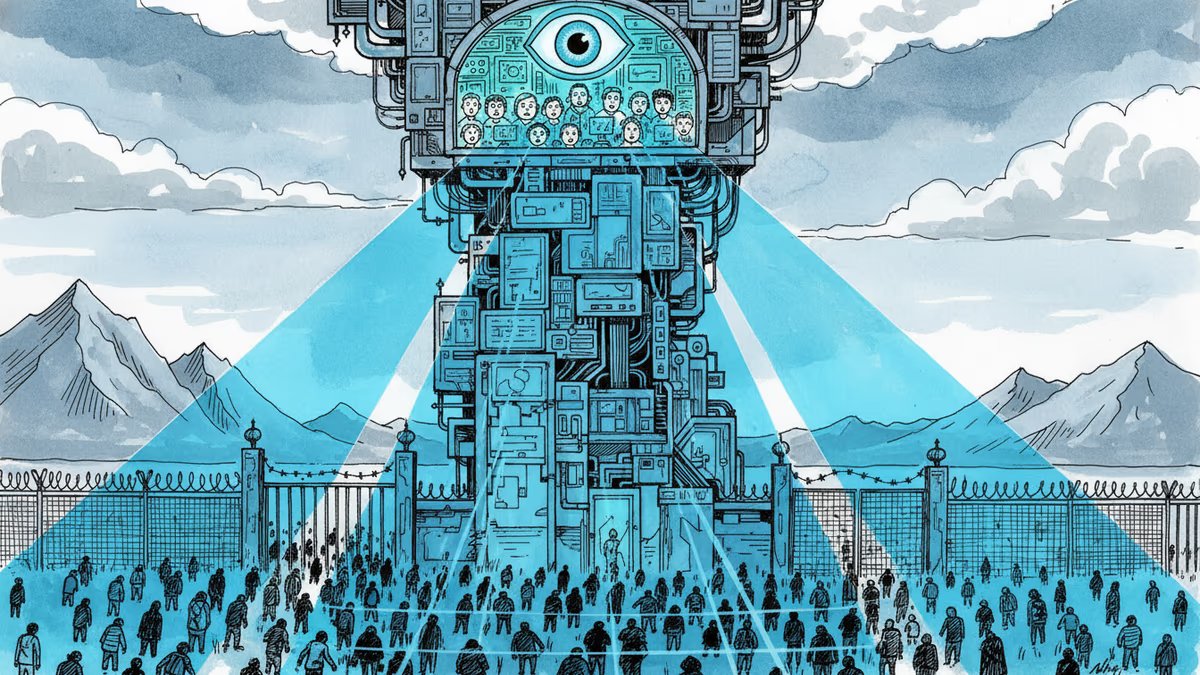
Palantir has become the tech backbone of Trump's immigration enforcement. Former employees are calling it a 'descent into fascism.' What happens when the people who build surveillance tools start asking uncomfortable questions?
Google's Gmail Live lets you ask your inbox questions out loud. Announced at I/O 2026, it's AI's pitch to skeptics — and a reminder of how much Google already knows about you.
Taiwan's Thunder Tiger became the first Asian firm to win US military drone clearance with a China-free supply chain. As Trump meets Xi, the drone arithmetic reshapes defense strategy.
Five major publishers and author Scott Turow have filed a class action lawsuit against Meta, alleging the company used illegal pirate sites like LibGen to train its Llama AI models without permission.
Palantir has become the tech backbone of Trump's immigration enforcement. Former employees are calling it a 'descent into fascism.' What happens when the people who build surveillance tools start asking uncomfortable questions?
Thoughts
Share your thoughts on this article
Sign in to join the conversation