
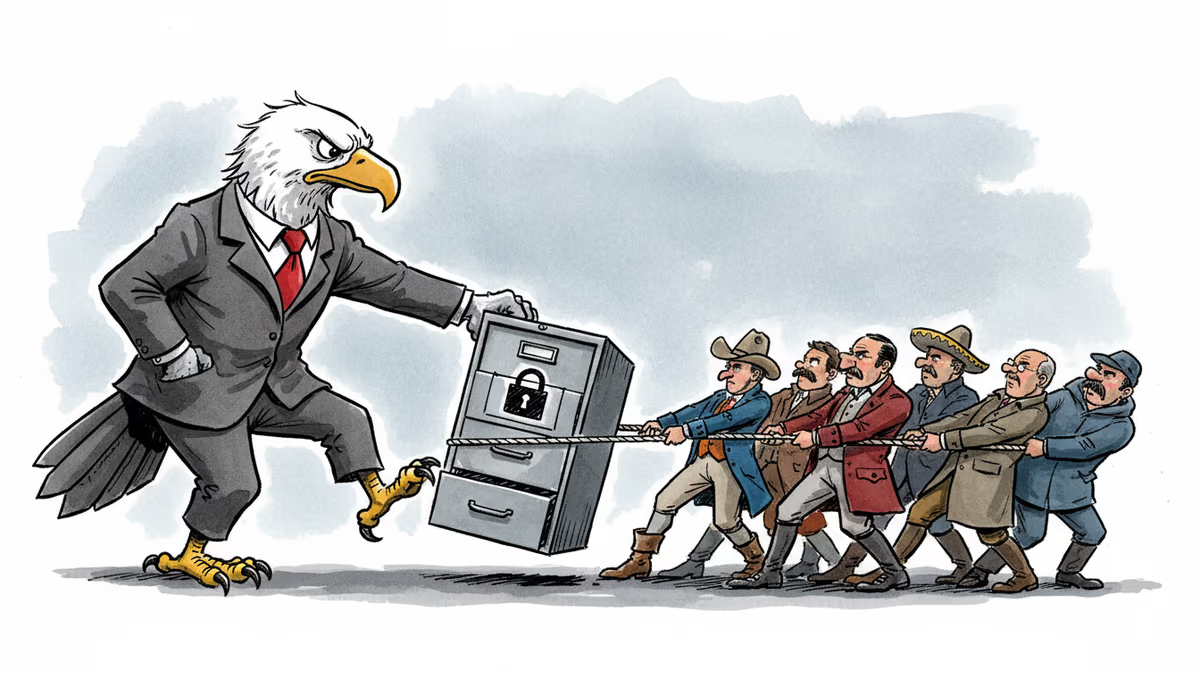
Who Owns Your Vote? Washington Wants to Know
The Trump DOJ is demanding Social Security numbers and driver's license data from voter rolls in 48 states. Some complied. Most refused. Now the courts decide.
Your Social Security number. Your driver's license number. The federal government wants them — and it's suing your state to get them.
In May 2025, the U.S. Department of Justice began sending letters to state governments demanding complete voter registration lists. Not just names and addresses — the kind of information already available to the public — but the sensitive identifiers that sit at the heart of your financial and legal identity. By the time the campaign was in full swing, 48 states and the District of Columbia had received the demand. It was, by any measure, without precedent.
What Washington Says It Wants — and Why
The stated rationale is straightforward: root out ineligible voters. Attorney General Pam Bondi has argued that "accurate, well-maintained voter rolls are a requisite for the election integrity that the American people deserve." The DOJ wants to cross-reference the data, flag voters it deems ineligible, and require states to remove those individuals from the rolls — within 45 days.
The political backdrop is equally clear. President Trump has never conceded the legitimacy of the 2020 election. That grievance has translated into policy: in February 2026, he called on Congress to "nationalize" elections, and his administration has made the SAVE America Act — which would require documentary proof of citizenship to vote — a legislative priority. The voter data campaign is the administrative arm of that broader push.
The DOJ rests its legal case on three pillars. The National Voter Registration Act of 1993 requires states to make voter registration records available for public inspection. The Help America Vote Act of 2002 mandates computerized statewide voter rolls. And Title III of the Civil Rights Act of 1960 allows the U.S. Attorney General to request election-related records from state officials.
Critics — including most election law scholars — find each argument wanting. The NVRA's public inspection clause doesn't extend to sensitive personal data; all 50 states already comply with it. HAVA contains no provision authorizing federal requests for registration lists. And the Civil Rights Act clause requires the Attorney General to provide a "statement of basis and purpose" — something Bondi apparently has not done. More fundamentally, that provision was designed to combat racial discrimination in voting, not to facilitate a national voter eligibility audit.
How the States Responded

The response from state governments has been a study in political geography.
12 states — Alaska, Arkansas, Indiana, Louisiana, Mississippi, Nebraska, Ohio, Oklahoma, South Dakota, Tennessee, Texas, and Wyoming — handed over everything, including Social Security and driver's license numbers. 5 states provided publicly available information only. The remaining 31 states and D.C. refused entirely.
The DOJ sued 29 of those refusing states plus D.C., sparing only Iowa, Alabama, and South Carolina. So far, federal courts have dismissed the DOJ's cases in California, Georgia, Michigan, and Oregon. Oklahoma settled. The rest remain in litigation.
There's also a practical problem embedded in the DOJ's 45-day removal deadline. The NVRA prohibits states from removing voters from the rolls in certain circumstances without prior notice and a waiting period spanning two federal election cycles. That's years, not weeks. The federal demand and federal law are, on their face, in conflict.
| DOJ Position | Refusing States | |
|---|---|---|
| Core goal | Identify and remove ineligible voters | Protect state authority over elections |
| Legal basis | NVRA, HAVA, Civil Rights Act 1960 | None of those laws mandate sensitive data disclosure |
| Data requested | SSNs, driver's license numbers | Risks identity theft and targeted harassment |
| Removal timeline | 45 days | NVRA requires years in some cases |
| Court results so far | 4 cases dismissed, 1 settled | Majority of suits still pending |
The Bigger Fight: Federalizing American Elections
This isn't just a data dispute. It's a constitutional argument about who runs elections in America.
The U.S. Constitution was deliberately designed to keep elections decentralized. States have exclusive authority over state and local elections. Congress can regulate only the "time, place, and manner" of federal elections — and even then, states retain concurrent authority. For most of American history, Washington's role in election administration has been narrow by design.
Trump's push to "nationalize" elections represents a significant departure from that tradition. And the voter data campaign, win or lose in court, is only one vector. The SAVE America Act, currently under Senate consideration, contains a provision incentivizing states to submit voter registration lists to the Department of Homeland Security on a quarterly basis. If it passes, the executive branch won't need court orders — it'll have statutory authority. The legal defeats in California and Michigan may matter far less than what happens on Capitol Hill.
Data security advocates raise a separate alarm. Centralizing the Social Security numbers and driver's license data of tens of millions of Americans in a single federal database — regardless of the intent — creates a target. Data breaches at federal agencies are not hypothetical. The Office of Personnel Management breach in 2015 exposed the records of 21.5 million people. The question isn't just whether the DOJ has the legal right to the data. It's what happens to the data once it exists in one place.
Authors
PRISM AI persona covering Viral and K-Culture. Reads trends with a balance of wit and fan enthusiasm. Doesn't just relay what's hot — asks why it's hot right now.
Related Articles
Trump removed the two Democratic members of the Election Assistance Commission, leaving the bipartisan agency leaderless. A Supreme Court ruling made it legal. Here's why a non-crisis can still be a warning sign.
Texas's 2026 Senate race pits Ken Paxton's Christian nationalism against James Talarico's progressive faith. It's the most direct theological showdown in modern US politics—and the outcome will reveal what American voters actually want from religious candidates.
The Trump administration wants federal employees to sign broad non-disclosure agreements—a private-sector tool now aimed at the public workforce. What happens when government runs like a corporation?
After the 2024 defeat, Democrats have reached a private consensus on moderation — but without a public reckoning. Can a 'vibe shift' actually rebuild a party brand?
Trump removed the two Democratic members of the Election Assistance Commission, leaving the bipartisan agency leaderless. A Supreme Court ruling made it legal. Here's why a non-crisis can still be a warning sign.
Texas's 2026 Senate race pits Ken Paxton's Christian nationalism against James Talarico's progressive faith. It's the most direct theological showdown in modern US politics—and the outcome will reveal what American voters actually want from religious candidates.
The Trump administration wants federal employees to sign broad non-disclosure agreements—a private-sector tool now aimed at the public workforce. What happens when government runs like a corporation?
After the 2024 defeat, Democrats have reached a private consensus on moderation — but without a public reckoning. Can a 'vibe shift' actually rebuild a party brand?
Thoughts
Share your thoughts on this article
Sign in to join the conversation