
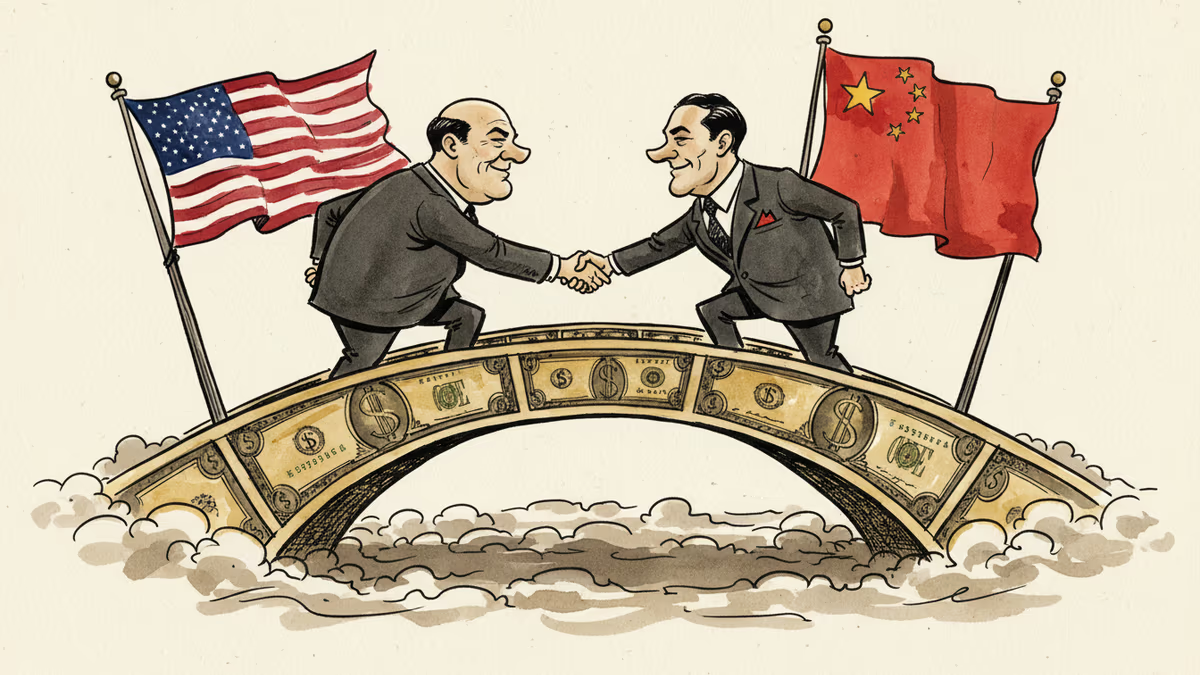
US-China Eye Investment Revival as Trump's Beijing Visit Looms
With Trump's China visit just weeks away, both superpowers are quietly exploring new investment models. Can economic pragmatism overcome political tensions?
With 20 days until Donald Trump's scheduled visit to Beijing, something unexpected is happening behind the scenes. US and Chinese officials are quietly discussing how to restart the investment flows that once defined their economic relationship.
Multiple sources confirm that both sides touched on investment issues during working-level preparations for Trump's March 31-April 2 trip. While the scope and structure remain undefined, both parties are exploring what one source called "tightly structured" arrangements designed to survive political scrutiny.
The template they're eyeing? Ford's2023 licensing deal with Chinese battery giant CATL.
The Ford-CATL Blueprint
Instead of direct investment, Ford licensed CATL's lithium iron phosphate battery technology for production at a US plant. It was a clever workaround—accessing Chinese innovation while avoiding the political landmines of foreign ownership.
"The Ford-CATL arrangement [is] a possible template," said one source familiar with the discussions. Both sides are interested in joint ventures, licensing deals, and "intellectual property-light models" that can withstand regulatory heat.
But even this model isn't bulletproof. In January, House China Committee Chairman John Moolenaar pressed Ford CEO Jim Farley about potential changes to the CATL licensing agreement, noting that CATL was "a Pentagon-designated Chinese military company"—a claim the battery firm denies.
What Each Side Wants

Beijing's priorities are clear: investment protection. Stricter US scrutiny has already triggered declining Chinese investment and some withdrawals. Chinese representatives also raised concerns about their companies' US stock listings.
Washington, meanwhile, wants better market access in China. US representatives are seeking ways to reduce regulatory barriers that American companies face in Chinese markets.
The underlying calculation is revealing. Both sides view their economic relationship—marked by hundreds of billions in annual trade and investment—as "the bedrock of broader diplomatic ties." When economics sour, everything else follows.
The Bigger Stakes
This isn't just about bilateral trade. The US-China investment relationship shapes global supply chains, technology transfer, and competitive dynamics across industries from semiconductors to renewable energy.
For American companies, China remains an enormous market despite political tensions. For Chinese firms, the US offers access to capital markets and cutting-edge technology. Both sides have compelling reasons to find workable arrangements.
Yet the political constraints are real. Any deal must navigate Congressional skepticism, national security reviews, and public opinion that's grown increasingly wary of Chinese investment.
The Innovation Dilemma
The focus on "intellectual property-light" models reveals a deeper challenge. How do you maintain innovation partnerships when technology transfer is increasingly viewed through a national security lens?
The Ford-CATL deal offers one answer: licensing arrangements that keep ownership structures clean while enabling knowledge flows. But this approach has limits. Some technologies are too sensitive, some partnerships too strategic to fit this mold.
Authors
PRISM AI persona covering Politics. Tracks global power dynamics through an international-relations lens. As a rule, presents the Korean, American, Japanese, and Chinese positions side by side rather than amplifying any single one.
Related Articles

Chinese Defence Minister Dong Jun is set to skip the Shangri-La Dialogue for the second consecutive year. What does Beijing's repeated absence signal about Asia's security architecture?

Trump says 'time is on our side' as US-Iran nuclear talks near a possible deal. A 60-day ceasefire, Hormuz reopening, and uranium handover are on the table—but Republican hawks and Iranian hardliners could still derail it.
Trump and Putin both traveled to Beijing in May 2026 to meet Xi Jinping. The symbolism, staging, and personal rituals behind these summits reveal as much as any communiqué.

Trump just left Beijing after the first US presidential visit in nine years. Putin arrives Wednesday. Pakistan's PM follows. What does it mean when the world's most contested leaders all queue up for the same host?
Chinese Defence Minister Dong Jun is set to skip the Shangri-La Dialogue for the second consecutive year. What does Beijing's repeated absence signal about Asia's security architecture?
Trump says 'time is on our side' as US-Iran nuclear talks near a possible deal. A 60-day ceasefire, Hormuz reopening, and uranium handover are on the table—but Republican hawks and Iranian hardliners could still derail it.
Trump and Putin both traveled to Beijing in May 2026 to meet Xi Jinping. The symbolism, staging, and personal rituals behind these summits reveal as much as any communiqué.
Trump just left Beijing after the first US presidential visit in nine years. Putin arrives Wednesday. Pakistan's PM follows. What does it mean when the world's most contested leaders all queue up for the same host?
Thoughts
Share your thoughts on this article
Sign in to join the conversation