
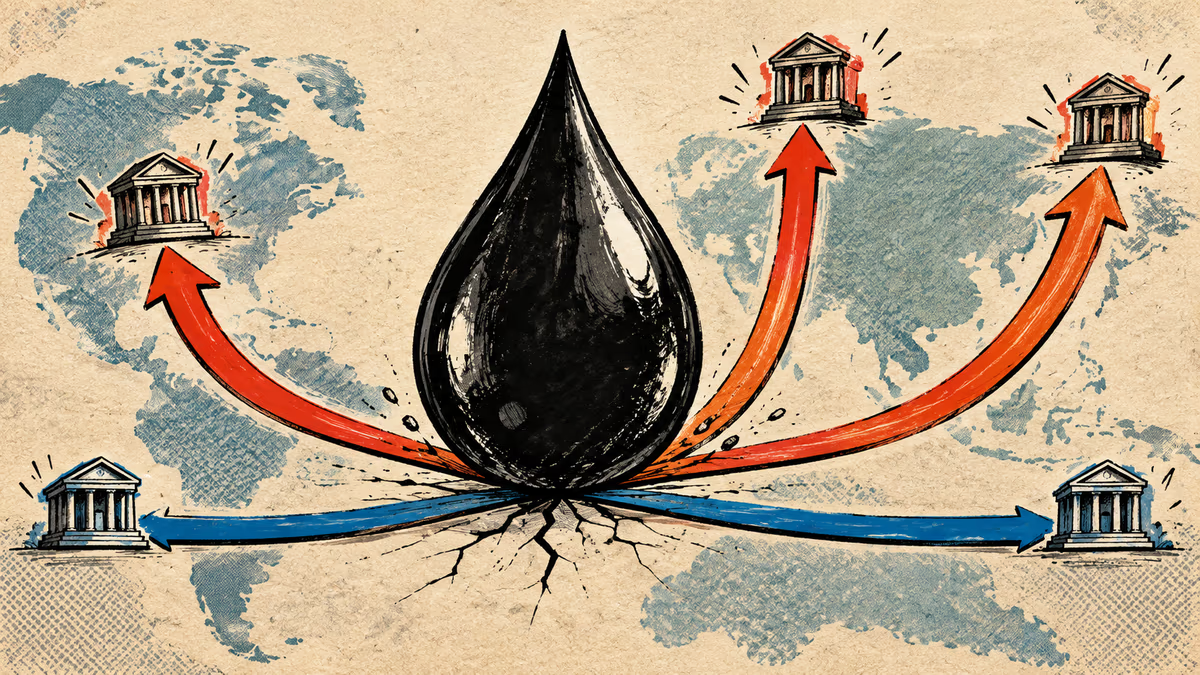
The Rate Map Under $100 Oil: the BOK, the Fed and the BOJ Hiked. Taiwan and China Held.
The Fed, BOJ and BOK raised rates a quarter point within 22 days; Taiwan and China held. What each said, plus the impact on Korean borrowers and the won.
Interest rates can't move the price of oil. That was the gist of Fed Chair Kevin Warsh's answer at the press conference after he raised rates on September 16, and the exchange sits in the Fed's preliminary transcript. A CBS reporter pointed out that a quarter-point hike does not reopen the Strait of Hormuz. "We cannot affect any individual price, whether it be oil prices, whether it be food stuffs at the grocery store," Warsh said. He went on: "But what we can do, and will do, is ensure that any change in relative prices don't broaden out."
The Bank of Korea moved on August 27, the Fed on September 16, the Bank of Japan on September 18. Three quarter-point hikes in 22 days. Taiwan's central bank left its policy rate alone a few hours after the Fed's announcement. China's loan prime rate, the benchmark its commercial banks quote each month, stayed put on August 20 as well. PRISM compared the BOK's monetary policy decision statement, the BOJ statement, the Taiwan central bank's press release and the Fed statement. None of them names oil as a reason in its decision language.
Oil turns up in the background passages of the Korean, Japanese and Taiwanese documents. The Fed's statement contains neither oil nor energy. In August, US energy prices were up 16.3% from a year earlier (Bureau of Labor Statistics) and Taiwan's fuel costs 11.86% (DGBAS, Taiwan's statistics agency). Korea's petroleum products index rose 14.2% (National Data Office, Korea's statistics agency). Brent has been trading above $100 a barrel amid tension in the Strait of Hormuz. The November contract settled at $103.87 in New York on September 18 (Bloomberg).
Five decisions, in each bank's own words
| Central bank | Decision date | Decision | Policy rate | Vote | Reason given in the statement | Where oil or energy appears | Next meeting |
|---|---|---|---|---|---|---|---|
| Bank of Korea | August 27 | Hike (second straight, after July) | 2.75% → 3.00% | 6-1 | Pre-emptive action to stop price pressure from broadening; financial stability risk | Global economy passage; listed as an uncertainty in the domestic inflation path | October 22 |
| US Federal Reserve | September 16 (ET) | Hike (first since July 2023) | 3.50–3.75% → 3.75–4.00% | 12-0 | Inflation still high; a faster return to the 2% target | Absent from the statement. Raised in the press conference Q&A | October 27–28 |
| Taiwan's central bank | September 17 | Hold (10th straight quarter); loan cap on a second home raised from 60% to 70% | Discount rate 2% | Not disclosed (two directors argued for a hike, per United Daily News and CNA) | Slower housing transactions and less speculation; domestic inflation around 2% | As a cause of global price pressure (high commodity prices, crude among them) | December 17 |
| Bank of Japan | September 18 | Hike (effective the 24th) | 1.00% → 1.25% | 7-2 | Sustained, stable achievement of the 2% price target | A driver of producer prices; the Middle East conflict as a downside risk to growth | October 29–30 |
| China LPR | August 20 | Hold (15th straight month) | 1-year 3.0%, 5-year and over 3.5% | n/a | No reasoning document (published from commercial bank quotes) | None | The 20th of each month (September's on the 20th or 21st) |
Europe produced both answers in the same stretch. The European Central Bank decided on September 10 to raise its deposit rate by 25 basis points to 2.5%, effective September 16 (ECB), and the Bank of England held at 3.75% on a 6-3 vote announced September 17, with three members pushing for a hike to 4% (Bank of England).
What the three hikers share: stopping the spread
The three that moved overlap on exactly one thing. Stop price increases before they broaden. The BOK wrote into its decision that pre-emptive action to "prevent the spread of upward price pressure" was important, and added growth running stronger than expected plus financial stability risk. The BOJ judged that underlying inflation has closed in on 2% and that medium- and long-term inflation expectations keep climbing. Warsh said the US economy appears to be strengthening, and that overall financial conditions are hard to call restrictive.
US consumer prices rose 3.4% in August, with core up 2.4% (Bureau of Labor Statistics). PRISM reads the gap between those two figures as coming mostly from energy, up 16.3%. The spread Warsh says he wants to block is that gap migrating into core.
Korea's housing, America's independence fight, Japan's two dissents
Korea stacked housing and credit on top of the shared logic. Household loans at banks stood at 1,198.3 trillion won at the end of August, up 3.4 trillion won in a month (BOK data released September 9). Governor Hyun Song Shin said the bank moved early to avoid a costlier fix later, reaching for a Korean proverb about plugging with a hoe what would otherwise take a shovel (Etoday). The vote was 6-1. Board member Hwang Kun-il wanted to hold. He argued for more time to confirm whether demand-side price pressure is persistent (minutes released September 15; Edaily and Herald Business).
In the US the vote was 12-0. The hawkish turn at Warsh's Fed that PRISM flagged in early July became an actual hike. Warsh is President Trump's own pick, and he raised rates seven weeks before the midterms, which reopened the argument over Fed independence. Trump demanded cuts on Truth Social and said he had told Warsh he might as well vote with the board (Yahoo Finance, CNBC). Warsh gave reporters nothing on his conversation with the president and described independence as a two-way street. Republican Senator Mike Rounds said the Fed "showed that they were independent" (Politico).
The BOJ split 7-2. The new 1.25% rate takes effect on the 24th, the highest level since 1995 (Nikkei). Governor Kazuo Ueda said the policy phase has changed (NHK). The two dissents came down to inflation. Core consumer prices rose 1.7% in August, an eighth straight month below 2% (Nikkei, NHK). Board member Ayano Sato said raising rates now is not appropriate (BOJ statement). Nikkei reported that the yen sold off on the two dissents and slipped briefly into the 158-per-dollar range.
Taiwan froze rates and loosened mortgages

Taiwan's central bank held its discount rate at 2% on the afternoon of September 17, a tenth straight quarter on hold since the hike in March 2024. At the same meeting it raised the cap on loans for an individual's second home purchase from 60% to 70% of appraised value, effective the 18th. Governor Yang Chin-long said Taiwan walks its own road (Economic Daily News). The bank's growth forecast for this year is 11.48%. Yang said exports pulled that growth and it has yet to reach domestic demand, a split he summed up as "hot outside, warm inside" (外熱內溫). He also cited a K-shaped divide across industries and the burden a hike would place on first-time homebuyers (CNA).
The hold drew dissent, and the mortgage easing drew suspicion that elections were behind it. Two directors argued for a hike (United Daily News, CNA). Yang said the decision had nothing to do with elections (Newtalk, CNA).
On the mainland, the argument is about when to cut
China's LPR stood at 3.0% for one year and 3.5% for five years and over as of August 20, unchanged for 15 months.
Costs are climbing while demand stays soft. August producer prices rose 3.8% and producer purchase prices 5.8% (National Bureau of Statistics). PPI for consumer goods fell 0.5%, and core consumer prices managed a rise of 1.0%. That combination makes hiking awkward and cutting awkward too.
[Outlook] At its August 1 conference on second-half work, the People's Bank of China said it would maintain an "appropriately loose" monetary policy. Feng Lin of Dongfang Jincheng said prices are not likely to be the main obstacle to a rate cut (Yicai).
Same month: Seoul tightened, Taipei eased
Korea's Financial Services Commission instructed banks on September 9 to tighten mortgage management for the autumn moving season, a peak stretch for Korean housing turnover (Global Economic). Taiwan's central bank loosened its mortgage rule on the 17th of the same month.
PRISM Insight · Comparative AnalysisBoth the BOK and Taiwan's central bank put a sentence about crude and energy into their decision documents. On housing credit they went opposite ways. The BOK wrote that home prices in the greater Seoul area kept rising at a high rate, and cited financial stability risk as a reason to hike. Taiwan's central bank saw housing transactions cooling and speculation thinning out. Real estate's share of bank lending fell from 35.56% at the end of March to 34.44% at the end of July (Economic Daily News and others). Taiwan cited that number when it loosened second-home lending.
What it leaves on Korean borrowers and the won
The won/dollar rate went from 1,480.4 on July 16 to 1,383.3 on September 18, a drop of 97.1 won. Both are 3:30 p.m. onshore closes (Money Today and others). A lower number means a stronger won, so the won gained that much ground. Measured against the September 16 close of 1,368.6, before the Fed's hike, the rate is 14.7 won higher two days later. The won gave some of the move back. The gap between the top of the Fed's target range and the BOK's policy rate widened from 0.75 percentage point to 1.00.
Inside the BOK board, the same exchange rate got two readings. Hwang argued for a hold, saying the won's substantial appreciation had eased the burden of keeping policy restrictive to defend the currency (minutes; Edaily, Herald Business).
[Outlook] Shin said a sustained stronger won could offset much of the pressure coming from import prices (Etoday).
PRISM Insight · Reader ImpactThe math on a 300 million won mortgage. This is a simple calculation that assumes the two hikes, 0.50 percentage point in total, pass through to loan rates fully and immediately. On that assumption, a borrower carrying 300 million won on a floating rate pays about 1.5 million won more a year, or 125,000 won a month. That's double the 750,000 won a year PRISM calculated at the first hike in July. Real pass-through runs slower than that. COFIX on newly handled loans came in at 3.18% in August, flat from the prior month (Korea Federation of Banks, published September 15). COFIX is the funding-cost benchmark Korean banks publish monthly and reset floating mortgage rates against. Roughly 68% of new mortgages in July carried floating rates, a figure derived by subtracting the 31.9% fixed-rate share (Hankook Ilbo).[Outlook] Given how COFIX is compiled and published, the August 27 hike may not show up in earnest until the September reading lands in mid-October.
The next fork is the last week of October
| Date (local) | Event |
|---|---|
| September 20 or 21 | China publishes the September LPR |
| September 24 | BOJ's 1.25% policy rate takes effect |
| October 1 | BOJ publishes the Summary of Opinions from the September meeting |
| October 20 | China publishes the October LPR |
| October 22 | BOK Monetary Policy Board |
| October 27–28 | US FOMC |
| October 29–30 | BOJ Monetary Policy Meeting |
| November 3 | US midterm elections |
| November 26 | BOK Monetary Policy Board |
| December 8–9 | US FOMC |
| December 17 | Taiwan central bank board meeting |
| December 17–18 | BOJ Monetary Policy Meeting |
[Outlook] The median dot among BOK board members for six months out is 3.25%. Shin described that as one more hike from where rates sit now (Etoday, Newspim). On August 27 the consensus in Korea's bond market was a pause in October and a hike in November (Etoday). Shinhan Securities said a hike could be pulled forward into the fourth quarter if high oil prices and another Fed increase arrive together (Global Economic).
[Outlook] The median year-end policy rate in the Fed's Summary of Economic Projections is 4.1%. Sixteen of the 18 participants marked a year-end rate above today's, and none marked one below. CME FedWatch put the odds of an October hike at 45% to 53% on September 16 and 17 (Reuters and others). The BOJ wrote in its statement that it will keep raising rates as the economy and prices warrant.
The BOK meets on October 22, the Fed on October 27 and 28, the BOJ on October 29 and 30. Six days after the Fed wraps up comes November 3, the US midterm elections. For Korean borrowers on floating rates, the first number to arrive is the September COFIX, published in mid-October.
This article is for information purposes only and is not a recommendation to buy any financial product or to invest.
This content is AI-generated based on source articles. While we strive for accuracy, errors may occur. We recommend verifying with the original source.
Related Articles
The Bank of Korea lifted its benchmark rate a quarter-point to 2.75%, its first increase in three and a half years. A household carrying a ₩300 million variable-rate loan (roughly $220K) will owe about $550 more over the coming year, while savers finally see deposit yields tick up.
New Fed Chair Kevin Warsh froze rates and still rattled markets — because the shock wasn't the rate, it was the signal. Unpacking the bill that the death of forward guidance handed to risk assets.
Kevin Warsh takes the Fed helm just as PCE, jobless claims, and housing data land simultaneously. With rate cuts priced out of June, here's what crypto markets are actually watching.

Nvidia posted 85% revenue growth and a $80B buyback. Its stock still dropped — for the fourth straight post-earnings quarter. Here's what that tells us about where AI investing stands right now.
The Bank of Korea lifted its benchmark rate a quarter-point to 2.75%, its first increase in three and a half years. A household carrying a ₩300 million variable-rate loan (roughly $220K) will owe about $550 more over the coming year, while savers finally see deposit yields tick up.
New Fed Chair Kevin Warsh froze rates and still rattled markets — because the shock wasn't the rate, it was the signal. Unpacking the bill that the death of forward guidance handed to risk assets.
Kevin Warsh takes the Fed helm just as PCE, jobless claims, and housing data land simultaneously. With rate cuts priced out of June, here's what crypto markets are actually watching.
Nvidia posted 85% revenue growth and a $80B buyback. Its stock still dropped — for the fourth straight post-earnings quarter. Here's what that tells us about where AI investing stands right now.
Thoughts
Share your thoughts on this article
Sign in to join the conversation