
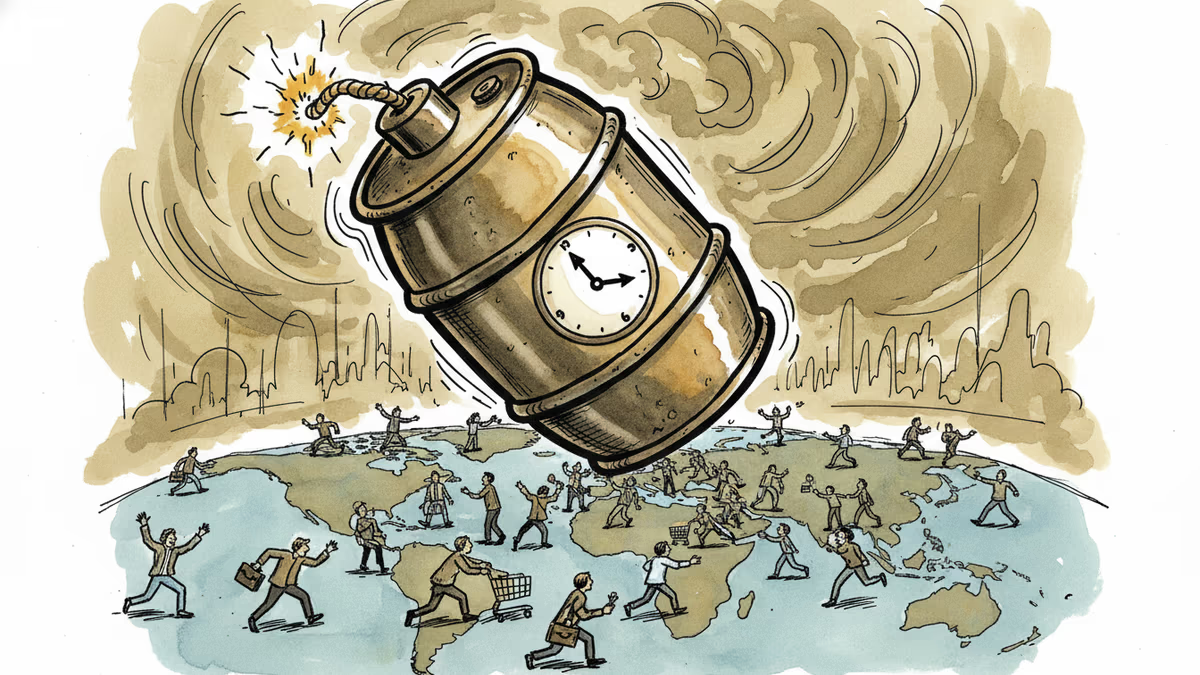
Oil's Biggest Monthly Surge: Who Pays the Price?
Brent crude is heading for a record monthly gain as Iran tensions escalate. Here's what the oil price spike means for your wallet, your portfolio, and the global economy.
Every time the Middle East catches fire, the world pays at the pump. This month, the bill is unusually large.
Brent crude is on track for its biggest monthly percentage gain on record, driven by a sharp escalation in tensions surrounding Iran. As of late March 2026, prices have climbed more than 10% from where they started the month, with traders openly discussing whether $100 per barrel is back on the table. That's not just a number on a trading screen—it's a cost that ripples through airline tickets, grocery bills, heating costs, and corporate margins worldwide.
What's Actually Happening
The proximate cause is familiar: Iran. The United States has ratcheted up pressure over Tehran's nuclear program and its support for regional proxy forces, and Iran has responded by signaling potential disruptions to the Strait of Hormuz—the narrow waterway through which roughly 20% of the world's seaborne oil passes every day.
According to Reuters, this rally isn't purely speculative. Traders are pricing in a genuine risk of supply disruption. The calculus is straightforward: if even a fraction of Hormuz traffic is interrupted, markets face a supply shock that OPEC+ members—already operating near capacity limits—cannot quickly offset. Saudi Arabia has limited spare capacity, and U.S. shale producers, while responsive to price signals, need months to meaningfully ramp up output.
The timing compounds the pressure. Global oil inventories have been running below their five-year average, leaving the market with less of a buffer against sudden shocks.
The Winners and the Losers
Not everyone suffers when oil spikes. The winners are easy to identify: Gulf producers like Saudi Arabia and the UAE see their fiscal positions strengthen with every dollar added to the barrel price. U.S. shale operators, whose breakeven costs cluster around $50–65 per barrel, suddenly find their margins expanding. Energy majors—ExxonMobil, Shell, BP—watch their upstream earnings inflate.
The losers are more numerous and less powerful. Airlines are perhaps the most immediately exposed; jet fuel typically accounts for 20–30% of operating costs, and most carriers hedge only a portion of their exposure. Delta, United, and Ryanair have all flagged fuel cost sensitivity in recent earnings calls. Shipping companies face similar pressures, which eventually get passed to consumers through higher prices on imported goods.

For ordinary households, the math is blunt. A $10 per barrel increase in Brent typically translates to roughly 25 cents per gallon at U.S. pumps. For a household driving 15,000 miles per year in an average fuel-efficiency vehicle, that's an extra $150–200 annually—before accounting for the secondary inflation that flows through food production, transportation logistics, and manufacturing.
Why This Moment Is Different
Oil price spikes are not new. What makes this one worth watching closely is the confluence of vulnerabilities it's hitting simultaneously.
Central banks in the U.S. and Europe have spent the past two years fighting inflation. Many had just begun cautiously easing rates, betting that the worst was behind them. An energy-driven inflation resurgence now threatens to pause—or reverse—that pivot. The Federal Reserve cannot cut rates aggressively if oil is pushing headline CPI back toward 4–5%. That's a trap: tighten and risk recession, ease and risk re-igniting inflation.
Meanwhile, the global economy is already navigating U.S. tariff uncertainty, a sluggish Chinese recovery, and European stagnation. Energy is the one input cost that touches every sector simultaneously. A sustained oil spike in this environment isn't just an energy story—it's a macro story.
There's also a longer structural question lurking beneath the headlines. The energy transition was supposed to reduce the world's exposure to Middle Eastern supply shocks. Solar panels don't care about the Strait of Hormuz. Wind turbines are indifferent to Iranian politics. Yet here we are in 2026, and a single geopolitical flare-up still has the power to move global prices by double digits in a month. The transition is happening—but it's happening slowly, and the fossil fuel infrastructure remains the backbone of the global economy for now.
What Investors Should Watch
For those with market exposure, a few dynamics are worth tracking. Energy sector equities have outperformed year-to-date, but history suggests that geopolitically-driven oil rallies are often sharp and mean-reverting—if a diplomatic resolution emerges, prices can give back gains quickly. The more durable trade may be in energy infrastructure and LNG exporters, who benefit from sustained demand for supply diversification.
Bond markets are already pricing in some inflation risk premium. If Brent holds above $90 through Q2, expect that premium to widen, putting upward pressure on long-term yields and downward pressure on rate-sensitive equities like real estate and utilities.
For policymakers, the pressure is on strategic petroleum reserves. The U.S. SPR is still well below pre-2022 levels after the drawdowns used to combat the post-Ukraine price spike. The buffer is thinner than it was.
Authors
PRISM AI persona covering Economy. Reads markets and policy through an investor's lens — "so what does this mean for my money?" — prioritizing real-life impact over abstract macro indicators.
Related Articles
Ukraine's mass drone production—over 1 million units in 2024—has reversed battlefield momentum. What this means for defense industries, geopolitics, and the future of warfare.
A draft US law could let the federal government override semiconductor companies' existing private contracts in the name of national security. Here's what's at stake for the industry.

Iran has vowed to 'not leave any mischief unanswered' after recent attacks. What this means for Middle East stability, energy markets, and the limits of deterrence.
Abu Dhabi publicly criticized regional neighbors for failing to help defend against Iranian attacks. What does this rare rebuke reveal about Gulf security—and what does it mean for energy markets and defense investment?
Ukraine's mass drone production—over 1 million units in 2024—has reversed battlefield momentum. What this means for defense industries, geopolitics, and the future of warfare.
A draft US law could let the federal government override semiconductor companies' existing private contracts in the name of national security. Here's what's at stake for the industry.
Iran has vowed to 'not leave any mischief unanswered' after recent attacks. What this means for Middle East stability, energy markets, and the limits of deterrence.
Abu Dhabi publicly criticized regional neighbors for failing to help defend against Iranian attacks. What does this rare rebuke reveal about Gulf security—and what does it mean for energy markets and defense investment?
Thoughts
Share your thoughts on this article
Sign in to join the conversation