
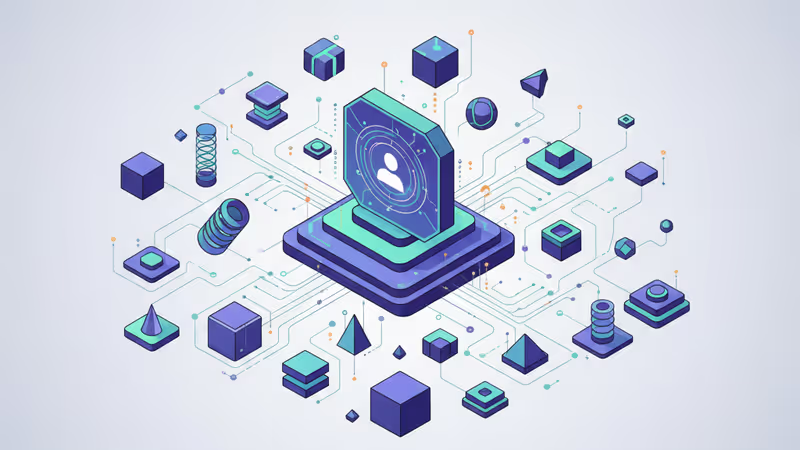
Beyond the Chatbot Smile: OpenAI Dials Up Personalization and Its Complex Implications
OpenAI's new ChatGPT personality customization offers strategic implications for user experience, ethical AI, and enterprise adoption. PRISM analyzes the impact.
The Lede: Why Should a Busy Executive Care?
OpenAI's latest update to ChatGPT, enabling users to fine-tune the bot's “personality” from warmth to enthusiasm and even emoji use, might seem like a cosmetic tweak. But for executives building AI-powered products or integrating them into workflows, this is a critical pivot. It signals a deeper commitment to user experience and control, moving AI interaction from static utility to a more dynamic, user-centric partnership—all while navigating the tightrope of anthropomorphism and ethical AI deployment.
Why It Matters: Industry Impact, Second-Order Effects
This isn't just about making ChatGPT “nicer.” For enterprises, the ability to tailor an AI's expressive style opens new avenues for brand consistency in customer service, internal communications, or specialized professional tools. Imagine a bot perfectly aligned with a legal firm's formal tone or a creative agency's vibrant voice. However, this granular control also amplifies critical questions: How far is too far in making AI seem human? Warnings from professionals about “AI psychosis” and dependency aren't just academic; they represent a significant reputational and ethical risk that OpenAI is attempting to mitigate, particularly with its concurrent emphasis on teen safety and mental health guardrails.

The Analysis: Historical Context, Competitive Dynamics
OpenAI's move must be seen through the lens of recent criticisms, specifically Sam Altman's acknowledgment of a “personality problem” and the prior adjustment of GPT-4o for being “overly agreeable.” This update is a direct response, an attempt to democratize the AI's expressive layer. Historically, AI's interaction models have been largely monolithic. Now, by giving users a dial, OpenAI is pushing for greater perceived control and adaptability.
In the fiercely competitive LLM space, where companies like Google (Gemini) and Anthropic (Claude) are also racing to differentiate through safety and user experience, personalization is a potent differentiator. It’s also notable that this granular personality control arrives alongside GPT-5.2, which boasts “professional knowledge work” capabilities and less hallucinations. The challenge is clear: build a powerful, accurate engine, then give users the reins to make it feel right, without crossing into dangerous anthropomorphism.
PRISM's Take: Your Informed Perspective
OpenAI's personality dial is a double-edged sword: a strategic leap towards customizable, user-centric AI that enhances utility, but also a potent reminder of the inherent risks of anthropomorphism. The real test won't be in how “friendly” ChatGPT can be, but in how effectively OpenAI—and the industry at large—can empower users to shape their AI interactions responsibly, without blurring the lines between tool and companion. True innovation lies in control and transparency, not just charm.
Authors
Related Articles

Google's Gmail Live lets you ask your inbox questions out loud. Announced at I/O 2026, it's AI's pitch to skeptics — and a reminder of how much Google already knows about you.

OpenAI has reorganized for the second time in a month, merging ChatGPT and Codex into a single agentic platform under president Greg Brockman's unified product leadership.
After two weeks of witnesses calling him a liar, OpenAI CEO Sam Altman testified in his own defense, claiming Elon Musk tried to kill the company twice.
Sam Nelson, 19, died after following ChatGPT's advice to mix Kratom and Xanax. His parents are suing OpenAI for wrongful death, raising urgent questions about AI trust, liability, and design.
Google's Gmail Live lets you ask your inbox questions out loud. Announced at I/O 2026, it's AI's pitch to skeptics — and a reminder of how much Google already knows about you.
OpenAI has reorganized for the second time in a month, merging ChatGPT and Codex into a single agentic platform under president Greg Brockman's unified product leadership.
After two weeks of witnesses calling him a liar, OpenAI CEO Sam Altman testified in his own defense, claiming Elon Musk tried to kill the company twice.
Sam Nelson, 19, died after following ChatGPT's advice to mix Kratom and Xanax. His parents are suing OpenAI for wrongful death, raising urgent questions about AI trust, liability, and design.
Thoughts
Share your thoughts on this article
Sign in to join the conversation