

Beyond Content Filters: OpenAI's New Playbook for Teen Safety is a Strategic Moat
OpenAI's new teen safety rules are more than a feature. It's a strategic move to redefine responsible AI, setting a new standard for Google and the industry.
The Lede: Why This Is More Than Just a Safety Update
OpenAI's new 'Under-18 Principles' for ChatGPT are not a simple feature update or a public relations maneuver. This is a strategic move to redefine the cost of entry for consumer-facing AI. By codifying age-appropriate behavior grounded in developmental science directly into its model specifications, OpenAI is shifting the industry battleground from raw performance to demonstrable responsibility. For any leader in the tech ecosystem, this signals that the era of 'move fast and break things' is officially over for AI; the new mandate is 'scale fast and protect users,' and the burden of proof is now on the model itself.
Why It Matters: Setting the Rules of Engagement
This initiative creates significant second-order effects that will ripple across the industry. First, it establishes a new competitive benchmark. Competitors like Google's Gemini and Anthropic's Claude can no longer just compete on response quality or speed; they must now articulate and implement their own sophisticated, developmentally-aware youth safety frameworks or risk being painted as negligent. Second, OpenAI is proactively shaping future regulation. By creating a detailed, public-facing 'Model Spec,' they are effectively handing policymakers a ready-made template for 'what good looks like,' potentially influencing legislation in the EU, UK, and US to their advantage. Finally, this moves the goalposts from reactive content moderation to proactive behavioral design. The challenge is no longer just filtering harmful outputs, but architecting an AI that can act as a responsible guide, a much more complex and computationally expensive problem.

The Analysis: Learning from Social Media's Sins
We've seen this movie before. A decade ago, social media giants treated child safety as an edge case, a problem to be solved with blocklists and reporting tools after the fact. The result was a decade of regulatory whack-a-mole, reputational damage, and real-world harm. OpenAI, by embedding these principles at the core of its model, is attempting to learn from history and build 'safety by design' into its foundational DNA. This is a direct response to the 'tech-lash' and a clear attempt to build the social license required for AI to become deeply integrated into sensitive areas like education and home life. The term 'developmental science' is key; it reframes the AI not as a neutral tool, but as an active participant in a young person's life that must be aware of its influence. This is a profound shift from a purely technical framework to a socio-technical one.
PRISM's Take: A Necessary, But Unproven, Evolution
OpenAI’s proactive stance is both strategically brilliant and socially necessary. It's a powerful move to front-run regulators, build a moat of public trust, and force competitors onto their playing field. However, the gap between a written 'Model Spec' and flawless execution in millions of unpredictable daily interactions with teenagers is vast. The principles are sound, but the implementation is the real test. The ultimate success won't be measured by the document's release, but by the absence of headlines about its failure. This is a critical step in maturing the AI industry, but it's the first step in a marathon, not the final lap.
Authors
Related Articles

OpenAI has reorganized for the second time in a month, merging ChatGPT and Codex into a single agentic platform under president Greg Brockman's unified product leadership.
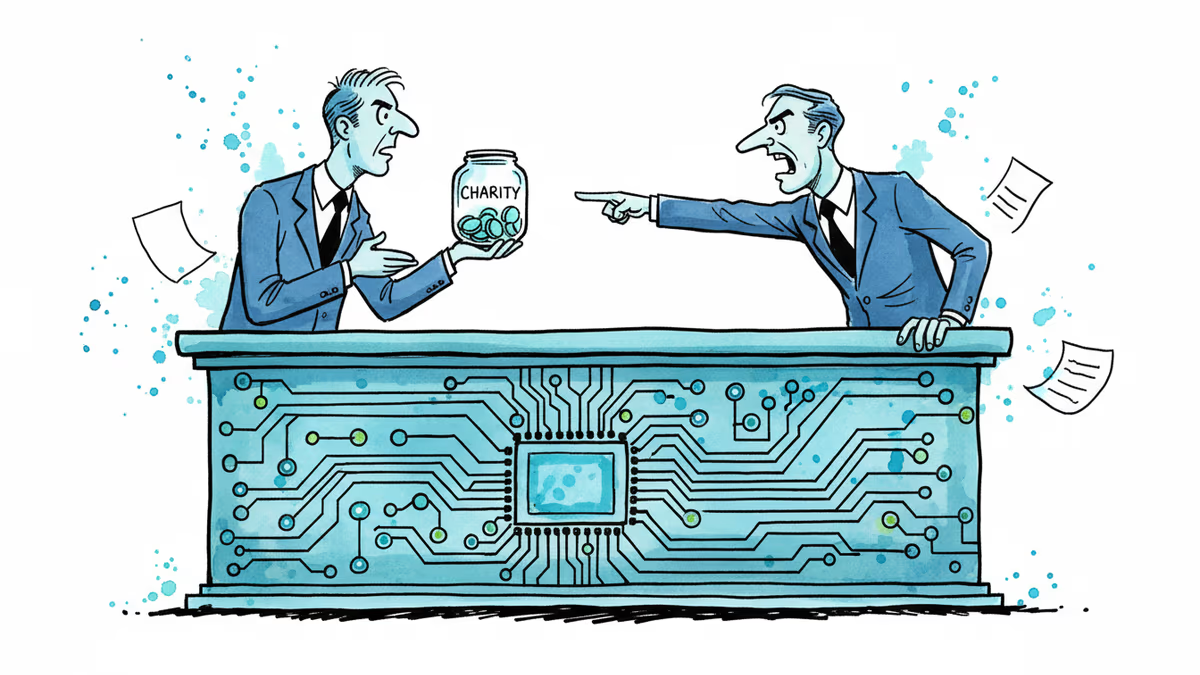
After two weeks of witnesses calling him a liar, OpenAI CEO Sam Altman testified in his own defense, claiming Elon Musk tried to kill the company twice.

Sam Nelson, 19, died after following ChatGPT's advice to mix Kratom and Xanax. His parents are suing OpenAI for wrongful death, raising urgent questions about AI trust, liability, and design.
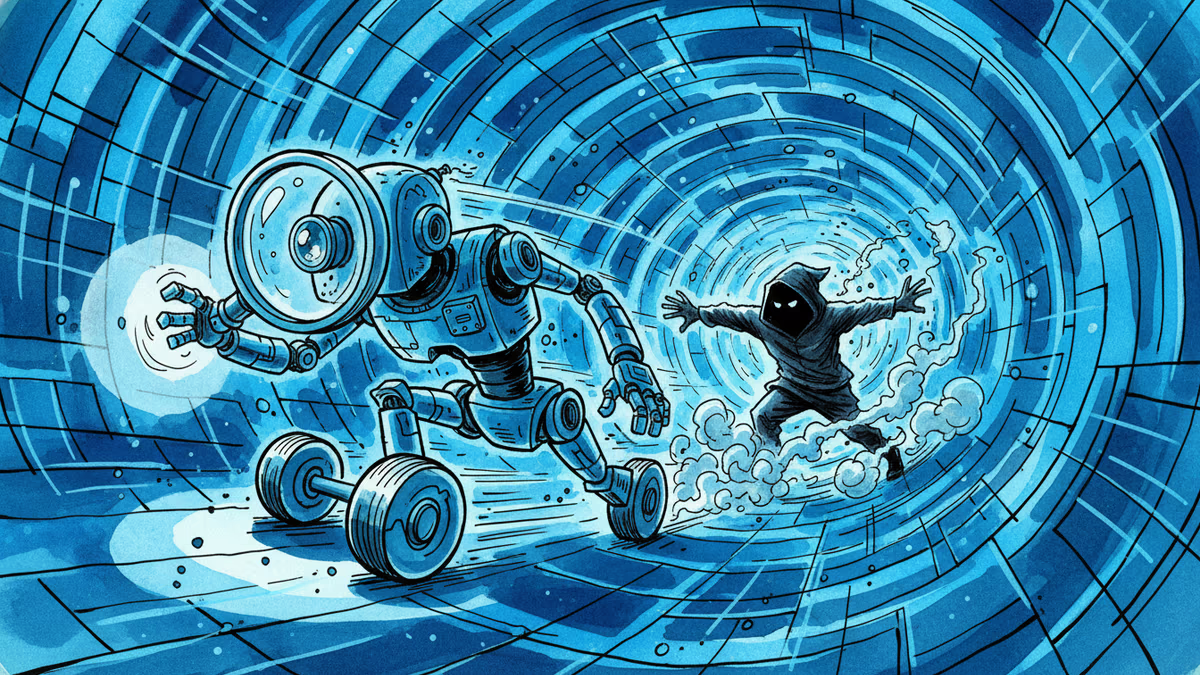
OpenAI's new Daybreak initiative uses the Codex AI agent to find and patch security vulnerabilities before attackers do—putting it in direct competition with Anthropic's secretive Claude Mythos.
OpenAI has reorganized for the second time in a month, merging ChatGPT and Codex into a single agentic platform under president Greg Brockman's unified product leadership.
After two weeks of witnesses calling him a liar, OpenAI CEO Sam Altman testified in his own defense, claiming Elon Musk tried to kill the company twice.
Sam Nelson, 19, died after following ChatGPT's advice to mix Kratom and Xanax. His parents are suing OpenAI for wrongful death, raising urgent questions about AI trust, liability, and design.
OpenAI's new Daybreak initiative uses the Codex AI agent to find and patch security vulnerabilities before attackers do—putting it in direct competition with Anthropic's secretive Claude Mythos.
Thoughts
Share your thoughts on this article
Sign in to join the conversation