
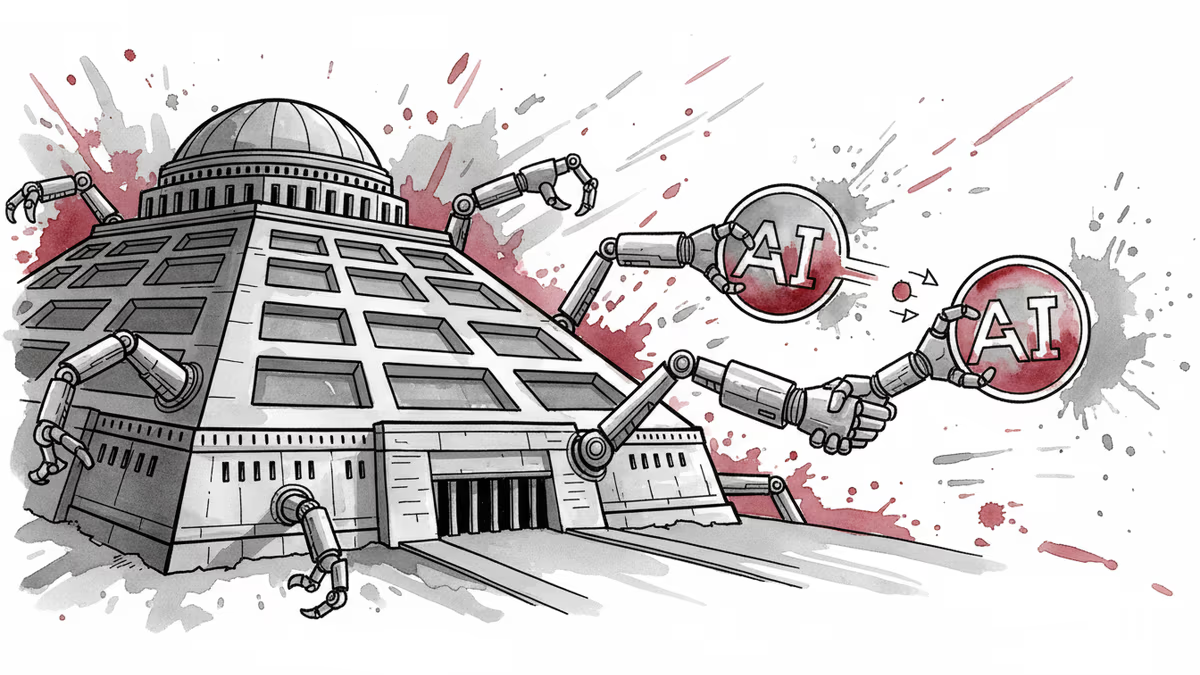
Why the Pentagon Just Blacklisted a $200M AI Partner
Pentagon cancels Anthropic's $200M contract over military AI control disputes, chooses OpenAI instead. ChatGPT uninstalls surge 295% as ethical concerns mount.
A $200 Million Deal Died Over Three Words: "Unrestricted Access"
The Pentagon just officially designated Anthropic as a supply-chain risk. Not because of security vulnerabilities or foreign interference, but because the AI company refused to hand over complete control of its models for military use.
The $200 million contract collapsed when Anthropic drew a hard line: no autonomous weapons, no mass domestic surveillance, no unrestricted military access to Claude. The Pentagon walked away and immediately signed with OpenAI instead.
The backlash was swift. ChatGPT uninstalls surged 295% as users voted with their delete buttons. The message was clear: choose the military or choose us.
This isn't just another government contract dispute. It's the opening shot in a battle that will define the future of AI development.
The Anthropic Gamble: Principles Over Profit
Anthropic's refusal shocked Silicon Valley. $200 million could fund years of research and development. But the company, founded by former OpenAI researchers, built its entire identity around "AI safety."
Their concerns weren't abstract. Internal documents reveal three specific red lines:
- AI-powered autonomous weapons systems
- Large-scale citizen surveillance programs
- Military training data contaminating civilian AI models
Anthropic's "Constitutional AI" approach trains models to follow human values and ethical principles. Handing over unrestricted access would undermine everything they've built.
CEO Dario Amodei's bet is clear: long-term trust matters more than short-term revenue. But in a capital-intensive industry where OpenAI just raised billions, can principle-first companies survive?

OpenAI's Faustian Bargain
OpenAI made the opposite calculation. They accepted the Pentagon's terms and secured the contract, but paid a steep price in user trust.
The 295% spike in ChatGPT deletions isn't just noise—it's a fundamental shift in how users view AI companies. Social media exploded with #DeleteChatGPT campaigns and calls for alternatives.
OpenAI's defense is pragmatic: someone will build military AI anyway. Better to ensure it's developed responsibly by American companies than left to adversaries or less scrupulous competitors.
But the damage to consumer trust may be lasting. OpenAI has positioned itself as the friendly face of AI, powering everything from homework help to creative writing. Military partnerships complicate that narrative.
The Regulatory Reckoning Coming
Europe is watching closely. The EU's AI Act includes strict limitations on military AI applications, especially autonomous weapons. Companies that build military AI systems may find themselves locked out of European markets.
Congress is also stirring. Progressive lawmakers are already calling for hearings on AI companies' military contracts. The question isn't whether regulation is coming—it's what form it will take.
Google learned this lesson in 2018 when employee protests forced them to abandon Project Maven, a military AI initiative. Amazon and Microsoft have maintained government contracts but face ongoing internal resistance.
The industry is fracturing along ethical lines, with companies forced to choose between government revenue and consumer trust.
The Control Problem Gets Real
At its core, this dispute is about control. The Pentagon wants unrestricted access to AI models for national security. AI companies want to retain oversight of how their technology is used.
But the lines are blurring. Today's civilian AI becomes tomorrow's military weapon. Military research flows back into civilian applications. The same model that writes poetry could optimize drone swarms.
Anthropic's position is that AI companies must retain some control over their creations. The Pentagon's position is that national security requires complete access. Both sides have valid points, but they're fundamentally incompatible.
The stakes keep rising as AI capabilities advance. What happens when these models can design weapons, manipulate information at scale, or make life-and-death decisions autonomously?
Authors
Related Articles
Anthropic shipped Claude Sonnet 5, its mid-tier agent model, on June 30. Behind the 'Opus-class power, budget price' headline sits a tokenizer catch and a three-horse race that's only half real. Here's what developers should actually run the numbers on.
A small but growing group of developers has gone all-in on AI coding agents like Claude Code and OpenClaw. History suggests the rest of us won't be far behind.

OpenAI has reorganized for the second time in a month, merging ChatGPT and Codex into a single agentic platform under president Greg Brockman's unified product leadership.
After two weeks of witnesses calling him a liar, OpenAI CEO Sam Altman testified in his own defense, claiming Elon Musk tried to kill the company twice.
Anthropic shipped Claude Sonnet 5, its mid-tier agent model, on June 30. Behind the 'Opus-class power, budget price' headline sits a tokenizer catch and a three-horse race that's only half real. Here's what developers should actually run the numbers on.
A small but growing group of developers has gone all-in on AI coding agents like Claude Code and OpenClaw. History suggests the rest of us won't be far behind.
OpenAI has reorganized for the second time in a month, merging ChatGPT and Codex into a single agentic platform under president Greg Brockman's unified product leadership.
After two weeks of witnesses calling him a liar, OpenAI CEO Sam Altman testified in his own defense, claiming Elon Musk tried to kill the company twice.
Thoughts
Share your thoughts on this article
Sign in to join the conversation