
ChatGPT's 'Adult Mode' Is Delayed. Again.
OpenAI has pushed back its adult content feature for the second time, with no new launch date. What's really behind the delay — and what does it mean for AI content regulation?
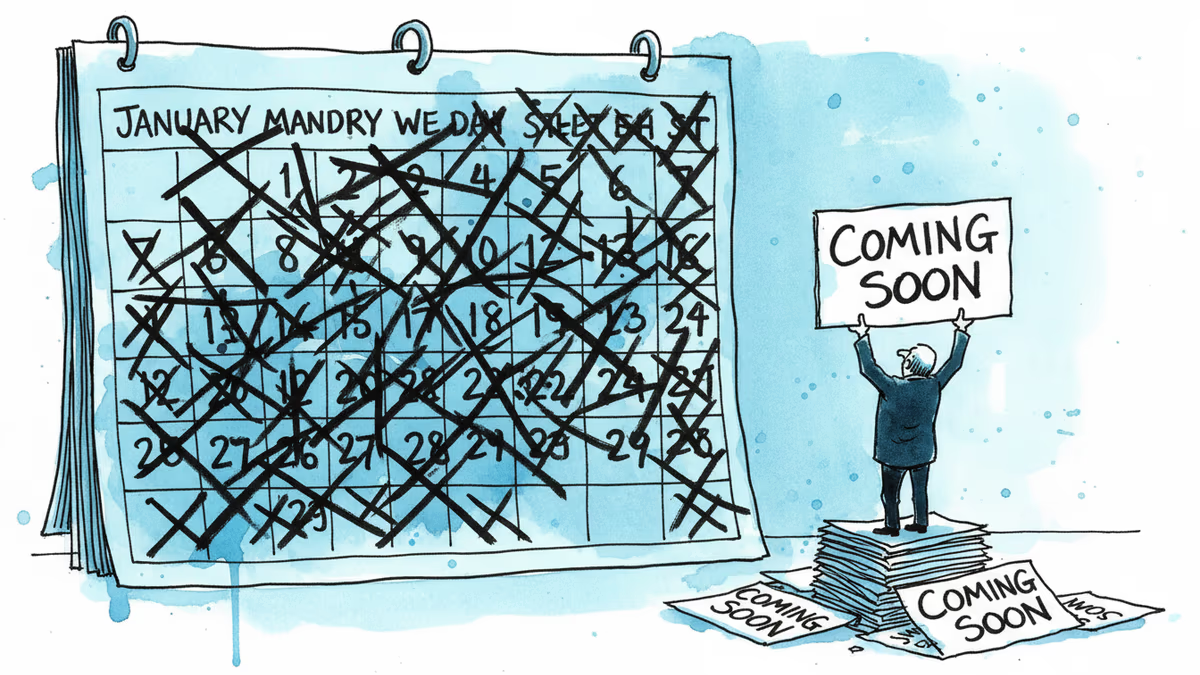
Last October, Sam Altman made a promise. Starting in December, he said, ChatGPT would allow verified adults to access erotica and other mature content — part of what he called the principle of "treating adult users like adults." December came and went. Altman reportedly declared a "code red" internally, pulling teams back to focus on core product. The feature slipped to Q1 2026. Now Q1 is nearly over, and OpenAI has quietly pushed the launch again — this time with no target date at all.
Two delays. One vague explanation. A lot of unanswered questions.
What OpenAI Actually Said
An OpenAI spokesperson told Axios the company is "pushing out the launch of adult mode" to focus on "work that is a higher priority for more users right now" — specifically improvements to the chatbot's intelligence, personality, and ability to be "more proactive." The statement added: "We still believe in the principle of treating adults like adults, but getting the experience right will take more time."
On the surface, it reads like a standard product prioritization call. But when the same feature gets delayed twice with nearly identical reasoning, it's worth asking what's actually driving the decision.
The Timing Is Hard to Ignore
OpenAI is not operating in a vacuum right now. The company is in the middle of a structural transformation — moving from a nonprofit-controlled entity toward a for-profit model — while reportedly navigating funding conversations that value it at over $300 billion. Launching an adult content platform, however carefully gated, carries reputational and regulatory weight that could complicate those conversations.

On the regulatory front, the pressure is real. Congress passed legislation criminalizing non-consensual AI-generated sexual imagery less than a year ago. Lawmakers on both sides of the aisle have been pushing for stronger age-verification requirements on digital platforms. The question of whether any verification system — credit card checks, ID uploads — can reliably keep minors out remains genuinely unresolved. OpenAI building that system incorrectly, even once, would be a liability far larger than a delayed feature.
Meanwhile, the competitive landscape hasn't waited. Platforms like Character.AI and various open-source model communities already offer adult content with varying levels of restriction. Every month OpenAI delays, users who want that functionality find other places to go.
Who Wins, Who Waits
For adult users who were expecting this feature, the delay is a straightforward frustration. The promise was made publicly. The timeline has slipped twice. Trust erodes in small increments like this.
For child safety advocates, the delay is a relief — though not a resolution. The harder question isn't whether OpenAI launches the feature, but whether any major AI platform can build age verification that actually works at scale. The technology for robust identity verification exists; the willingness to absorb its friction and cost is a different matter.
For OpenAI's competitors in the open-source space — Mistral, uncensored local model communities — this is an opportunity. When centralized platforms hesitate for compliance reasons, decentralized alternatives fill the gap. The irony is that regulatory caution by the biggest players may end up pushing demand toward less regulated corners of the AI ecosystem.
For investors watching OpenAI's trajectory, the calculus is genuinely complicated. Adult content is a high-margin business. But it's also the kind of business that makes institutional investors, enterprise clients, and school district IT administrators nervous. The company is trying to be everything to everyone — and adult mode is a sharp reminder that those audiences don't always want the same things.
Authors
Related Articles

OpenAI has reorganized for the second time in a month, merging ChatGPT and Codex into a single agentic platform under president Greg Brockman's unified product leadership.

After two weeks of witnesses calling him a liar, OpenAI CEO Sam Altman testified in his own defense, claiming Elon Musk tried to kill the company twice.

Sam Nelson, 19, died after following ChatGPT's advice to mix Kratom and Xanax. His parents are suing OpenAI for wrongful death, raising urgent questions about AI trust, liability, and design.

OpenAI's new Daybreak initiative uses the Codex AI agent to find and patch security vulnerabilities before attackers do—putting it in direct competition with Anthropic's secretive Claude Mythos.
OpenAI has reorganized for the second time in a month, merging ChatGPT and Codex into a single agentic platform under president Greg Brockman's unified product leadership.
After two weeks of witnesses calling him a liar, OpenAI CEO Sam Altman testified in his own defense, claiming Elon Musk tried to kill the company twice.
Sam Nelson, 19, died after following ChatGPT's advice to mix Kratom and Xanax. His parents are suing OpenAI for wrongful death, raising urgent questions about AI trust, liability, and design.
OpenAI's new Daybreak initiative uses the Codex AI agent to find and patch security vulnerabilities before attackers do—putting it in direct competition with Anthropic's secretive Claude Mythos.
Thoughts
Share your thoughts on this article
Sign in to join the conversation