
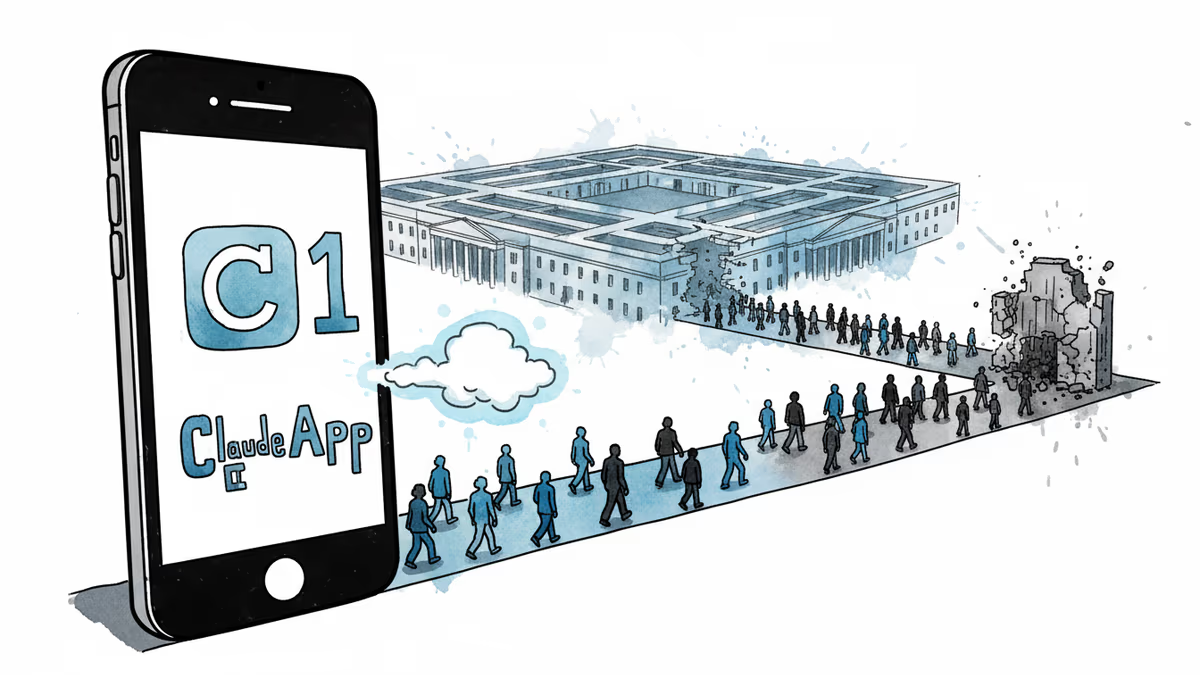
The AI That Said No to Pentagon Surveillance Just Hit #1
Claude surpassed ChatGPT with 149k daily downloads after Anthropic refused Pentagon surveillance deals. Ethical AI stance drives unexpected market success.
149,000 vs 124,000. That's Claude's daily U.S. downloads compared to ChatGPT's on March 2nd. But this isn't just about numbers—it's about what happens when an AI company chooses principles over Pentagon contracts.
The story begins with a refusal that should have hurt business. When the Department of Defense approached Anthropic about using Claude for mass surveillance of Americans and fully autonomous weapons, CEO Dario Amodei said no. The result? Anthropic got labeled a "supply-chain risk."
Yet consumers seem to be voting with their downloads.
The Unexpected Surge
According to Appfigures, Claude's mobile app downloads have consistently outpaced ChatGPT's since the Pentagon fallout became public. But downloads only tell part of the story—what about actual usage?
Similarweb's data reveals the real impact:
- Claude's daily active users hit 11.3 million on March 2nd
- That's 183% growth since January (up from 4 million)
- 126% jump from early February (up from 5 million)
- Growth timing coincides precisely with Pentagon controversy
ChatGPT still dominates with 250.5 million daily active users, but Claude's trajectory suggests something significant is happening.
Global Vote of Confidence

Claude now ranks #1 in app stores across 16 countries, including the U.S., Australia, Canada, France, Germany, and the U.K. Anthropic reports breaking signup records daily in every available region, with over 1 million new users joining each day.
Meanwhile, web traffic tells a similar story. Claude's February traffic jumped 43% month-over-month and 297.7% year-over-year. ChatGPT's web traffic dropped 6.5% during the same period.
Even ChatGPT app uninstalls are reportedly surging by 295% following OpenAI's military partnerships.
The Stakeholder Calculation
For consumers, this represents a clear preference signal. Privacy concerns and AI misuse fears are driving choices beyond pure functionality. Users appear willing to switch platforms based on ethical positioning—a phenomenon rarely seen in tech.
For Anthropic, the gamble seems to be paying off. Trading government contracts for consumer trust has generated massive organic growth. But questions remain about monetization and whether principle-driven users convert to paying customers.
For OpenAI, the situation creates strategic tension. Military partnerships provide funding and technical advancement opportunities, but risk alienating privacy-conscious users. The company's pivot toward commercial and defense applications may be accelerating user migration to alternatives.
For the broader AI industry, Claude's success suggests ethical positioning could become a legitimate competitive differentiator—not just marketing speak.
The Regulatory Wild Card
This consumer preference for "ethical AI" comes as regulators worldwide scrutinize AI companies' military relationships. The EU's AI Act, pending U.S. federal AI regulations, and growing congressional oversight of defense AI contracts could make Anthropic's principled stance look prescient rather than naive.
But there's a flip side: will Anthropic's refusal to work with defense agencies limit its access to government research funding and partnerships that fuel innovation?
Authors
Related Articles
Anthropic shipped Claude Sonnet 5, its mid-tier agent model, on June 30. Behind the 'Opus-class power, budget price' headline sits a tokenizer catch and a three-horse race that's only half real. Here's what developers should actually run the numbers on.
Samsung and SK unveiled a chip and AI investment package worth thousands of trillions of won on June 29. The headline number swings wildly by outlet, but the real contest isn't capital — it's water and power.

A small but growing group of developers has gone all-in on AI coding agents like Claude Code and OpenClaw. History suggests the rest of us won't be far behind.
Viral videos show 2026 graduates jeering executives who praise AI at commencement ceremonies. It's not just rudeness — it's a signal about who pays for technological optimism.
Anthropic shipped Claude Sonnet 5, its mid-tier agent model, on June 30. Behind the 'Opus-class power, budget price' headline sits a tokenizer catch and a three-horse race that's only half real. Here's what developers should actually run the numbers on.
Samsung and SK unveiled a chip and AI investment package worth thousands of trillions of won on June 29. The headline number swings wildly by outlet, but the real contest isn't capital — it's water and power.
A small but growing group of developers has gone all-in on AI coding agents like Claude Code and OpenClaw. History suggests the rest of us won't be far behind.
Viral videos show 2026 graduates jeering executives who praise AI at commencement ceremonies. It's not just rudeness — it's a signal about who pays for technological optimism.
Thoughts
Share your thoughts on this article
Sign in to join the conversation