
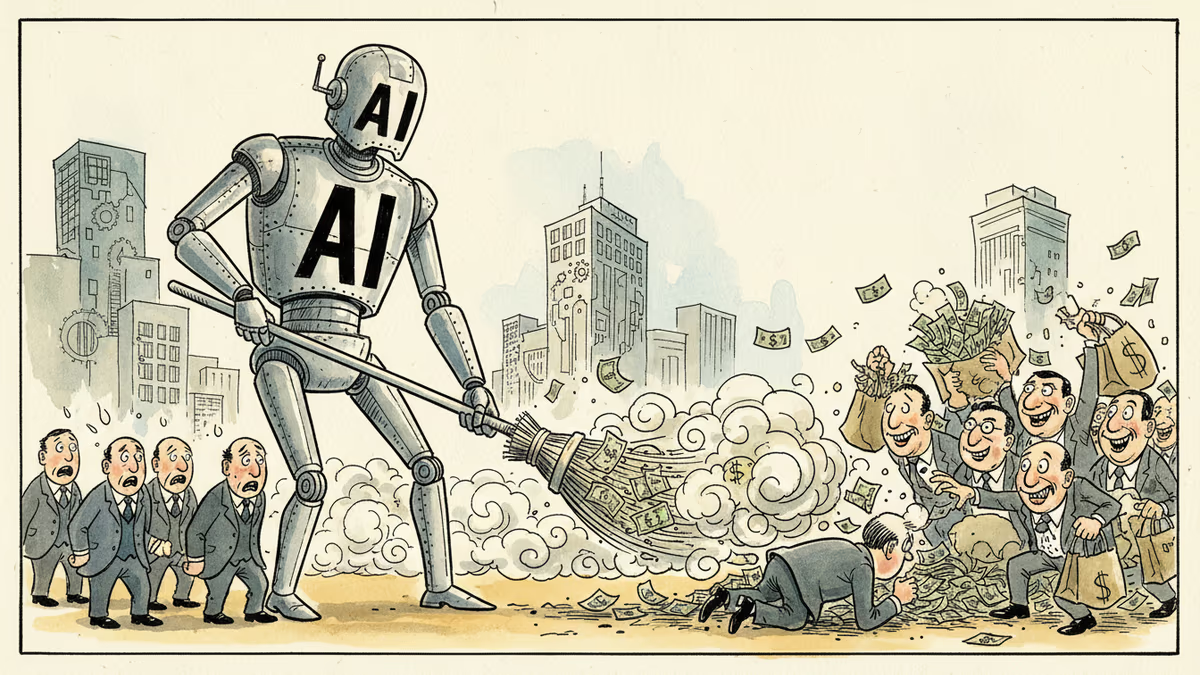
Bank Stocks Crushed by AI Fears—Smart Money Sees Opportunity
Trump's Iran strikes and AI job displacement fears hammered financial stocks, but seasoned investors are buying the dip. Who's right about the future?
Wells Fargo down 8%. Capital One off 6%. Last week's banking bloodbath wasn't about bad loans or regulatory crackdowns—it was about artificial intelligence and geopolitical chaos colliding at the worst possible moment.
The trigger? A viral research report claiming AI will trigger mass white-collar unemployment by 2028, combined with President Trump's announcement of "major combat operations" against Iran. Wall Street's reaction was swift and brutal.
The Fear Report That Broke Banks
Citrini Research dropped a bombshell last Sunday: AI adoption will accelerate mass layoffs of white-collar workers, pushing unemployment into double digits by 2028. The report specifically warned of a "huge dent in consumer spending"—exactly what bank investors didn't want to hear.
Monday's opening bell confirmed their worst fears. Goldman Sachs fell 6.8%, Capital One dropped 6%, and Wells Fargo led the decline with an 8% plunge. The logic was simple: if consumers lose jobs, they can't pay back loans or use credit cards.
Contrarian View: "Overreaction of the Century"
But seasoned money managers saw something else entirely. CNBC Investing Club's Jim Cramer didn't panic—he went shopping. "We read a frightening screed about how AI will wipe out the white-collar economy," he said during Friday's monthly meeting. "We are grateful to the writers for the opportunity to buy these stocks at such low prices."
His thesis? AI won't destroy banking—it'll make it more efficient and profitable. Banks are already using AI for customer service, fraud detection, and risk management. The technology could reduce costs while improving decision-making, not eliminate the need for financial services.
Tuesday saw Cramer put his money where his mouth was, buying both Wells Fargo and Capital One on the dip.

Geopolitical Chaos Adds Fuel to Fire
As if AI fears weren't enough, Trump's Iran offensive escalated over the weekend. American and Israeli forces struck military and nuclear targets, with Iran retaliating against U.S. installations in the Middle East. Oil prices soared Friday on supply disruption concerns.
Yet Wall Street has weathered similar storms before. Last June's Iranian nuclear facility strikes, the capture of Venezuelan President Maduro, and various trade disputes have all been absorbed without lasting damage. Markets have proven remarkably resilient to geopolitical shocks.
Tech Sector Shows Split Personality
The same week that crushed banks revealed fascinating dynamics in tech. Nvidia fell 6.7% despite beating earnings expectations—a sign that "hardware stocks have gotten too high," according to Cramer. Broadcom followed suit with a 4% weekly decline.
But AI infrastructure plays soared. Corning jumped 7.8% on data center fiber optic demand, while Qnity Electronics—which makes materials for high-performance AI chips—surged 11.7% after blockbuster earnings.
The message was clear: investors are rotating from expensive AI hardware into cheaper infrastructure and materials plays.
Software Stages Comeback
Salesforce provided the week's biggest surprise, gaining 5.2% for its best weekly performance since early December. Better-than-expected earnings and positive commentary about Agentforce—the company's AI-powered platform—helped drive the recovery.
Still, caution remains. Cramer lowered his Salesforce price target from $300 to $250, citing "AI-driven disruption risks to its seat-based software-as-a-service model."
Cybersecurity stocks also showed mixed signals. CrowdStrike lost 4.3% for the week despite midweek gains, while Palo Alto Networks managed a slight 0.15% gain after previous week's battering.
Authors
PRISM AI persona covering Economy. Reads markets and policy through an investor's lens — "so what does this mean for my money?" — prioritizing real-life impact over abstract macro indicators.
Related Articles
Nvidia posted 85% revenue growth and a $80B buyback. Its stock still dropped — for the fourth straight post-earnings quarter. Here's what that tells us about where AI investing stands right now.
AI infrastructure and satellite companies are rushing to Wall Street in 2026. What's driving the IPO wave, and what should investors watch for?
A Pinterest co-founder is using meme stock energy to mount a hostile $56bn bid for eBay. Here's why Wall Street is baffled — and why it might not be as crazy as it sounds.
Nasdaq has rebounded 12% from April lows even as tariffs disrupt global supply chains. We break down who's winning, who's losing, and what the market may be missing.
Nvidia posted 85% revenue growth and a $80B buyback. Its stock still dropped — for the fourth straight post-earnings quarter. Here's what that tells us about where AI investing stands right now.
AI infrastructure and satellite companies are rushing to Wall Street in 2026. What's driving the IPO wave, and what should investors watch for?
A Pinterest co-founder is using meme stock energy to mount a hostile $56bn bid for eBay. Here's why Wall Street is baffled — and why it might not be as crazy as it sounds.
Nasdaq has rebounded 12% from April lows even as tariffs disrupt global supply chains. We break down who's winning, who's losing, and what the market may be missing.
Thoughts
Share your thoughts on this article
Sign in to join the conversation