
The $56 Billion Bet That's Breaking M&A Rules
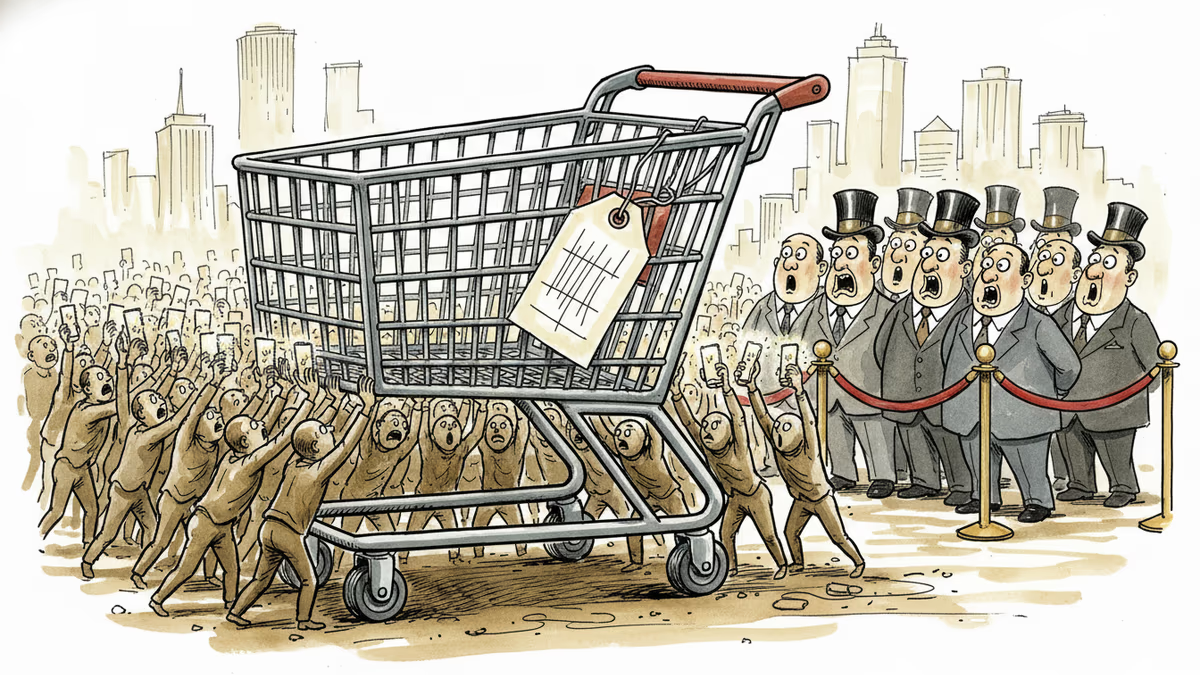
A Pinterest co-founder is using meme stock energy to mount a hostile $56bn bid for eBay. Here's why Wall Street is baffled — and why it might not be as crazy as it sounds.
Can a hostile takeover be crowd-funded by meme stock energy? One investor is betting $56 billion that the answer is yes.
What's Actually Happening
Steve Berkman, a co-founder of Pinterest, is leading a consortium that has made an unsolicited offer to acquire eBay at $67 per share — a premium of roughly 32% over the stock's pre-announcement price, valuing the company at $56 billion. eBay's board has formally rejected the bid. Berkman's group has responded by escalating to a proxy fight, going directly to shareholders to build support.
So far, this is a familiar M&A playbook. What isn't familiar is the financing structure. The consortium has signaled it intends to raise a portion of the capital through retail investor communities — specifically, networks organized via Reddit and X (formerly Twitter). The proposal would allow individual investors to participate directly in the deal, making them simultaneously eBay shareholders and platform users. Some analysts are calling it the first credible attempt at a meme stock-driven M&A transaction in history.
Wall Street's reaction has ranged from skepticism to outright bewilderment.
Why eBay, and Why Now
eBay isn't a random target. It's a structurally undervalued one — and the gap between its potential and its current performance has been widening for years.
The platform peaked culturally in the early 2000s and has spent the years since losing ground to Amazon on convenience and to Chinese platforms like Temu and AliExpress on price. Its gross merchandise volume (GMV) in 2024 was approximately $73 billion, essentially flat over five years. The stock has underperformed the Nasdaq by more than 40 percentage points over the same period.
But the bear case misses something. eBay's 132 million active buyers and its dominance in secondhand, vintage, and rare goods are assets that look different in 2026 than they did in 2016. Gen Z's obsession with resale culture — sneakers, vintage clothing, collectibles — maps almost perfectly onto eBay's core inventory. The platform's sneaker and luxury resale categories grew 18% year-over-year in 2023. And the ongoing US-China trade tensions have begun to erode the price advantage that Temu and AliExpress relied on to capture American consumers. A window may be opening.

Berkman's timing, in other words, isn't random.
The Meme Stock Problem — and the Meme Stock Opportunity
The most serious challenge to this deal isn't strategic. It's structural.
Retail investor commitments raised through social media don't carry the same legal enforceability as institutional capital commitments. Whether the consortium can actually close a $56 billion transaction with this financing model is the question every M&A lawyer and arbitrageur is asking right now. The SEC is almost certainly watching. Post-GameStop (2021), regulators have been acutely sensitive to coordinated retail investment behavior on social platforms, and soliciting investment through Reddit threads carries real regulatory exposure under public offering rules.
Berkman's counter-argument is more interesting than the skeptics give it credit for. The core thesis is a flywheel: when users become owners, they use the platform more, spend more, and advocate for it more aggressively. There's real data behind this. When Robinhood gave customers priority access to its IPO shares, those customers showed measurably higher engagement on the platform afterward. If eBay's buyers become eBay's shareholders, the unit economics of the business could improve in ways that don't show up in a traditional DCF model.
It's not a crazy idea. It's an unproven one at this scale.
Who Wins, Who Loses
For existing eBay shareholders, the immediate math is simple: a 32% premium is real money. The question is whether they believe the deal will close. If the bid collapses, the stock reverts. Merger arbitrageurs are already pricing in a significant probability of failure.
For Amazon, Etsy, and the broader resale market — StockX, Depop, ThredUp — a recapitalized eBay with fresh management and a loyal shareholder-user base is a more formidable competitor than the current version. The competitive implications are real, even if the deal timeline is uncertain.
For retail investors considering participating in the consortium, the risk profile is asymmetric in a way that deserves careful attention. The upside is genuine. The downside — a deal that doesn't close, leaving participants holding illiquid positions in a special purpose vehicle — is also genuine.
This content is AI-generated based on source articles. While we strive for accuracy, errors may occur. We recommend verifying with the original source.
Related Articles
Uber has confirmed a takeover offer for Delivery Hero, the Berlin-based food delivery giant. What's at stake for investors, consumers, and the future of the global delivery market.
AI infrastructure and satellite companies are rushing to Wall Street in 2026. What's driving the IPO wave, and what should investors watch for?

Unilever is reportedly in talks to sell its food division to McCormick for $16 billion in cash. What this tells us about the future of consumer goods — and who wins.

Poste Italiane has requested a board meeting with Telecom Italia to discuss a potential takeover. With the Italian government holding a 29% stake in Poste, this is more than a corporate approach.
Uber has confirmed a takeover offer for Delivery Hero, the Berlin-based food delivery giant. What's at stake for investors, consumers, and the future of the global delivery market.
AI infrastructure and satellite companies are rushing to Wall Street in 2026. What's driving the IPO wave, and what should investors watch for?
Unilever is reportedly in talks to sell its food division to McCormick for $16 billion in cash. What this tells us about the future of consumer goods — and who wins.
Poste Italiane has requested a board meeting with Telecom Italia to discuss a potential takeover. With the Italian government holding a 29% stake in Poste, this is more than a corporate approach.
Thoughts
Share your thoughts on this article
Sign in to join the conversation