
Tesla Tops, Toyota Tanks: Why Supply Chain Rankings Reveal Auto Industry's New Reality
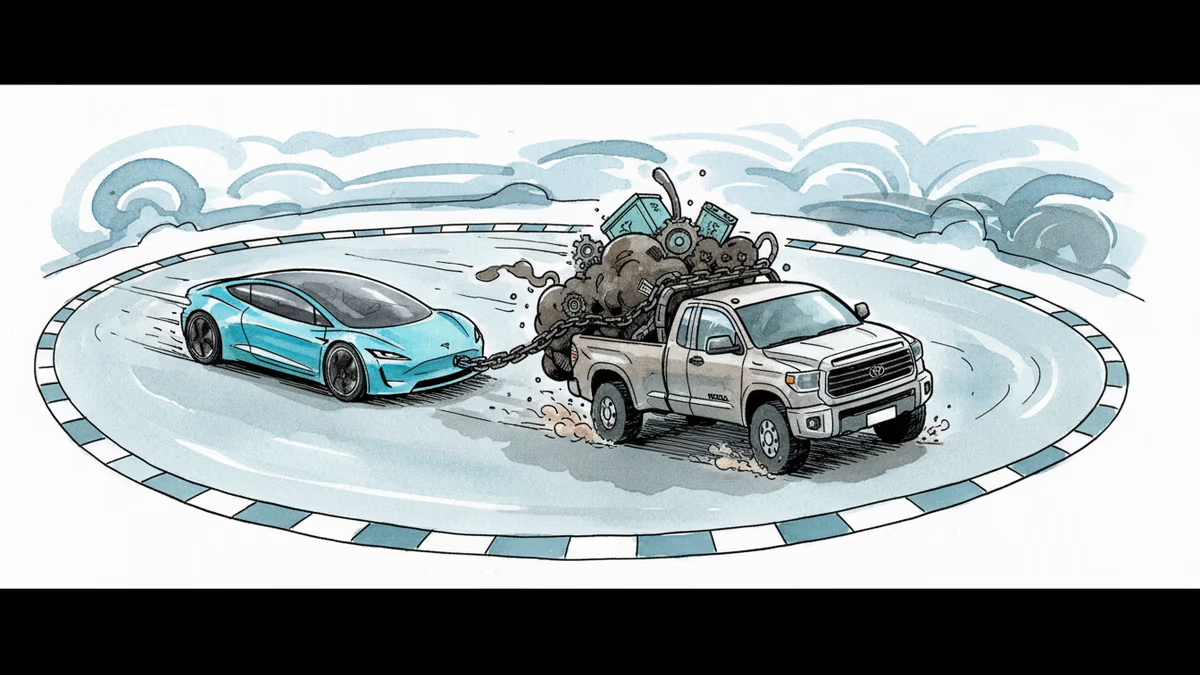
Tesla leads 18 global automakers in supply chain sustainability while Toyota ranks near bottom. Is this the canary in the coal mine for traditional auto giants?
The World's Largest Automaker Just Got Schooled
Something's shifting in the auto world's power dynamics. Toyota, the company that sells 10.5 million vehicles annually and practically invented lean manufacturing, finds itself languishing near the bottom of a supply chain sustainability ranking. Meanwhile, Tesla—a company that didn't exist 20 years ago—sits at the top.
The rankings come from Lead the Charge, a coalition of climate and human rights organizations including the Sierra Club and Public Citizen. Their fourth annual assessment evaluated 18 global automakers on efforts to eliminate carbon emissions, environmental damage, and human rights violations from their supply chains. Ford claimed second place, Volvo third.
Size Becomes a Liability
Here's the paradox: Toyota's greatest strength—its massive, efficient global supply network—has become its biggest weakness in the sustainability game. The company that perfected just-in-time manufacturing now faces the challenge of transforming thousands of suppliers across dozens of countries.
Tesla, by contrast, benefits from what we might call "supply chain adolescence." Its relatively young, vertically integrated approach means fewer moving parts to coordinate. When Elon Musk talks about "supply chain transparency as competitive advantage," this is what he means—it's easier to monitor and control what you can see.
But it's not just about company age. Ford's second-place finish proves that legacy automakers can adapt. The company's aggressive push into electric vehicles, combined with strategic partnerships and supplier audits, demonstrates that transformation is possible—if you're willing to disrupt your own system.

The Regulatory Tsunami Approaches
This ranking arrives at a crucial moment. The EU's Corporate Sustainability Due Diligence Directive takes effect in 2024, requiring companies to monitor their entire supply chains for environmental and human rights violations. California's supply chain transparency laws are tightening. China's carbon tracking requirements are expanding.
What looked like voluntary corporate responsibility five years ago is becoming mandatory compliance today. Companies that built their rankings on efficiency and cost optimization now face a different scorecard entirely.
Investors are paying attention too. ESG-focused funds managing $35 trillion globally increasingly use supply chain metrics as key investment criteria. A poor sustainability ranking isn't just bad PR—it's becoming a material financial risk.
The Innovation Paradox
Toyota's struggle reveals a deeper tension in the industry. The company's famous Toyota Production System revolutionized manufacturing by eliminating waste and maximizing efficiency. But that same system, optimized for cost and speed, wasn't designed for sustainability tracking or human rights monitoring.
Meanwhile, companies building supply chains from scratch can embed ESG principles from day one. They don't have to retrofit decades of established relationships and processes. They can choose suppliers based on sustainability metrics, not just historical performance and cost.
Authors
Related Articles
AI sustainability researcher Sasha Luccioni is launching a new venture to push for energy transparency in AI. Here's why Big Tech keeps the numbers hidden—and what's starting to change.
Taiwan's Thunder Tiger became the first Asian firm to win US military drone clearance with a China-free supply chain. As Trump meets Xi, the drone arithmetic reshapes defense strategy.
Apple quietly removed the entry-level $599 Mac Mini, raising the starting price to $799 — just one day after Tim Cook warned of chip supply constraints on the earnings call.
Mercedes-Benz is bringing steer-by-wire to the refreshed EQS sedan, eliminating the physical link between steering wheel and wheels. Here's what that actually means for drivers, safety, and the future of the car.
AI sustainability researcher Sasha Luccioni is launching a new venture to push for energy transparency in AI. Here's why Big Tech keeps the numbers hidden—and what's starting to change.
Taiwan's Thunder Tiger became the first Asian firm to win US military drone clearance with a China-free supply chain. As Trump meets Xi, the drone arithmetic reshapes defense strategy.
Apple quietly removed the entry-level $599 Mac Mini, raising the starting price to $799 — just one day after Tim Cook warned of chip supply constraints on the earnings call.
Mercedes-Benz is bringing steer-by-wire to the refreshed EQS sedan, eliminating the physical link between steering wheel and wheels. Here's what that actually means for drivers, safety, and the future of the car.
Thoughts
Share your thoughts on this article
Sign in to join the conversation