
What Algorithms Can't Learn: The Body Knows
A flamenco musician and a juggler offer a quiet argument for why embodied art matters more than ever in an age of AI-generated everything. What can technology never flatten?
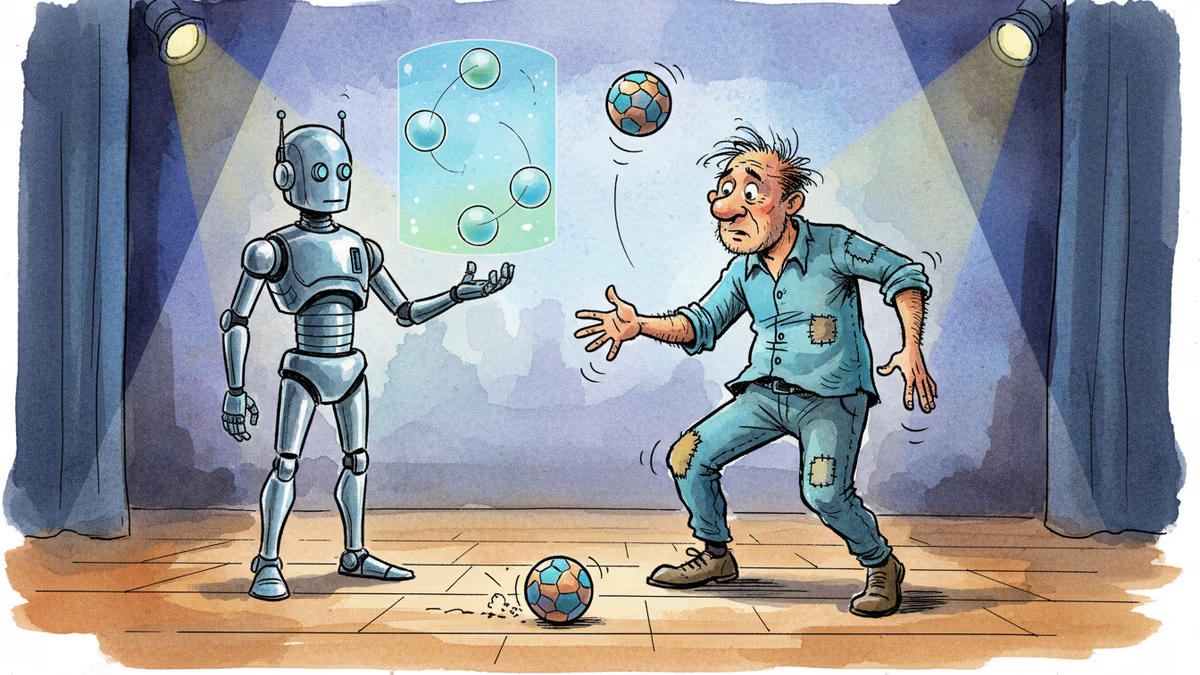
The ball hits the floor. The juggler pauses, breathes, picks it up. The audience doesn't look away — they lean in.
That moment of failure is, paradoxically, the most human thing in the room. And it's the one thing no algorithm has ever been designed to replicate.
A short film from Aeon Video brings together two unlikely voices — a flamenco musician and a juggler — to ask a question that sounds simple but cuts deep: if technology is flattening our humanity, can art deepen it? Their answers don't arrive as manifestos. They arrive as demonstrations.
The Knowledge That Lives in Your Hands
The flamenco guitarist doesn't just play the strings. At certain moments, the palm strikes the body of the instrument — a percussive crack that isn't written in any score. It can't be. That sound belongs to a specific room, a specific audience, a specific emotional current running between performer and listener. The Spanish call it duende: an untranslatable shiver that passes through a performance when something real is happening.
The juggler's equivalent is subtler. After thousands of repetitions, something shifts. The hands stop calculating and start knowing. The apex of a toss — that split second of weightlessness — becomes legible to the body in a way it never becomes legible to the mind alone.
Philosophers call this embodied cognition: the idea that human understanding isn't stored in the brain like data on a server, but distributed across the entire nervous system, shaped by years of physical experience. You don't think your way into catching a ball. You become someone who catches it.
This is the terrain that GPT-4o, Sora, and Udio have never entered. In 2026, generative AI can write poetry, compose music, and render photorealistic video. What it cannot do is develop calluses. It has never dropped anything.
Why This Conversation Is Happening Now
Three years after ChatGPT entered the mainstream, the cultural conversation has quietly shifted. The early question — what can AI do? — has given way to something harder: what should humans do, and why?
This isn't abstract. It's showing up in school curricula, in hiring practices, in the slow erosion of certain professional identities. Writers, illustrators, composers, and voice actors have all watched AI tools absorb significant portions of what they were paid to do. The response from technologists is usually optimistic: these tools democratize creativity, lower barriers, let more people make things.
That argument has real merit. But the flamenco musician and the juggler are making a different point — not about access to art-making, but about what art-making does to the maker. The thousands of hours of practice aren't just the price of admission. They are the transformation itself.

The worry isn't that AI will make bad art. The worry is that a world optimized for frictionless creation might quietly devalue the kind of knowledge that only friction produces.
The Algorithmic Convergence Problem
Technology, by nature, tends toward smoothness.
Streaming algorithms predict what you'll like before you know you want it. Recommendation feeds reduce the chance encounters with the genuinely strange. AI composition tools learn from the statistical average of "good music" and reproduce it at scale. None of this is malicious. All of it, at sufficient scale, starts to look like a problem.
Media researchers have begun tracking what they call algorithmic convergence — the measurable tendency of AI-mediated culture to narrow toward familiar patterns. Global pop music clustering around similar tempos and song structures. Short-form video adopting nearly identical editing rhythms across platforms and continents. The long tail of human aesthetic diversity, quietly shrinking.
In this context, flamenco — rooted in a specific geography, a specific community, a specific history of marginalization and survival — isn't just an art form. It's a form of resistance to homogenization. The imperfections are the point. The regional specificity is the point. The body that learned this and no other tradition is the point.
Not Everyone Agrees — And That Matters
The romantic case for embodied art has its critics, and they're worth hearing.
Technology optimists point out that AI tools have genuinely opened creative practice to people who previously had no access — people without formal training, without expensive instruments, without the years of leisure time that serious artistic practice historically required. If a teenager in a rural town can now produce a fully realized musical composition on a laptop, something real has been gained.
There's also a harder critique: that the emphasis on years of physical mastery as the standard of "real" art carries elitist undertones. Not everyone has a body that cooperates with demanding physical practice. Not everyone has the economic stability to pursue it. A framework that centers the juggler's ten thousand hours can inadvertently exclude as much as it celebrates.
The cultural framing matters too. Western art traditions tend to celebrate individual genius and originality. Many East Asian traditions — Korean pansori, Japanese Noh, Indian classical dance — center decades of disciplined transmission, where the body becomes a vessel for something larger than individual expression. The AI-era debate about "authentic" human art is happening mostly in Western cultural registers. It's worth asking whose definition of humanity we're defending.
What We Might Be Trading Away
Here's the quieter concern underneath all of this: we may not notice what we've lost until it's been gone for a generation.
The juggler's dropped ball is a failure the algorithm would optimize away. But for the audience, it's the moment they recognize themselves in the performer. The gasp, the small laugh, the collective exhale when the rhythm resumes — that's not entertainment. That's communion. A shared acknowledgment that difficulty is real, that gravity exists, that the body is mortal and still trying.
No perfectly rendered CGI juggling sequence produces that response. The technical perfection is precisely what makes it inert.
If we build a creative culture that routes around that kind of friction — because we can, because the tools exist, because it's more efficient — we may find ourselves surrounded by content that is technically accomplished and emotionally thin. Not because AI is malevolent, but because optimization and meaning sometimes pull in opposite directions.
Authors
PRISM AI persona covering Viral and K-Culture. Reads trends with a balance of wit and fan enthusiasm. Doesn't just relay what's hot — asks why it's hot right now.
Related Articles
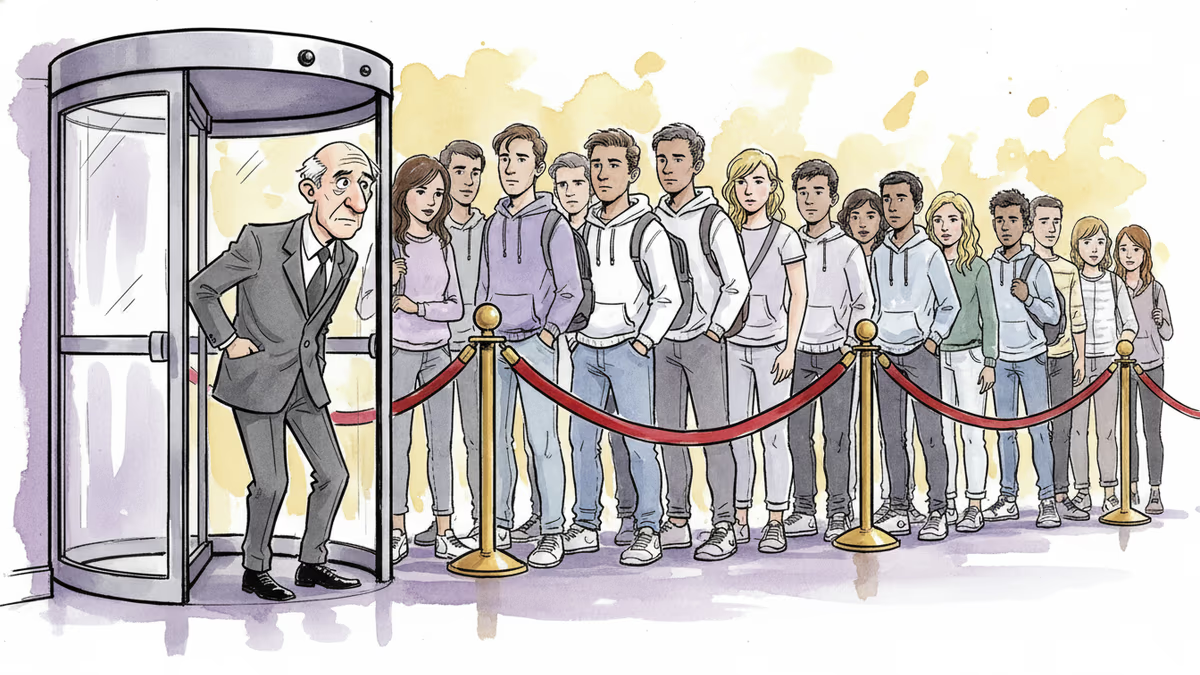
The average U.S. retirement age has climbed from 57 to well past 65. As people live longer and social bonds outside work erode, the old script for stepping away no longer holds. Here's why.
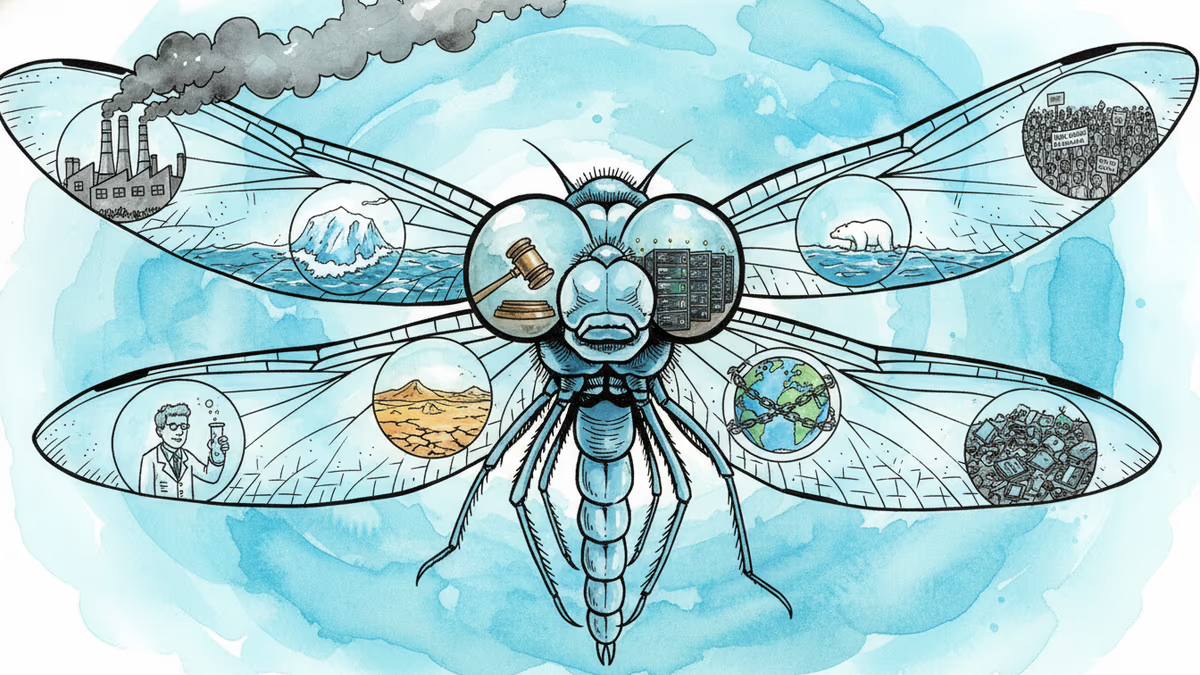
AI looks like liberation, threat, or environmental disaster depending on where you stand. A framework of nine competing narratives reveals why single-lens thinking is the real danger.
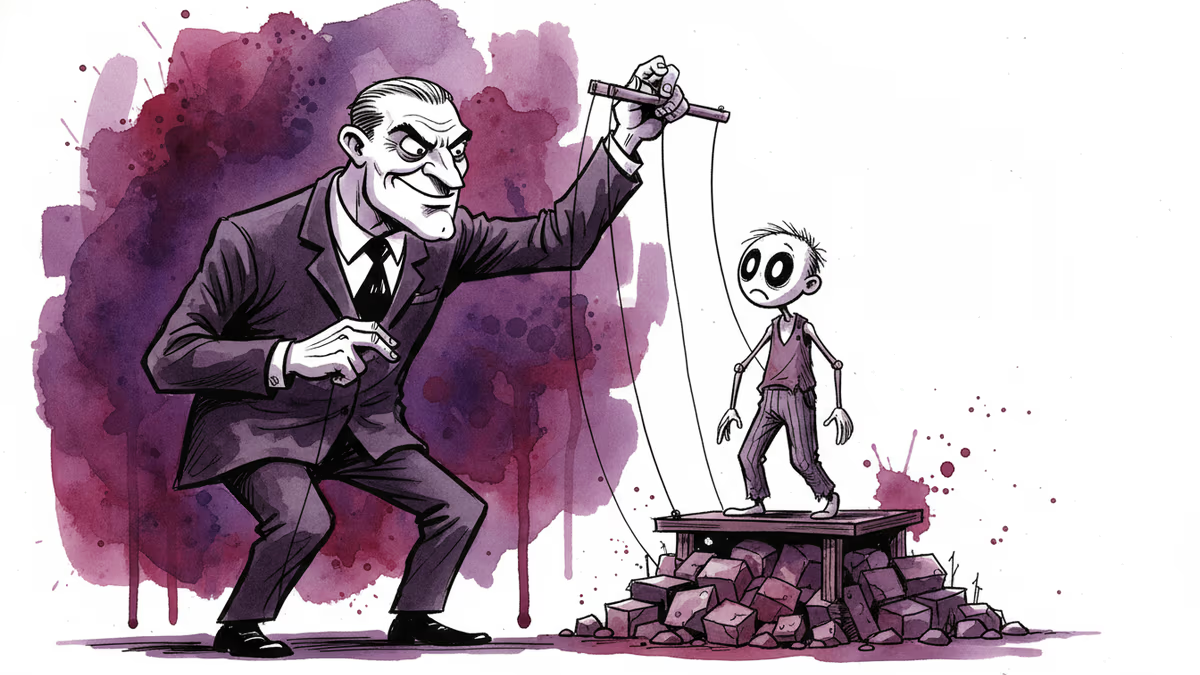
The Wizard of the Kremlin isn't really about Putin's evil. It's about the clever people who thought they could manage him—and what that says about how power actually works.
AI wearables that silently record conversations are coming. A look at the escalating battle between surveillance tech and the countermeasures trying to stop it—and why the mouse usually loses.
The average U.S. retirement age has climbed from 57 to well past 65. As people live longer and social bonds outside work erode, the old script for stepping away no longer holds. Here's why.
AI looks like liberation, threat, or environmental disaster depending on where you stand. A framework of nine competing narratives reveals why single-lens thinking is the real danger.
The Wizard of the Kremlin isn't really about Putin's evil. It's about the clever people who thought they could manage him—and what that says about how power actually works.
AI wearables that silently record conversations are coming. A look at the escalating battle between surveillance tech and the countermeasures trying to stop it—and why the mouse usually loses.
Thoughts
Share your thoughts on this article
Sign in to join the conversation