
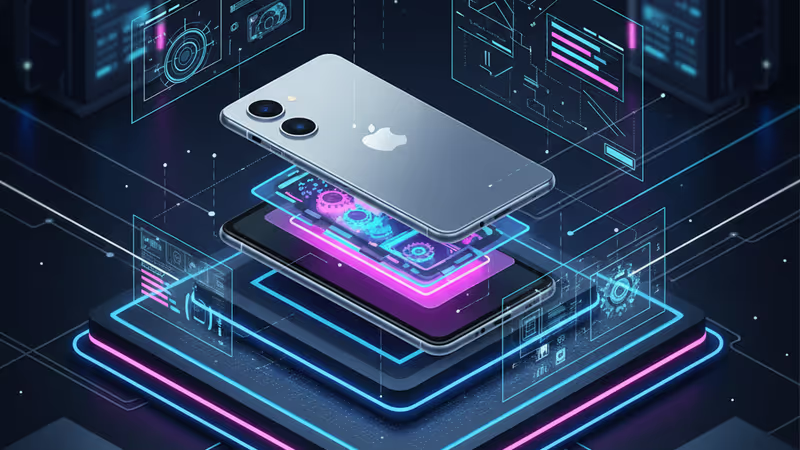
Apple's iPhone Fold: The $2,400 Delay Is a Strategic Masterstroke, Not a Mistake
Analysis: Apple's 2026 foldable iPhone faces delays and a high price. PRISM explores why this scarcity is a deliberate strategy, not a supply chain failure.
The Lede: Beyond the Hype
Executives and investors watching Apple should not interpret the rumored 2026 iPhone Fold delay and production bottlenecks as a failure. Instead, this should be viewed as a calculated, strategic entry into a new product category. Apple isn't just building a foldable phone; it's architecting a new ultra-premium tier, using scarcity and a staggering price point to manage expectations, mitigate risk, and redefine the upper limits of the smartphone market. This isn't a product launch—it's a market-shaping maneuver.
Why It Matters: Second-Order Effects
The predicted manufacturing friction for the iPhone Fold signals more than just a difficult production ramp. It reveals the immense physical and material science challenges of creating a foldable device at Apple's exacting standards. For the industry, this has several critical implications:
- Supply Chain Strain: Apple's entry will push the entire component ecosystem—from flexible OLED displays to sophisticated hinge mechanisms—to new levels of quality and scale. Companies that can meet Apple's demands will win immense contracts, while others will be left behind.
- Competitor's Clock: Samsung, Google, and others have a roughly two-year window to solidify their market lead. However, Apple’s eventual entry will validate the entire foldable category, potentially expanding the pie for everyone. The question for them becomes: can they create a deep enough moat before the tide of iOS and Apple's ecosystem arrives?
- Market Stratification: A ~$2,400 iPhone creates a new 'halo' tier, sitting well above the current Pro Max models. This will have a gravitational effect on the entire market, pulling the average selling price (ASP) of premium phones even higher and cementing the smartphone as a primary computing device worthy of a laptop-level investment.

The Analysis: The Classic Apple Playbook
This situation is pure, unadulterated Apple strategy, echoing its entries into past product categories. The company rarely pioneers a new form factor; it observes, waits for the technology and market to mature, and then enters with a product designed to define the category. The iPod wasn't the first MP3 player, and the iPhone wasn't the first smartphone. In both cases, Apple waited for key technologies (like multitouch screens and component miniaturization) to be 'ready' for a mainstream, premium experience.
The iPhone Fold delay into 2026/2027 fits this pattern perfectly. Apple is letting competitors absorb the R&D costs and user-experience pain points of the first few generations. The comparison to the iPhone 14 Pro/Max shortages is telling. Apple has experienced—and survived—scarcity launches. It understands that for a certain segment of its user base, unavailability doesn't deter demand; it amplifies it, turning the product into a status symbol. A two-year wait gives Apple time to perfect not just the hardware, but the crucial foldable-specific software experience, which remains the weakest link for many Android competitors.
- Manages Risk: It prevents a mass-market flop if the form factor has unforeseen issues.
- Builds Exclusivity: It frames the Fold as an aspirational, next-generation device for the most dedicated loyalists.
- Buys Time: It allows the manufacturing process to be perfected in a lower-volume environment before a more mainstream push in subsequent generations.
PRISM's Take: The Halo Effect
The narrative of Apple 'failing' to meet demand for the iPhone Fold is fundamentally flawed. This is a deliberate and masterful execution of market entry for a high-risk, high-reward product. The production challenges and eye-watering price are not bugs in the strategy; they are central features. Apple is not trying to sell a foldable iPhone to everyone in 2026. It is trying to sell the idea of the ultimate iPhone, a halo product so advanced and exclusive that its very existence makes the rest of the iPhone lineup feel more valuable. This isn't just about a new phone; it's about reinforcing Apple's position at the apex of technology and luxury for the next decade.
Authors
Related Articles
After 15 years of fragmented mobile messaging, Apple and Google are rolling out end-to-end encrypted RCS messaging between iPhones and Android devices. Here's what changed, why it took so long, and what it means for your privacy.
Taiwan's Thunder Tiger became the first Asian firm to win US military drone clearance with a China-free supply chain. As Trump meets Xi, the drone arithmetic reshapes defense strategy.
Apple agreed to pay $250 million to settle claims it misled iPhone 16 buyers about Apple Intelligence features. What this means for consumers, Big Tech marketing, and the AI industry.
Apple quietly removed the entry-level $599 Mac Mini, raising the starting price to $799 — just one day after Tim Cook warned of chip supply constraints on the earnings call.
After 15 years of fragmented mobile messaging, Apple and Google are rolling out end-to-end encrypted RCS messaging between iPhones and Android devices. Here's what changed, why it took so long, and what it means for your privacy.
Taiwan's Thunder Tiger became the first Asian firm to win US military drone clearance with a China-free supply chain. As Trump meets Xi, the drone arithmetic reshapes defense strategy.
Apple agreed to pay $250 million to settle claims it misled iPhone 16 buyers about Apple Intelligence features. What this means for consumers, Big Tech marketing, and the AI industry.
Apple quietly removed the entry-level $599 Mac Mini, raising the starting price to $799 — just one day after Tim Cook warned of chip supply constraints on the earnings call.
Thoughts
Share your thoughts on this article
Sign in to join the conversation