
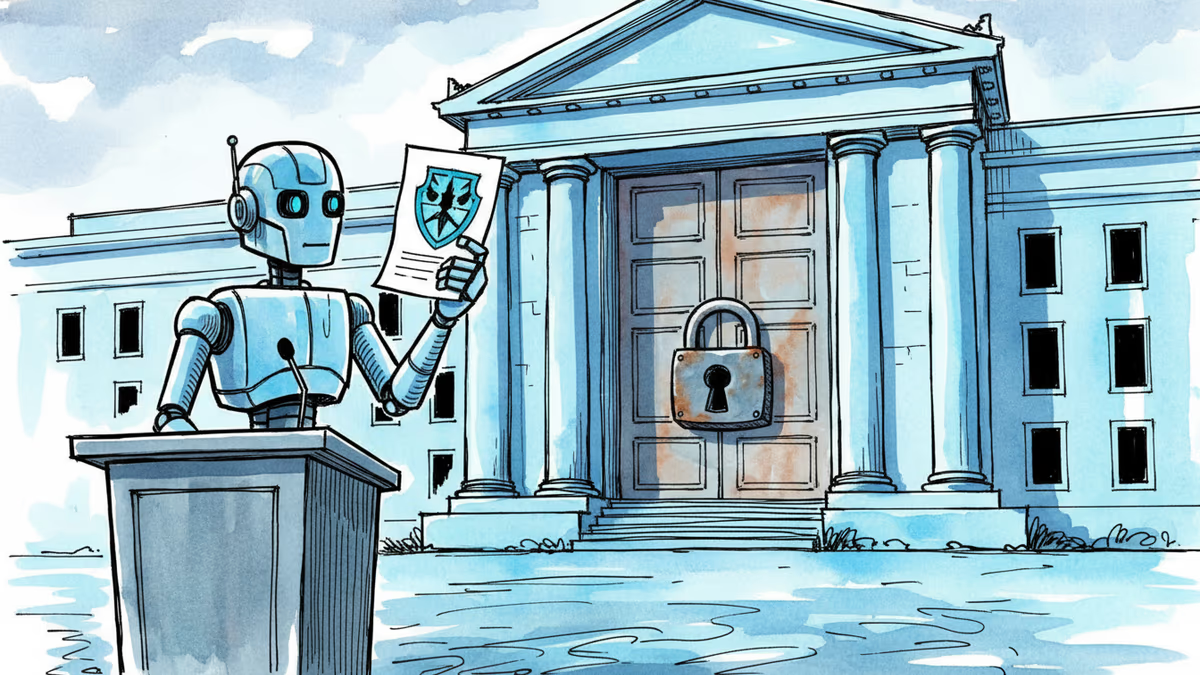
Anthropic Sued the Government for Saying No to AI Warfare
Anthropic filed suit against the Trump administration after being blacklisted for refusing to let Claude be used for autonomous warfare and mass surveillance. The First Amendment is now at the center of AI safety law.
An AI company told the Pentagon its chatbot couldn't safely run autonomous kill missions. The Pentagon agreed — then the White House blacklisted the company anyway.
What Happened
On March 9, 2026, Anthropic filed suit against the Trump administration in the US District Court for the Northern District of California. The company is challenging a government decision that has effectively cut it off from the entire US defense industrial base.
The sequence of events, as laid out in the complaint, is striking. Anthropic had been supplying its Claude AI models to the Department of War under an agreement that included two conditions: Claude could not be used for autonomous lethal warfare, and it could not be used for mass surveillance of Americans. The Department of War had accepted those terms. Then Anthropic made its position public — and said the same things openly to the government.
The response was swift. The President ordered every federal agency to "IMMEDIATELY CEASE all use of Anthropic's technology." Hours later, Secretary of War Pete Hegseth designated Anthropic a "Supply-Chain Risk to National Security" and barred any contractor, supplier, or partner doing business with the US military from conducting any commercial activity with the company.
Anthropic's lawsuit makes two distinct legal arguments. First, the company says the First Amendment protects its right to express views — publicly and to the government — about the limitations of its own AI services and about AI safety broadly. Retaliating against that speech with a blacklist, the company argues, is unconstitutional. Second, Anthropic argues the supply-chain risk designation was procedurally improper. That designation exists specifically to guard against adversaries sabotaging national security systems — not to punish a US company for its stated policy positions.
Why This Case Is Different
AI companies have been sued before. They've been regulated, fined, and hauled before Congress. But this is the first time a major AI lab has gone to court arguing that its AI safety stance is constitutionally protected speech.

The timing matters. The Trump administration has moved consistently since taking office to roll back AI safety frameworks — rescinding Biden-era executive orders, deprioritizing safety guardrails in favor of competitive positioning against China. In that context, Anthropic's insistence on usage limits reads less like corporate caution and more like political opposition. The blacklist, Anthropic argues, is the government treating it exactly that way.
The supply-chain risk designation is particularly aggressive as a legal instrument. It was designed for scenarios where a foreign adversary — say, a Chinese telecom supplier — might embed vulnerabilities in hardware or software used by the military. Applying it to an American AI company because of a policy disagreement about use cases is, legal scholars are already noting, a significant stretch of the statute's intended scope.
Three Ways to Read This
For AI developers and the industry: The outcome of this case will set the terms for every AI company navigating government contracts. If Anthropic wins, companies can legally assert ethical usage limits as protected expression. If it loses, the implicit message is clear: if you want federal business, you don't get to say no. That's a chilling effect on the entire field of AI safety research, since the companies doing that research are also the ones building the most capable systems.
For policymakers and legal professionals: The First Amendment angle is genuinely novel. Courts have extended corporate speech protections in various contexts, but applying them to a company's statements about its own product's capabilities and limitations in a government contracting context is uncharted territory. The procedural argument — that the supply-chain designation was misused — may actually be the stronger near-term legal hook, but the constitutional question is the one that will define the broader precedent.
For civil liberties advocates: Here's the uncomfortable irony. Anthropic was trying to protect Americans from mass surveillance by their own government. The company held the line, got punished for it, and is now in court. That's a private corporation acting as a check on government power — a role that, in a functioning democracy, shouldn't fall to a startup's legal team. If Anthropic hadn't taken that stand, or if it loses this case, what's the mechanism that prevents the next AI system from being deployed against civilians with no pushback at all?
What Comes Next
Anthropic will almost certainly seek a preliminary injunction to suspend the blacklist while the case proceeds. How the court rules on that motion will signal which direction this is heading. A favorable ruling would restore Anthropic's access to defense-adjacent business and send a message to the administration. An unfavorable one would leave the company locked out and potentially force a settlement.
Beyond the immediate litigation, this case puts a question in front of every AI lab with government ambitions: how much of your safety policy are you willing to defend in court? OpenAI, Google DeepMind, and others have their own usage policies. They're watching this closely.
Investors are watching too. Anthropic's valuation is built partly on its reputation as the "safety-first" AI company. A prolonged legal battle — or a loss — could complicate its next fundraising round and its positioning against competitors who've been more accommodating to government demands.
Authors
Related Articles
Anthropic shipped Claude Sonnet 5, its mid-tier agent model, on June 30. Behind the 'Opus-class power, budget price' headline sits a tokenizer catch and a three-horse race that's only half real. Here's what developers should actually run the numbers on.
A small but growing group of developers has gone all-in on AI coding agents like Claude Code and OpenClaw. History suggests the rest of us won't be far behind.
Sam Nelson, 19, died after following ChatGPT's advice to mix Kratom and Xanax. His parents are suing OpenAI for wrongful death, raising urgent questions about AI trust, liability, and design.
OpenAI's new Daybreak initiative uses the Codex AI agent to find and patch security vulnerabilities before attackers do—putting it in direct competition with Anthropic's secretive Claude Mythos.
Anthropic shipped Claude Sonnet 5, its mid-tier agent model, on June 30. Behind the 'Opus-class power, budget price' headline sits a tokenizer catch and a three-horse race that's only half real. Here's what developers should actually run the numbers on.
A small but growing group of developers has gone all-in on AI coding agents like Claude Code and OpenClaw. History suggests the rest of us won't be far behind.
Sam Nelson, 19, died after following ChatGPT's advice to mix Kratom and Xanax. His parents are suing OpenAI for wrongful death, raising urgent questions about AI trust, liability, and design.
OpenAI's new Daybreak initiative uses the Codex AI agent to find and patch security vulnerabilities before attackers do—putting it in direct competition with Anthropic's secretive Claude Mythos.
Thoughts
Share your thoughts on this article
Sign in to join the conversation