
A Shot at the Press Dinner — and the President's First Response
A gunman attacked a Secret Service checkpoint at the White House Correspondents' Dinner. Trump's first public reaction wasn't about security. It was about his $400M ballroom project.
The gunshots hadn't finished echoing before the spin began.
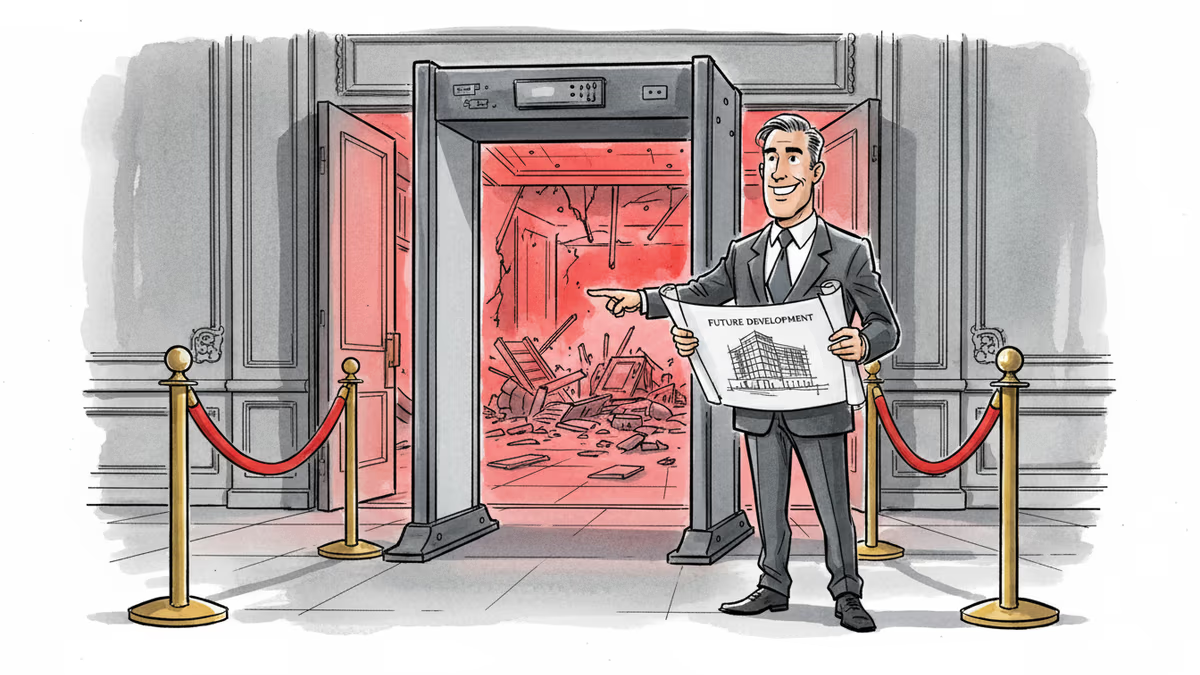
Within hours of an armed man approaching a Secret Service checkpoint at the White House Correspondents' Dinner — shotgun, handgun, and multiple knives in tow — President Trump posted to Truth Social. Not a message of reassurance. Not a call for calm. Instead: "This event would never have happened with the Militarily Top Secret Ballroom currently under construction at the White House."
The attack was real. The pivot was faster.
What Happened Saturday Night
On the evening of April 26, Cole Tomas Allen, 31, of Torrance, California, approached a Secret Service screening checkpoint at the Washington Hilton, where Trump and Vice President JD Vance were preparing to speak at the annual Correspondents' Dinner. Agents intercepted him before he reached the ballroom. Shots were fired. One agent was struck but protected by his bulletproof vest — Trump later confirmed the agent was unharmed.
The crowd inside heard the gunfire. Agents moved Trump and Vance off the stage. Metropolitan Police Department interim chief Jeffery Carroll described Allen as a "lone actor" who was taken to a hospital for psychiatric evaluation after his arrest.
Approximately 10 minutes before the shooting, Allen allegedly emailed his family what officials and the New York Post described as a manifesto. In it, the author — in language the Post read as targeting Trump — wrote that he was "no longer willing to permit a pedophile, rapist, and traitor to coat my hands with his crimes." He said he chose buckshot over slugs to "minimize casualties" but warned he would "go through most everyone here" if necessary, framing dinner guests as "complicit." He also mocked the venue's security: "I walk in with multiple weapons and not a single person there considers the possibility that I could be a threat."
Allen appeared Monday in US District Court for the District of Columbia. He faces three federal charges: attempting to assassinate the president, transporting a firearm across state lines, and discharging a firearm during a crime of violence. He was ordered held pending a detention hearing Thursday and was not asked to enter a plea.
Who Is Cole Allen?

A WIRED review of public databases paints a portrait of someone largely invisible online. Allen held a degree from Caltech in mechanical engineering and had recently completed a master's in computer science from California State University, Dominguez Hills. He tutored part-time at a test-prep company in Torrance and built indie video games on the side. No significant social media footprint. No prior public record of radicalization.
The profile raises uncomfortable questions that investigators will spend months trying to answer: Was there a detectable warning? Was there a community — online or otherwise — that shaped his thinking? Or was this, as Carroll suggested, a solitary descent?
The Political Aftershock
Before the weekend was over, Trump, Republican lawmakers, and right-wing commentators had converged on a unified message: the attack proved that Trump's $400-million, 90,000-square-foot White House ballroom — currently under construction on the demolished East Wing — should face no further legal obstacles.
That project is currently being challenged in court. The National Trust for Historic Preservation argues Trump bypassed Congress to demolish a historically significant structure. Trump's Truth Social post landed like a brief in that case.
There's a structural problem with the argument, though. The White House Correspondents' Association is an independent nonprofit — not a White House entity. It exists specifically to celebrate press freedom and scrutinize the executive branch. Whether it would ever agree to hold that event inside the president's residence is, to put it mildly, doubtful.
Three Ways to Read This
For press freedom advocates: The target wasn't random. The Correspondents' Dinner is one of the most visible annual gatherings of journalists who cover — and frequently challenge — the administration. Even if Allen's stated grievance was personal to Trump, his manifesto labeled attendees "complicit." That framing matters. The chilling effect on journalists who cover power is real, regardless of the attacker's stated motive.
For security analysts: The checkpoint held. Agents stopped Allen before he reached the ballroom — that's the system working. But Allen's own words — "I walk in with multiple weapons and not a single person there considers the possibility" — suggest the outer perimeter failed. The debate about venue is a distraction from the harder question: how did he get that far?
For legal observers: Allen is currently on a criminal complaint, not a grand jury indictment. The psychiatric evaluation ordered post-arrest could become central to how this case unfolds. Federal prosecutors will need to establish intent and mental state — both of which are complicated by the manifesto's coherent, strategic language alongside its evident breaks from reality.
Authors
Related Articles
Josh D'Amaro took over Disney with a bold Disney Plus vision. Days later, he's in a First Amendment fight with the Trump administration over The View. What does this mean for media freedom?
The Trump administration has gutted the DOJ's Voting Section, pushing out two dozen experienced lawyers and replacing them with loyalists. With 2026 midterms approaching, what does this mean for American democracy?
Hours after an armed suspect attempted to breach the White House Correspondents Dinner, Trump used the security scare to publicly defend his White House ballroom project. What does that tell us?
Dr. Erica Schwartz, a pro-vaccine physician with an unimpeachable public health résumé, is Trump's third CDC director nominee—a quiet but pointed rebuke of RFK Jr.'s agenda.
Josh D'Amaro took over Disney with a bold Disney Plus vision. Days later, he's in a First Amendment fight with the Trump administration over The View. What does this mean for media freedom?
The Trump administration has gutted the DOJ's Voting Section, pushing out two dozen experienced lawyers and replacing them with loyalists. With 2026 midterms approaching, what does this mean for American democracy?
Hours after an armed suspect attempted to breach the White House Correspondents Dinner, Trump used the security scare to publicly defend his White House ballroom project. What does that tell us?
Dr. Erica Schwartz, a pro-vaccine physician with an unimpeachable public health résumé, is Trump's third CDC director nominee—a quiet but pointed rebuke of RFK Jr.'s agenda.
Thoughts
Share your thoughts on this article
Sign in to join the conversation