
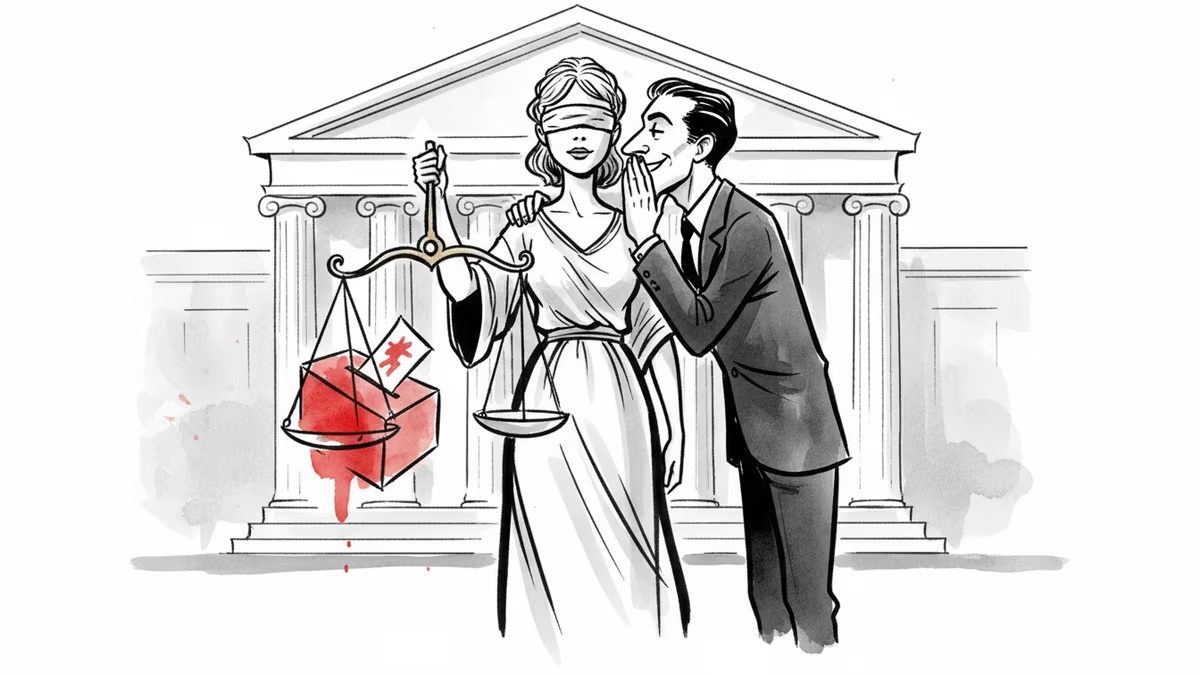
The Attorney General Shortlist Has One Thing in Common
Every leading candidate to replace fired AG Pam Bondi has a history of promoting 2020 election denial. What happens when the nation's top law enforcement officer is chosen for their willingness to contest democratic outcomes?
On a Monday afternoon conference call, Michael Flynn complained that the Justice Department had "wasted a year." John Eastman said he was "deeply troubled." A right-wing radio host claimed he'd personally texted Trump to fire the attorney general—and that it worked.
This wasn't a fringe gathering. It was a window into who may soon run the Department of Justice.
Last week, Trump fired Attorney General Pam Bondi. The criticism from her own side wasn't that she'd gone too far—it was that she hadn't gone far enough. "Pam Bondi was terrible," said Wayne Root, a conservative radio host, on the call. "No arrests of terrible Deep State and Democrat thieves." Now, as Trump selects her replacement, the names circulating share a striking credential: each has a documented history of promoting the false claim that the 2020 election was stolen.
The Shortlist
The frontrunner is Todd Blanche, currently serving as acting AG. Before that, he was Trump's personal defense attorney—handling the Stormy Daniels case, the classified documents charges, and the federal election obstruction case. At last month's Conservative Political Action Conference, Blanche floated deploying ICE agents to polling stations in the 2026 midterms. "Illegals can't vote," he said. "Why is there objection?" A 2017 study found noncitizen voting accounted for 0.0001% of ballots cast across a dozen states in 2016. Blanche has also championed building a national voter database—a project currently being fought in courts by multiple states.
Lee Zeldin, administrator of the EPA, is the other name most frequently mentioned. On January 6, 2021—hours after the Capitol riot—Zeldin voted against certifying election results in Arizona and Pennsylvania, calling the process "unlawful and unconstitutional." He also signed an amicus brief backing Trump's Supreme Court lawsuit to overturn Biden's victory. In 2022, his own gubernatorial campaign had more than 13,000 petition signatures thrown out for being duplicates.
Further down the list: Jeanine Pirro, the former Fox News host who spread 2020 election conspiracies so aggressively that Dominion Voting Systems cited her broadcasts in its defamation lawsuit against the network—a case Fox settled for $787 million. Texas AG Ken Paxton, who sued four states to overturn their 2020 results and has since been accused of targeting Latino voter registration drives. Senator Eric Schmitt, who recruited 16 state attorneys general to join Paxton's Supreme Court challenge. And Senator Mike Lee, a vocal supporter of the SAVE America Act, legislation critics say would disenfranchise tens of millions of voters.
None of them responded to requests for comment.

What They Actually Want
The Monday call made the agenda explicit. Joe Hoft of the Gateway Pundit told listeners that whoever becomes attorney general must ensure Republicans win the 2026 midterms. "Everything, all our effort, needs to be on this election process," he said.
This is worth sitting with. The position being discussed—the nation's top law enforcement officer, who oversees federal election law—is being evaluated, by some of its most vocal advocates, on the basis of whether the appointee will help one party win future elections.
Eastman, architect of the legal strategy to keep Trump in power after 2020, said on the call that the DOJ's failure to investigate voting machine conspiracy theories was evidence of sabotage from within. Flynn called career department employees "Deep State goop."
The Department Has Already Changed
It would be a mistake to treat this as purely forward-looking. The DOJ has already moved. The voting section of the Civil Rights Division—built over decades by career lawyers with deep expertise in election law—has been hollowed out. Experienced attorneys have been replaced with Trump loyalists who have themselves spread election conspiracies. The department has filed dozens of lawsuits demanding states hand over unredacted voter rolls.
The Constitution assigns election administration to states and Congress, not the executive branch. But when the federal government deploys immigration enforcement at polling places, assembles a national voter database, and litigates selectively against jurisdictions it dislikes, the constitutional boundary becomes, in practice, negotiable.
The Argument on the Other Side
To be fair, supporters of these candidates would argue that election integrity is a legitimate concern, that the DOJ has historically been politicized in both directions, and that restoring confidence in elections—even if the methods are contested—serves a democratic purpose. Blanche and others would likely say they're not undermining elections; they're protecting them.
That argument has a floor, though. When the specific claims driving DOJ action—widespread noncitizen voting, rigged machines, stolen results—have been repeatedly examined and found to be false, the question shifts from intent to effect. An institution that acts on false premises, however sincerely held, still produces outcomes shaped by those premises.
Authors
Related Articles
Josh D'Amaro took over Disney with a bold Disney Plus vision. Days later, he's in a First Amendment fight with the Trump administration over The View. What does this mean for media freedom?
AI is reshaping how citizens know, act, and deliberate together. Three researchers argue democracy's infrastructure wasn't built for this—and the design choices are already being made.
The Trump administration has gutted the DOJ's Voting Section, pushing out two dozen experienced lawyers and replacing them with loyalists. With 2026 midterms approaching, what does this mean for American democracy?
A gunman attacked a Secret Service checkpoint at the White House Correspondents' Dinner. Trump's first public reaction wasn't about security. It was about his $400M ballroom project.
Josh D'Amaro took over Disney with a bold Disney Plus vision. Days later, he's in a First Amendment fight with the Trump administration over The View. What does this mean for media freedom?
AI is reshaping how citizens know, act, and deliberate together. Three researchers argue democracy's infrastructure wasn't built for this—and the design choices are already being made.
The Trump administration has gutted the DOJ's Voting Section, pushing out two dozen experienced lawyers and replacing them with loyalists. With 2026 midterms approaching, what does this mean for American democracy?
A gunman attacked a Secret Service checkpoint at the White House Correspondents' Dinner. Trump's first public reaction wasn't about security. It was about his $400M ballroom project.
Thoughts
Share your thoughts on this article
Sign in to join the conversation