
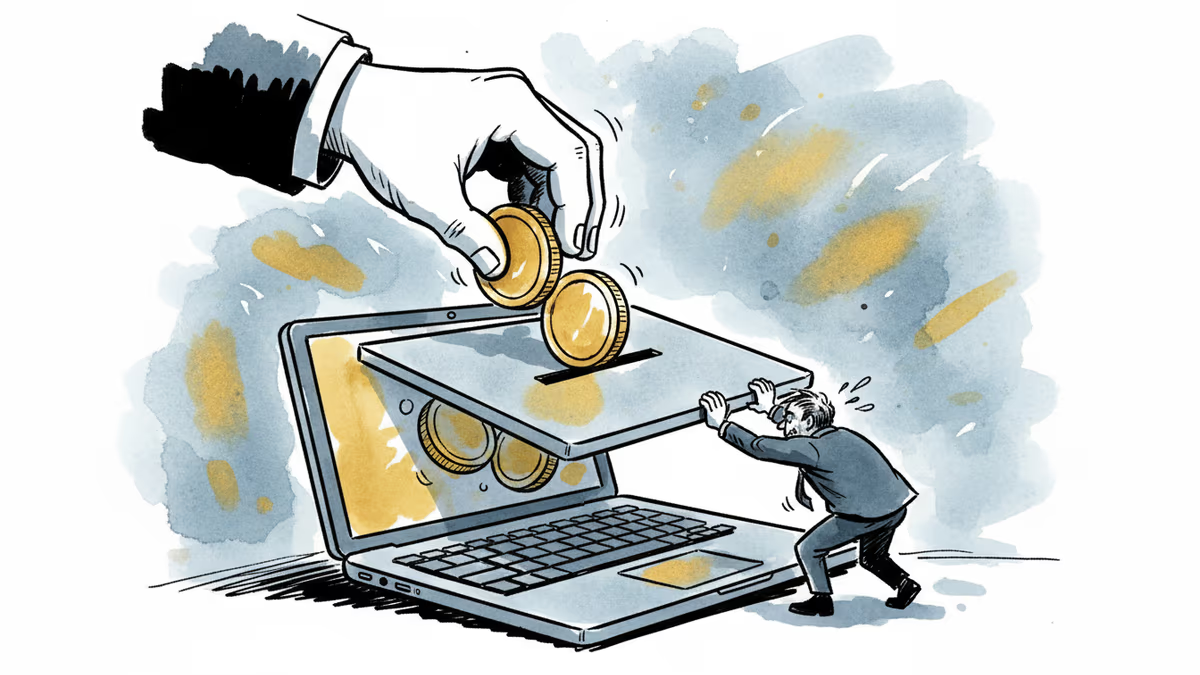
Silicon Valley's Billionaires Are Buying a Congressional Seat
In CA-17, tech founder Ethan Agarwal is challenging five-term incumbent Ro Khanna — backed by billionaires opposed to a wealth tax. It's already getting dirty.
The primary isn't until June. The anonymous smear packages are already in the mail.
In California's 17th congressional district — the heart of Silicon Valley, home to Apple's headquarters — a race that shouldn't be competitive is suddenly very much one. Five-term incumbent Ro Khanna is facing Ethan Agarwal, a tech founder who entered the race in March, bankrolled by a who's-who of tech billionaires. And in the past week, newsrooms covering the race have started receiving anonymous envelopes stuffed with court documents detailing Agarwal's legal past.
Welcome to the future of tech-money politics.
How This Fight Started
The origin story is almost too on-the-nose. Khanna publicly backed a proposed California ballot measure that would impose a one-time 5% tax on residents worth more than $1 billion. That was enough. Within weeks, Agarwal had announced his candidacy, and a roster of prominent tech investors — including Chamath Palihapitiya — had lined up behind him.
Agarwal came out swinging first, going after Khanna over stock trades made while in office — a line of attack that has become standard-issue in congressional races, but lands differently when your opponent represents the district where those companies are headquartered.
Then the packages arrived.
What Was in the Envelopes
The anonymous file contained three legal matters. Their weight varies considerably.
The most substantive: a copyright dispute with Universal Music Group. Agarwal's company Aaptiv — a workout app that paired audio coaching with licensed music — was accused of using UMG's recordings without permission. The parties reached a $2 million settlement, which Agarwal personally guaranteed. He then stopped making payments with three months left to go. A $683,000 personal judgment followed. The two sides eventually brokered a second settlement. This one has teeth.
The second item: a nearly $2 million landlord lawsuit tied to Aaptiv's One World Trade Center office, filed in 2023 after Aaptiv walked away from its lease during COVID. That case was later dropped.
The third: a 2019 federal lawsuit alleging adult content was downloaded from Agarwal's IP address. The plaintiff, Malibu Media, filed thousands of nearly identical suits against IP addresses across the country and was widely condemned as a legal shakedown operation. The case settled without any court finding of liability.

Two of the three items are, in context, weak. One isn't.
Agarwal's Move: Get Ahead of It
What's notable is how Agarwal handled the rollout. When the New York Post ran the headline "Silicon Valley tech candidate was sued for downloading lots of porn," Agarwal didn't go quiet. He shared the article himself, writing:
"I think transparency and authenticity is important among political candidates. We're people. We're not perfect. Yes, this is embarrassing. But now you know my worst thing."
Palihapitiya followed almost immediately, tweeting at Agarwal: "The opposition research has started on you because you may win and Ro is starting to get worried."
It was a calculated move — own the embarrassing story before it owns you, and reframe the attack as evidence you're a threat. Whether voters buy it is another question.
The Bigger Game
Zoom out and the structure of this race is striking. A group of billionaires who would be directly subject to a proposed wealth tax is funding a candidate whose explicit purpose is to unseat the legislator who supported it. The mechanism is legal. The intent is transparent. And it raises a question that goes well beyond CA-17.
This isn't the first time tech money has tried to reshape electoral politics — Elon Musk's involvement in the 2024 election cycle made that abundantly clear. But there's something more targeted about this race. It's not ideological in the broad sense. It's transactional: back a candidate who will oppose the specific policy that costs you money.
For tech industry observers, the campaign also functions as a stress test. Can a well-funded outsider with a messy legal history beat a five-term incumbent in a district where name recognition matters? If Agarwal wins, expect the playbook to be replicated.
The Stakeholders Don't Agree on What This Is
Khanna's camp hasn't commented on the anonymous packages. They don't need to — the documents are public record. Someone just organized and distributed them. The question of who did that is unanswered.
Agarwal's backers are framing the opposition research as proof of momentum. Palihapitiya's tweet was a signal to donors: this race is real, keep writing checks.
Voters in CA-17 — a district that skews educated, tech-adjacent, and Democratic — will have to weigh a candidate whose financial track record includes a broken personal guarantee against an incumbent whose stock trades have drawn scrutiny. Neither is a clean story.
Policymakers watching from outside California are tracking something else entirely: whether a wealth tax can even survive the political pressure that comes the moment it's proposed. If Khanna loses his seat over this, the chilling effect on similar proposals elsewhere could be significant.
Authors
Related Articles
Indian venture capital has quietly displaced Silicon Valley in its own backyard. Only one American VC made India's top 10 investor list last year. Here's why that matters beyond India.
After two weeks of witnesses calling him a liar, OpenAI CEO Sam Altman testified in his own defense, claiming Elon Musk tried to kill the company twice.
The Trump administration has gutted the DOJ's Voting Section, pushing out two dozen experienced lawyers and replacing them with loyalists. With 2026 midterms approaching, what does this mean for American democracy?
A gunman attacked a Secret Service checkpoint at the White House Correspondents' Dinner. Trump's first public reaction wasn't about security. It was about his $400M ballroom project.
Indian venture capital has quietly displaced Silicon Valley in its own backyard. Only one American VC made India's top 10 investor list last year. Here's why that matters beyond India.
After two weeks of witnesses calling him a liar, OpenAI CEO Sam Altman testified in his own defense, claiming Elon Musk tried to kill the company twice.
The Trump administration has gutted the DOJ's Voting Section, pushing out two dozen experienced lawyers and replacing them with loyalists. With 2026 midterms approaching, what does this mean for American democracy?
A gunman attacked a Secret Service checkpoint at the White House Correspondents' Dinner. Trump's first public reaction wasn't about security. It was about his $400M ballroom project.
Thoughts
Share your thoughts on this article
Sign in to join the conversation