
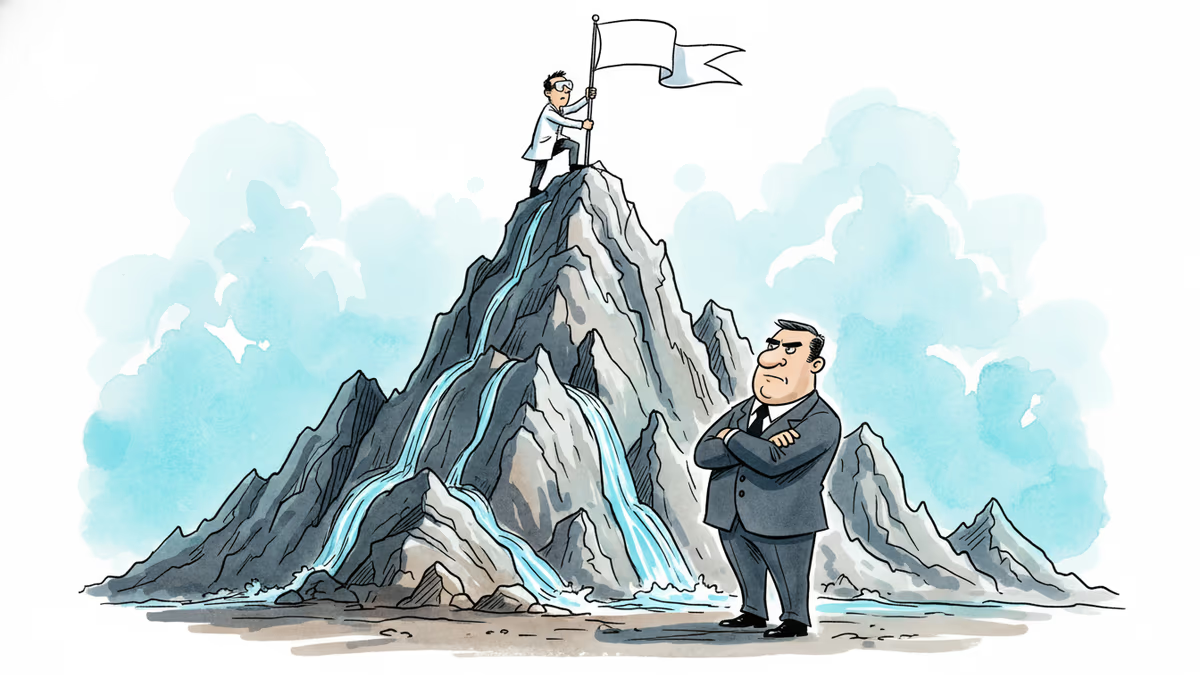
Anthropic Fought the Pentagon — and Its Subscriber Count Won
Claude's paid subscriptions more than doubled in early 2026 as Anthropic's DoD standoff and Super Bowl ads drove record consumer sign-ups. Here's what the data actually shows.
Can refusing a government contract be a growth strategy? Anthropic's early 2026 numbers suggest the answer might be yes.
What the Data Actually Shows
An analysis of billions of anonymized credit card transactions from roughly 28 million U.S. consumers, conducted by consumer transaction firm Indagari for TechCrunch, shows Claude signing up paid subscribers at a record pace. Anthropic confirmed to TechCrunch that paid subscriptions have more than doubled so far this year. New subscriber acquisition hit an all-time high between January and February. Lapsed users returning to the platform also reached a record in February.
A few caveats matter here. The dataset doesn't capture every consumer, can't calculate Anthropic's total user base, and excludes Claude's enterprise business — which is where most of the revenue actually lives. Free-tier users aren't counted either. Public estimates for total Claude users range widely, from 18 million to 30 million, and Anthropic hasn't disclosed the real figure. What the data can tell us is directional momentum — and the direction is sharply upward.
The majority of new sign-ups are at the $20/month Pro tier, not the $100 or $200 premium plans. These are consumers dipping a toe in, not power users doubling down.
Two Events, One Surge
The timing of the spike points to two distinct catalysts running in parallel.
The first was a Super Bowl ad campaign that openly mocked OpenAI's decision to run ads for its users — and promised Claude never would. The spots were sharp enough to visibly irritate OpenAI CEO Sam Altman, which, in internet terms, is its own form of free publicity.
The second, and more consequential, was Anthropic's escalating public standoff with the Department of Defense. Starting in late January, major outlets including the Wall Street Journal and Axios reported that Anthropic had refused to allow the DoD to use its models for lethal autonomous operations — AI-assisted killing decisions — or mass surveillance of American citizens. The DoD pushed back hard, threatening to label Anthropic a supply risk to its business. It followed through on that threat. Lawsuits followed. A federal judge this week temporarily blocked the designation.

CEO Dario Amodei issued a firm public statement on February 26. Plot the new subscriber curve against the timeline, and the steepest climb falls almost exactly between those late-January media reports and Amodei's statement. The louder the fight got, the more people opened their wallets.
Beyond the Drama: The Product Story
It would be too easy to credit the growth entirely to controversy. Claude Code and Claude Cowork — developer and productivity tools launched in January — drove meaningful subscription conversions on their own. Computer Use, released this week, allows Claude to navigate a computer independently: clicking, scrolling, executing tasks autonomously. It works alongside Dispatch, which lets users assign tasks directly from their phones. Both features are paywalled. Anthropic says Computer Use has already triggered another subscriber spike.
The product suite is maturing in ways that give paying users tangible reasons to stay.
The Uncomfortable Comparison
Here's the part that complicates the narrative: OpenAI is still winning.
When OpenAI announced its own DoD contract — the move that stood in direct contrast to Anthropic's refusal — app uninstalls spiked. The backlash was real and measurable. But Indagari's data shows OpenAI continuing to add paid subscribers at a rapid clip. It remains the dominant consumer AI platform by a significant margin. Anthropic's growth is notable. The gap is still large.
The consumer AI market may be splitting into two camps: those who choose based on capability and familiarity, and those who choose based on perceived values alignment. The first group is still much bigger.
Three Ways to Read This
For investors, the signal is that brand differentiation in AI is becoming real and monetizable — but Anthropic's enterprise business, not its consumer subscriptions, is where the financial weight sits. Consumer growth is a leading indicator of brand health, not a revenue story yet.
For competitors, the uncomfortable question is whether OpenAI's ad-supported model announcement handed Anthropic a gift. A single product decision became the premise of a national ad campaign that framed the entire competitive landscape as a values choice.
For regulators and policymakers, the episode is a preview. As AI companies embed deeper into government and defense infrastructure, the question of where a private company's ethical limits lie — and who enforces them — is no longer theoretical.
Authors
Related Articles
Anthropic shipped Claude Sonnet 5, its mid-tier agent model, on June 30. Behind the 'Opus-class power, budget price' headline sits a tokenizer catch and a three-horse race that's only half real. Here's what developers should actually run the numbers on.
Samsung and SK unveiled a chip and AI investment package worth thousands of trillions of won on June 29. The headline number swings wildly by outlet, but the real contest isn't capital — it's water and power.
A small but growing group of developers has gone all-in on AI coding agents like Claude Code and OpenClaw. History suggests the rest of us won't be far behind.
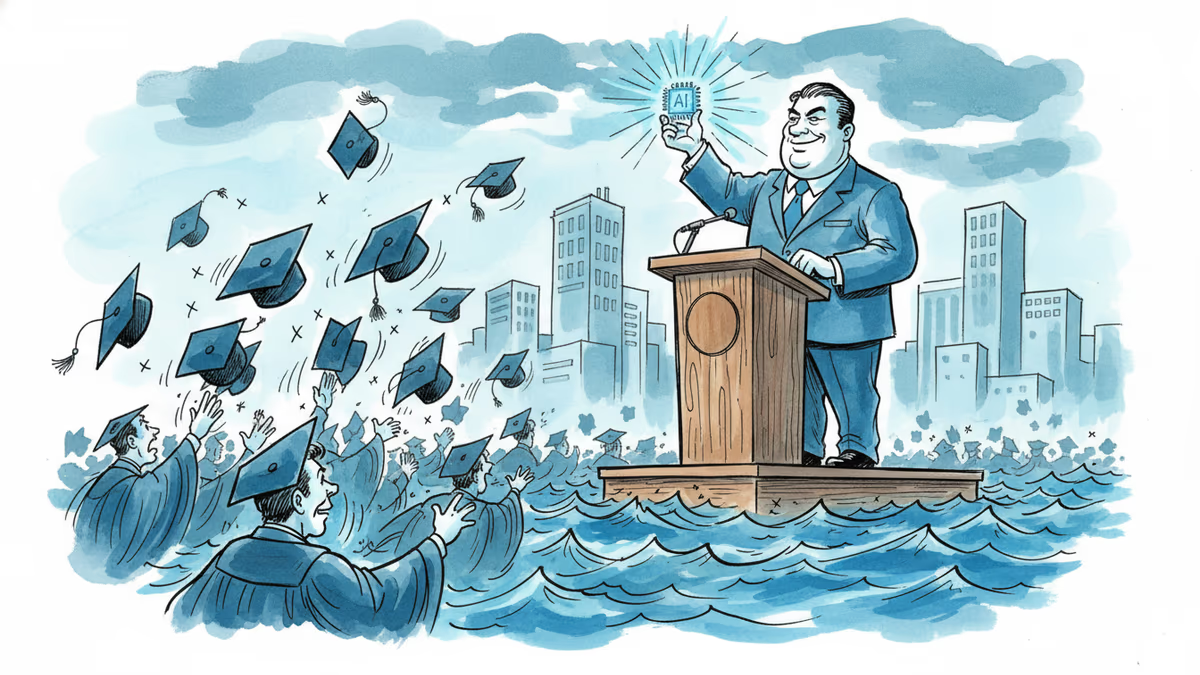
Viral videos show 2026 graduates jeering executives who praise AI at commencement ceremonies. It's not just rudeness — it's a signal about who pays for technological optimism.
Anthropic shipped Claude Sonnet 5, its mid-tier agent model, on June 30. Behind the 'Opus-class power, budget price' headline sits a tokenizer catch and a three-horse race that's only half real. Here's what developers should actually run the numbers on.
Samsung and SK unveiled a chip and AI investment package worth thousands of trillions of won on June 29. The headline number swings wildly by outlet, but the real contest isn't capital — it's water and power.
A small but growing group of developers has gone all-in on AI coding agents like Claude Code and OpenClaw. History suggests the rest of us won't be far behind.
Viral videos show 2026 graduates jeering executives who praise AI at commencement ceremonies. It's not just rudeness — it's a signal about who pays for technological optimism.
Thoughts
Share your thoughts on this article
Sign in to join the conversation