
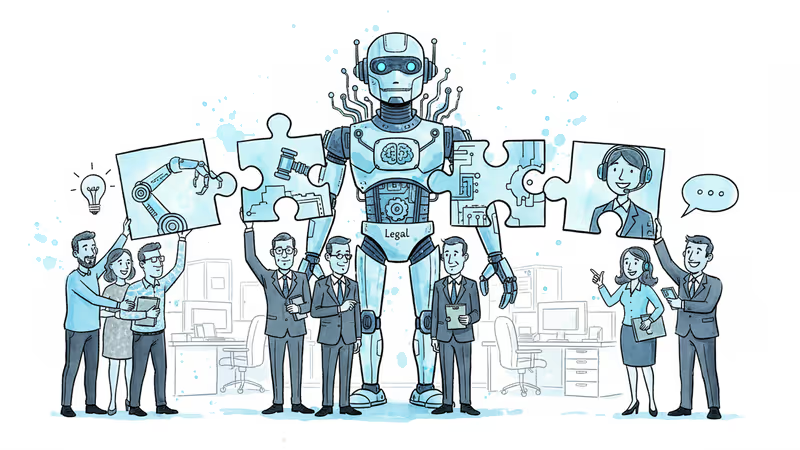
AI Plugins Are Democratizing Workplace Automation
Anthropic's new Cowork plugins let non-coders automate specialized tasks across departments. From marketing to legal, anyone can now build custom AI tools without technical expertise.
What if your marketing team could build their own AI content generator, or your legal department could automate contract risk reviews—all without writing a single line of code?
That's exactly what Anthropic is making possible with the launch of plugins for Cowork, expanding beyond its developer-focused Claude Code to serve everyday business users. The company released 11 open-source plugins this month, promising that custom automation tools are now "easy to build, edit, and share" without technical expertise.
Beyond Generic AI: Department-Specific Intelligence
The plugin approach represents a shift from one-size-fits-all AI to specialized automation. Instead of generic chatbots, companies can now create focused tools: marketing teams drafting brand-consistent content, legal teams reviewing document risks, customer support generating personalized responses.
Matt Piccolella from Anthropic's product team told TechCrunch that enterprise users are expected to create "bespoke use-cases" tailored to their specific workflows. The company has already seen promising results internally, particularly in sales where plugins help teams stay "better connected to the customer and customer feedback."
What makes this significant isn't just the technology—it's the accessibility. These aren't tools requiring months of developer time and six-figure budgets. They're designed for the marketing manager who understands brand voice, or the HR specialist who knows hiring workflows.
The Learning Loop Advantage

Anthropic reveals an intriguing detail: the more enterprise users utilize plugins, the better Claude understands company workflows and optimizes them. This creates a learning loop where AI becomes increasingly valuable over time, essentially building institutional knowledge.
Currently, plugins save locally to individual machines, but Anthropic is developing organization-wide sharing capabilities. This evolution from personal productivity tools to enterprise-wide intelligence systems could fundamentally change how companies standardize and scale their operations.
The Democratization Question
While Cowork remains in research preview just two weeks after launch, plugins are available to all paying Claude customers. This rapid expansion raises important questions about the democratization of AI tools.
On one hand, lowering technical barriers means smaller companies can compete with enterprise-level automation. A startup's customer service team could potentially match the consistency of a Fortune 500 company's support system.
On the other hand, this accessibility might create new forms of competitive pressure. Companies that fail to adopt these tools quickly could find themselves at a significant operational disadvantage, not because they lack technical resources, but because they lack the organizational insight to identify automation opportunities.
Beyond the Hype: Real Workflow Integration
What distinguishes Anthropic's approach from typical AI marketing is the focus on workflow integration rather than revolutionary capabilities. These plugins aren't promising to replace human workers—they're designed to amplify existing expertise and standardize best practices.
The real test will be adoption patterns across different industries and company sizes. Will plugins become essential infrastructure, like email or project management tools? Or will they remain niche productivity enhancers for early adopters?
Authors
Related Articles
Anthropic shipped Claude Sonnet 5, its mid-tier agent model, on June 30. Behind the 'Opus-class power, budget price' headline sits a tokenizer catch and a three-horse race that's only half real. Here's what developers should actually run the numbers on.
Samsung and SK unveiled a chip and AI investment package worth thousands of trillions of won on June 29. The headline number swings wildly by outlet, but the real contest isn't capital — it's water and power.

A small but growing group of developers has gone all-in on AI coding agents like Claude Code and OpenClaw. History suggests the rest of us won't be far behind.

Viral videos show 2026 graduates jeering executives who praise AI at commencement ceremonies. It's not just rudeness — it's a signal about who pays for technological optimism.
Anthropic shipped Claude Sonnet 5, its mid-tier agent model, on June 30. Behind the 'Opus-class power, budget price' headline sits a tokenizer catch and a three-horse race that's only half real. Here's what developers should actually run the numbers on.
Samsung and SK unveiled a chip and AI investment package worth thousands of trillions of won on June 29. The headline number swings wildly by outlet, but the real contest isn't capital — it's water and power.
A small but growing group of developers has gone all-in on AI coding agents like Claude Code and OpenClaw. History suggests the rest of us won't be far behind.
Viral videos show 2026 graduates jeering executives who praise AI at commencement ceremonies. It's not just rudeness — it's a signal about who pays for technological optimism.
Thoughts
Share your thoughts on this article
Sign in to join the conversation