
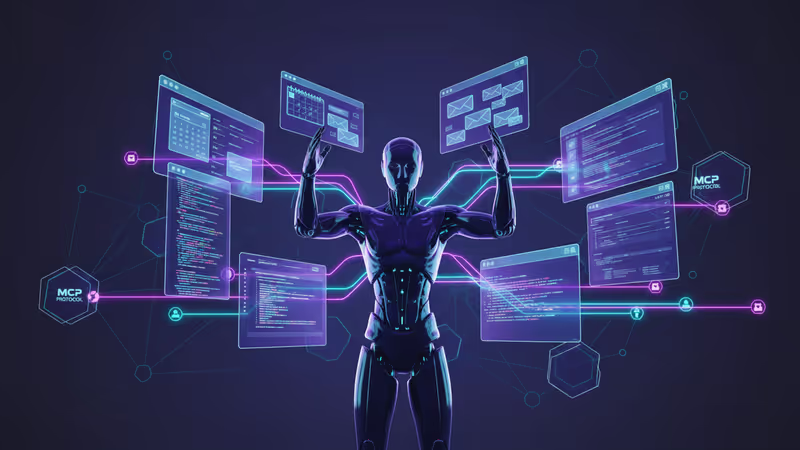
AI Agents: The Protagonists of 2025
1. Chatbot vs. Agent: The Critical Difference
Ask ChatGPT or Claude to "schedule a meeting," and you'll get a response like this:
"To schedule a meeting, you'll need to check participants' availability in your calendar app, select an appropriate time, and send invitation emails."
Excellent advice. But it doesn't actually do it for you. That's a chatbot.
Ask an AI agent the same thing, and here's what happens:
- Accesses your calendar to check participants' schedules
- Finds a time when everyone is available
- Checks the room booking system for availability
- Creates the meeting and sends invitation emails to attendees
- "I've scheduled a meeting for April 15 at 2 PM in Conference Room A on the 3rd floor."
Responding with action, not just words—that's the essence of an AI agent.
Key Differences
| Aspect | Chatbot | AI Agent |
|---|---|---|
| Output | Text responses | Actual task execution |
| Tool Usage | None or limited | Integration with various external systems |
| Autonomy | Only reacts to questions | Plans and executes toward goals independently |
| State Management | Remembers only conversation context | Tracks long-term task states |
| Decision Making | Delegates to user | Executes after making own judgments |
IBM AI researcher Maryam Ashoori defines it this way: "A true AI agent is an intelligent entity equipped with reasoning and planning capabilities that can act autonomously."
2. Why 2025 Is "The Year of the Agent"
In 2025, interest in AI agents exploded. This isn't mere marketing hype—technology and markets have crossed a critical threshold.
The Agent Era in Numbers
- 62% of enterprises are experimenting with or deploying AI agents (McKinsey)
- 99% of enterprise AI developers are exploring or building agents (IBM survey)
- $7.38 billion — 2025 AI agent market size (doubled from $3.7B in 2023)
- $103.6 billion — Projected 2032 market size (45.3% CAGR)
Why Now?
First, LLM reasoning capabilities leaped forward. Reasoning models like OpenAI o1 and DeepSeek R1 emerged, enabling AI to solve complex problems step-by-step beyond simple responses. The agent's "brain" was upgraded.
Second, tool integration standards were established. MCP (Model Context Protocol), announced by Anthropic in November 2024, became an industry standard within one year. AI gained a "common language" for communicating with external systems.
Third, practical use cases proved the concept. Coding agents like Cursor and Claude Code dramatically improved real development productivity. They demonstrated that "agents actually work."
According to Gartner's forecast, 40% of enterprise applications will integrate task-specific AI agents by 2026—a surge from under 5% in 2025.
3. MCP: The Common Language of AI Agents
For AI agents to be truly useful, they must integrate with external systems: calendars, email, databases, APIs... The problem was that connecting all of these required building custom connectors for each one.
Anthropic created MCP (Model Context Protocol) to solve this problem.
What Is MCP?
MCP is an open standard protocol for connecting AI models to external tools, data sources, and systems. Once developers build an MCP server, any AI client can use that tool.
Think of it like USB. Before USB, printers, mice, and keyboards each needed different ports. Once USB became standard, all devices connected through a single port. MCP is the USB of the AI world.
Explosive Growth
Announced in November 2024, MCP achieved remarkable growth in just one year:
- Thousands of MCP servers developed by the community
- 97 million+ monthly SDK downloads (Python, TypeScript)
- Official adoption by OpenAI, Google DeepMind, Microsoft
- Donated to the Linux Foundation's Agentic AI Foundation in December 2025
OpenAI's adoption of MCP in March 2025 was particularly pivotal—a rare case of the entire industry accepting a competitor's protocol as standard.
What MCP Enables
| Domain | Use Case Examples |
|---|---|
| Development Tools | Cursor, Replit, Sourcegraph connect AI to codebases via MCP |
| Enterprise Systems | Integration with Google Drive, Slack, Salesforce, GitHub |
| Databases | Natural language queries to PostgreSQL, MongoDB, etc. |
| Automation | Integration of workflow builders (n8n, etc.) with agents |
4. Agents That Actually Work
Enough theory. What AI agents are actually functioning today?
Coding Agents
The most mature agent category in 2025.
| Service | Features |
|---|---|
| Claude Code | Anthropic's CLI agent. Autonomously writes, refactors, and debugs code. 80.9% on SWE-bench |
| Cursor | AI-native code editor. Agent mode enables full feature implementation |
| GitHub Copilot | VS Code integration. Increasingly agentic features being added |
| OpenAI Codex | Asynchronous coding agent. Performs tasks in the background |
Coding agents have moved beyond simple autocomplete. Say "fix this bug," and they analyze code, diagnose problems, make fixes, and run tests.
Computer Use Agents
Agents that operate computers like humans do.

| Service | Features |
|---|---|
| Anthropic Computer Use | Claude views screenshots and controls mouse/keyboard |
| OpenAI Operator | Navigates websites to perform multi-step tasks like bookings and orders |
Operator handles tasks like food ordering, flight booking, and form filling. However, sensitive operations like payments and logins still require human intervention.
Research Agents
Automate information gathering and analysis.
| Service | Features |
|---|---|
| Perplexity | AI-powered search + deep research capabilities |
| ChatGPT Deep Research | Analyzes dozens of sources to generate comprehensive reports |
| Gemini Deep Research | Automatically generates research reports up to 48 pages |
Customer Service Agents
Gartner forecasts that 80% of customer service issues will be resolved by AI agents without human intervention by 2029.
5. The Rise of Agentic Browsers
From mid-2025, a new trend emerged: Agentic Browsers. These integrate AI agents directly into web browsers, navigating the web and performing tasks on behalf of users.
Major Agentic Browsers
| Browser | Developer | Features |
|---|---|---|
| Comet | Perplexity | Chromium-based. Automates email management, shopping, travel planning |
| Operator-integrated Browser | OpenAI | In development. Will integrate Operator agent with ChatGPT |
| Dia | Browser Company (Arc) | AI-native browser. Understands user context |
| Opera Neon | Opera | Built-in AI assistant that takes actions on user's behalf |
| Project Mariner | Gemini 2.0-based. Runs AI agents in Chrome |
Perplexity Comet Case Study
Released in late 2025, Comet positions itself as an "AI-native browser."
- Perplexity assistant resides in the left sidebar
- Understands context from open tabs and incorporates it into conversations
- Agent Mode: Performs complex tasks like "Find the cheapest noise-canceling headphones on Amazon and add them to my cart"
- Voice command support
According to an IBM Think review, Comet is showing "demand reminiscent of the early Gmail launch."
Security Concerns
However, agentic browsers present serious security risks. In August 2025, Brave Software discovered an indirect prompt injection vulnerability in Comet. Malicious web pages could manipulate the AI agent through hidden instructions.
Because AI agents can access multiple sites with user privileges, traditional web security measures (same-origin policy, etc.) can be rendered ineffective. Browser vendors are scrambling to address these issues.
6. How Enterprises Are Adopting Agents
Adoption Status
According to Deloitte, 25% of enterprises using generative AI started agentic AI pilots in 2025, with projections to reach 50% by 2027.
Current most active areas for agent AI adoption:
| Rank | Domain | Use Cases |
|---|---|---|
| 1 | IT/Development | Code refactoring, automated testing, bug fixes |
| 2 | Customer Service | Ticket classification, automated responses, issue resolution |
| 3 | Marketing | Content generation, A/B test automation |
| 4 | Sales | Lead scoring, email automation |
| 5 | Finance/Legal | Contract review, compliance monitoring |
Adoption Strategy
Experts recommend a phased approach:
- Start with low-risk use cases: Pilot in areas without critical data
- Human-on-the-loop: Structure where humans review after agent decisions
- Gradual autonomy expansion: Grant more authority as trust builds
- Governance framework: Clearly define agent action scope and permissions
ROI?
According to a Superhuman report, early-adopting companies experienced 40% reduction in operational costs and significant improvement in customer satisfaction. However, most enterprises are still in pilot stages, making comprehensive ROI measurement premature.
7. Risks and Limitations to Know
AI agents are powerful, but many challenges remain unsolved.
Hallucination Propagation
When agents act on false information, real damage occurs. Chatbot hallucinations are just "wrong answers," but agent hallucinations can lead to "incorrect orders," "wrong reservations," or "deleting files that shouldn't be deleted."
More seriously, hallucinations can propagate in multi-agent systems. One agent's error passes to others, causing cascading mistakes.
Security Vulnerabilities
- Prompt Injection: Hidden instructions in malicious web pages or documents manipulate agents
- Permission Issues: Excessive agent permissions expand damage scope
- Credential Theft: Risk of authentication information accessed by agents being leaked
In April 2025, security researchers identified multiple security issues in MCP itself, including tool permission problems and lookalike tool replacement attacks.
Reliability Issues
OpenAI Operator achieved a 38.1% success rate on the WebVoyager benchmark (humans: 72.4%). Not yet trustworthy enough for full delegation. Specifically:
- Complex instructions are often misunderstood
- Stops at unexpected situations
- Errors occur with details like dates and numbers
Ethical Considerations
- Who is responsible for decisions made by agents?
- Privacy of data collected by agents
- Transparency of automated decision-making
8. How Will Jobs Change?
The rise of AI agents inevitably brings workforce changes. What will happen?
Optimistic View
- Agents augment rather than replace humans
- Liberation from repetitive/mechanical tasks enables focus on creative/strategic work
- New roles created: AI trainers, agent managers, prompt engineers
- McKinsey: AI could create 97 million new jobs by 2025
Realistic View
- Certain roles will face automation pressure (data entry, basic customer service, simple analysis)
- Concerns about polarization due to skill gaps
- Frictional unemployment during transition periods is inevitable
- 25% of companies are already using AI to address labor shortages (IBM)
Response Strategies
For Individuals:
- Develop AI tool proficiency (AI literacy)
- Strengthen capabilities that agents struggle to replace (complex judgment, interpersonal relationships, creativity)
- Cultivate continuous learning habits
For Organizations:
- Invest in retraining programs
- Design human-AI collaborative workflows
- Allow adaptation time through gradual implementation
Glossary
| Term | Definition |
|---|---|
| AI Agent | Autonomous AI system that plans toward goals, uses tools, and completes tasks independently |
| MCP (Model Context Protocol) | Open standard developed by Anthropic. Common protocol for AI to integrate with external systems |
| Agentic Browser | Browser with integrated AI agent that navigates web and performs tasks on user's behalf |
| Computer Use | Technology where AI views screenshots and controls mouse/keyboard to operate computers |
| Human-on-the-loop | Collaborative approach where agents perform tasks and humans review afterward |
| Prompt Injection | Attack technique that manipulates AI behavior through malicious inputs |
| Multi-agent System | Structure where multiple AI agents collaborate to perform complex tasks |
| Agentic AI Foundation | Agent AI standards foundation under Linux Foundation, co-founded by Anthropic, OpenAI, and Block |
Update Log
| Date | Changes |
|---|---|
| 2026-01-06 | Initial publication |
This content does not constitute investment advice. When using AI services, please review each service's terms of use and privacy policy.
© 2026 PRISM by Liabooks. All rights reserved.
Authors

"17 years in the field, now telling the story of technology"
Related Articles

Five stories from late September, traced to where the paper trail stops: Korea's export record, Nvidia's Hugging Face 8-K, a US-China AI channel, the UN on AI, and rising births.
Huawei's CANN is open source under a license barring software for non-Ascend chips. Inside China's second CUDA, and the two links still outside it: pre-training compute and 5nm capacity.
Samsung Electronics' union branch revealed that 84% of survey respondents oppose the government's roughly $290 billion (₩400 trillion) semiconductor megaproject in Gwangju. Government, management, the union and shareholders are all reading the same national project in sharply different ways.

Nvidia shipped roughly a billion RISC-V cores in 2024, then announced it would run CUDA on the open standard. We break down how royalty-free instruction sets and open software stacks are trying to route around CUDA's lock-in. Part 2 of the Semiconductor Sovereignty series.
Five stories from late September, traced to where the paper trail stops: Korea's export record, Nvidia's Hugging Face 8-K, a US-China AI channel, the UN on AI, and rising births.
Huawei's CANN is open source under a license barring software for non-Ascend chips. Inside China's second CUDA, and the two links still outside it: pre-training compute and 5nm capacity.
Samsung Electronics' union branch revealed that 84% of survey respondents oppose the government's roughly $290 billion (₩400 trillion) semiconductor megaproject in Gwangju. Government, management, the union and shareholders are all reading the same national project in sharply different ways.
Nvidia shipped roughly a billion RISC-V cores in 2024, then announced it would run CUDA on the open standard. We break down how royalty-free instruction sets and open software stacks are trying to route around CUDA's lock-in. Part 2 of the Semiconductor Sovereignty series.
Thoughts
Share your thoughts on this article
Sign in to join the conversation