
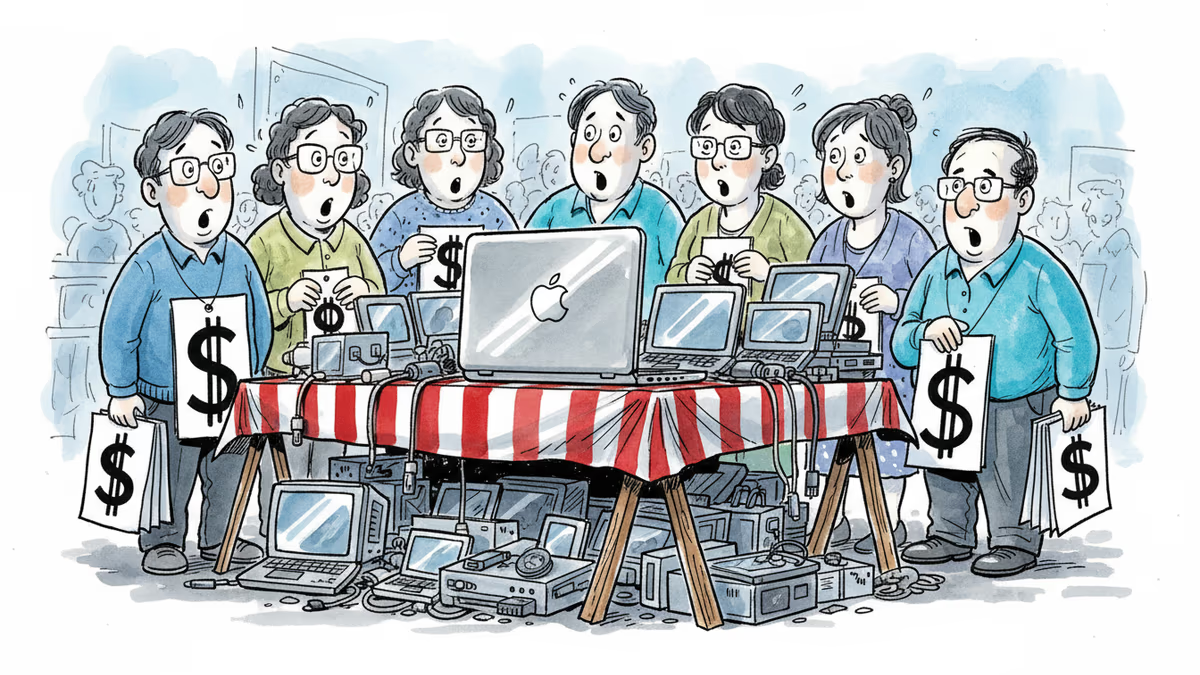
Apple Built a $599 Laptop. And It Actually Works.
Apple's MacBook Neo enters the affordable laptop market at $599 — a price point the company once ignored. Here's what it means for consumers, competitors, and the PC market.
For years, Apple's answer to the budget laptop market was simple: that's not our market.
While Chromebooks and Windows machines fought over the $400–$700 price range — the sweet spot for students, first-time buyers, and cost-conscious professionals — Apple stood firmly at the premium end, content to let others compete on price. That posture ended in March 2026, when Apple introduced the MacBook Neo at $599.
What's more surprising than the price? It apparently works.
What Happened
The Verge'sNilay Patel and David Pierce both purchased the MacBook Neo and put it through its paces. Their verdict: the device checks most of the boxes that a $599 laptop buyer actually cares about. For a company making its first real attempt at this price tier, that's a meaningful result.
To put the number in context: Apple's current entry-level MacBook Air starts at $1,099 — nearly double the Neo's price. The gap between Apple and the affordable laptop market has historically been enormous. Chromebooks from Google, budget Dell and HP machines, and mid-range Lenovo ThinkPads have owned this space for over a decade.
The MacBook Neo changes that calculus. Whether it changes the market is a different question.
Why Apple Could Do This Now
Timing is rarely accidental. Three structural shifts made this possible.

First, Apple Silicon rewrote the cost equation. The M-series chips Apple designs in-house deliver performance-per-dollar that Intel-based architectures couldn't match. Manufacturing a capable, power-efficient laptop at $599 simply wasn't feasible before the chip transition.
Second, the education market has been a persistent wound. Chromebooks dominate K-12 schools across the US, with market share estimates north of 60% in some districts. School purchasing decisions run on budget, not brand loyalty. Apple has tried to compete with education discounts and the iPad, but a sub-$600 Mac is a different kind of offer.
Third, there's a large cohort of consumers who want a Mac but won't pay Mac prices. They buy Windows instead, stay outside the Apple ecosystem, and become harder to convert over time. The MacBook Neo is an attempt to intercept them earlier.
Who Benefits — and Who Doesn't
For the average consumer, the pitch is straightforward: you get the macOS experience, Apple Silicon performance, and the build quality Apple is known for, at a price that competes with mainstream Windows laptops. If the Neo delivers on that promise, it's a genuine value proposition.
For students and parents, the calculus is particularly interesting. A MacBook that fits a back-to-school budget — rather than requiring a financing plan — opens up a segment that's been effectively closed to Apple for years.
But competitors have reason to be concerned. Dell, HP, Lenovo, and Samsung have built substantial businesses in this price range. They've competed on specs, keyboard quality, port selection, and display brightness — the kinds of trade-offs buyers scrutinize at $599. Apple entering with brand cachet and ecosystem lock-in changes the competitive dynamics meaningfully.
The Skeptic's Case
Not everyone is ready to celebrate.
Apple's affordable products have a history of hidden compromises. The iPhone SE and earlier iPad Mini lines showed that entry-level pricing often comes with trade-offs in RAM, port selection, display quality, or repairability. The MacBook Neo likely follows a similar pattern — and the details matter at this price point.
There's also the total cost of ownership question. Apple's repair ecosystem is notoriously expensive. A consumer who buys a $599 laptop expecting budget-friendly ownership may face a $300 repair bill for a cracked screen or battery replacement — costs that feel different when the device itself cost half as much. Right-to-repair advocates have flagged this dynamic repeatedly, and it doesn't disappear just because the entry price dropped.
Finally, there's the ecosystem lock-in dimension. Buying a MacBook Neo is rarely just buying a laptop. It's often the beginning of a longer relationship with iCloud, Apple One, AirPods, and eventually an iPhone upgrade. The $599 price point may be less about margin on the device and more about the lifetime value of a new Apple customer.
Authors
Related Articles

Two commencement speakers learned the hard way that AI enthusiasm doesn't land well with today's graduates. The backlash reveals a widening gap between tech optimism and Gen Z's economic reality.
After 15 years of fragmented mobile messaging, Apple and Google are rolling out end-to-end encrypted RCS messaging between iPhones and Android devices. Here's what changed, why it took so long, and what it means for your privacy.
Apple agreed to pay $250 million to settle claims it misled iPhone 16 buyers about Apple Intelligence features. What this means for consumers, Big Tech marketing, and the AI industry.
Apple quietly removed the entry-level $599 Mac Mini, raising the starting price to $799 — just one day after Tim Cook warned of chip supply constraints on the earnings call.
Two commencement speakers learned the hard way that AI enthusiasm doesn't land well with today's graduates. The backlash reveals a widening gap between tech optimism and Gen Z's economic reality.
After 15 years of fragmented mobile messaging, Apple and Google are rolling out end-to-end encrypted RCS messaging between iPhones and Android devices. Here's what changed, why it took so long, and what it means for your privacy.
Apple agreed to pay $250 million to settle claims it misled iPhone 16 buyers about Apple Intelligence features. What this means for consumers, Big Tech marketing, and the AI industry.
Apple quietly removed the entry-level $599 Mac Mini, raising the starting price to $799 — just one day after Tim Cook warned of chip supply constraints on the earnings call.
Thoughts
Share your thoughts on this article
Sign in to join the conversation