
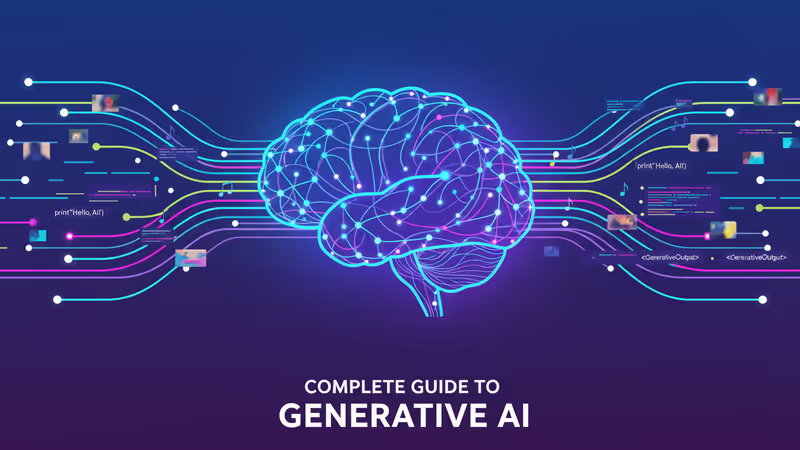
The Complete Guide to Generative AI: A Practical Handbook for Beginners
1. Why Is Everyone Talking About Generative AI?
In November 2022, ChatGPT launched. It reached 1 million users in 5 days and 100 million in 2 months—the fastest-growing application in human history.
Fast forward to 2025, and the generative AI market has exploded. Enterprise AI spending hit $37 billion, a 3.2x increase from the previous year. ChatGPT now sees 526 million monthly visitors (as of March 2025), and 78% of businesses have integrated AI into their operations, up from 55% in 2023.
What drove this transformation? Three simultaneous shifts:
First, the technology matured. The Transformer architecture, invented in 2017, dramatically improved AI's language comprehension. Models with billions of parameters began producing human-quality text.
Second, accessibility revolutionized. Previously, using AI required programming expertise. Now, you simply type a message. Interacting with AI became as intuitive as texting a friend.
Third, costs collapsed. The inference cost for GPT-3.5-level performance dropped 280-fold between November 2022 and October 2024. In January 2025, China's DeepSeek R1 emerged, offering comparable performance at 95% lower cost than OpenAI, triggering industry-wide price competition.
We've moved beyond "Should I try AI?" to "How do I use it effectively?"
2. What Is Generative AI?
Generative AI is artificial intelligence that creates new content. While traditional AI focused on questions like "Is this photo a cat or a dog?", generative AI responds to "Draw me a cat" by producing an entirely new image.
Think of it this way: Traditional AI was a test grader—distinguishing right from wrong, recognizing patterns, making predictions. Generative AI is a creator—drawing from billions of learned texts, images, and code samples to produce original work.
| Aspect | Traditional AI | Generative AI |
|---|---|---|
| Primary Function | Classification, prediction, recognition | Creation, synthesis, generation |
| Output | Labels, numbers, probabilities | Text, images, video, code |
| Use Cases | Spam filtering, recommendation engines | Writing, design, coding assistance |
| Interaction | Structured input formats | Natural language conversation |
A common misconception is that generative AI simply "parrots" what it learned. That's not accurate. These systems extract patterns and structures from training data, then recombine these elements to produce outputs that never existed before. Like a chef who's read thousands of cookbooks creating a novel recipe.
3. Types of Generative AI
Generative AI comes in several forms, categorized by the content it produces.
Text Generation AI
The most widely used category. Handles writing, translation, summarization, coding, and analysis.
| Service | Developer | Strengths |
|---|---|---|
| ChatGPT (GPT-5.1) | OpenAI | Most versatile; image and voice integration; plugin ecosystem |
| Claude (Opus 4.5) | Anthropic | Coding leader (54% market share); long document analysis; safety-focused |
| Gemini (3 Pro) | 1M token context; Google services integration; real-time information | |
| DeepSeek R1 | DeepSeek | Open-source; reasoning-specialized; 95% cost reduction |
Image Generation AI
Creates visuals from text descriptions—illustrations, photographs, designs.
| Service | Strengths |
|---|---|
| Midjourney V7 | Most artistic style; designer favorite |
| DALL-E 3 | ChatGPT integration; beginner-friendly |
| Stable Diffusion | Open-source; highly customizable |
Video Generation AI
A rapidly growing sector in 2025. Produces video from text or image inputs.
| Service | Strengths |
|---|---|
| Sora 2 (OpenAI) | Released September 2025; cinema-quality output; 200+ Disney characters |
| Runway Gen-3 | Integrated video editing; creator-focused |
| Google Veo 3 | Google ecosystem integration |
Music Generation AI
Capable of composition, arrangement, and vocal synthesis.
| Service | Strengths |
|---|---|
| Suno | Complete songs from lyrics input |
| Udio | High audio quality; diverse genres |
Coding AI
In 2025, these evolved from assistants to autonomous agents—writing, testing, and debugging code independently.
| Service | Strengths |
|---|---|
| Claude Code | Anthropic's coding agent; 80.9% on SWE-bench |
| Cursor | AI-native code editor |
| GitHub Copilot | VS Code integration; largest user base |
4. How Does It Work?
Let's understand the core principles without complex mathematics.
LLM Mechanics: The "Next Word Prediction" Game
The essence of Large Language Models is surprisingly simple: predicting the next word.
Given "The weather today is really...", the AI draws on billions of learned texts to predict likely continuations—"nice," "hot," "cold"—selecting the most contextually appropriate option.
This simple principle, combined with billions of parameters and massive training data, produces outputs that appear genuinely intelligent.
Analogy: The Superhuman Scribe
Imagine a scribe who has read billions of books, web pages, and code files. This scribe hasn't memorized everything verbatim but has internalized the structures and patterns of human communication.
When asked "Draft a business email," this scribe combines formats, tones, and conventions learned from millions of business emails to create something new.
Prompts: Your Communication Language with AI
A prompt is your instruction to the AI. The same model produces vastly different results depending on how you phrase your request.
Poor prompt: "Write an email" Strong prompt: "I'm a marketing manager at a tech startup. Write a customer email announcing our new product launch. Tone: friendly but professional. Length: around 150 words. Include a call-to-action."
Prompt engineering has become a critical skill in the AI era.
5. Getting Started: Practical Applications
Unsure where to begin? Here are scenario-based applications.
Personal Use
| Scenario | Sample Prompt |
|---|---|
| Travel Planning | "Create a 3-day Tokyo itinerary. I enjoy local food and quiet temples. Budget: mid-range." |
| Recipe Ideas | "I have chicken breast, broccoli, and garlic. Suggest a healthy dinner recipe under 500 calories." |
| Learning | "Explain Python list comprehension so a middle schooler can understand. Include 3 examples." |
Professional Use
| Scenario | Sample Prompt |
|---|---|
| Email Drafting | "Write a polite email to reschedule a client meeting. Propose 3 alternative times." |
| Report Summarization | "Condense this report into a 1-page executive summary. Focus on key metrics and implications." |
| Data Analysis | "Analyze monthly sales trends from this CSV. Flag any anomalies." |
| Meeting Notes | "Structure these meeting notes into: decisions made, action items, and next steps." |
Creative Use
| Scenario | Sample Prompt |
|---|---|
| Blog Drafts | "Write a blog post draft on remote work pros and cons. Mark spots where I should add personal anecdotes." |
| Ideation | "Brainstorm 10 subscription service ideas for young professionals. Price point: under $20/month." |
| Social Content | "Create an Instagram carousel concept for this product photo. Include a hook caption." |

6. Mastering Prompts: 5 Key Principles
Prompt engineering is the essential skill of the AI era. Remember these five principles.
Principle 1: Assign a Role
Giving AI a specific expert persona changes the perspective and depth of responses.
"You are a UX designer with 10 years of experience. Analyze this app's usability issues."
"You are a contract lawyer. Review this agreement for concerning clauses."
Principle 2: Be Specific
Vague requests yield vague responses. Clarify exactly what you need.
❌ "Tell me about marketing strategy"
✅ "Outline a content marketing strategy for a B2B SaaS startup. Monthly budget: $5,000. Team size: 3."
Principle 3: Provide Context
AI doesn't know your situation. Supply necessary background information.
"I run an e-commerce store selling clothing and accessories to women in their 30s.
Sales dropped 20% last month. Analyze potential causes and suggest improvements."
Principle 4: Specify Output Format
Request tables, lists, markdown, or JSON for structured results.
"Organize this information as:
- Title: One-line summary
- Key Points: 3 bullets
- Action Items: Checklist format"
Principle 5: Break Into Steps
Divide complex tasks into sequential stages.
Step 1: "Analyze the current state of this market"
Step 2: "Based on your analysis, identify 3 opportunity areas"
Step 3: "Propose execution strategies for each opportunity"
7. Limitations and Precautions
Generative AI is powerful but has clear limitations. Understanding them prevents costly mistakes.
Hallucinations: Confident Falsehoods
Hallucination occurs when AI presents false information with apparent confidence. In 2023, a New York lawyer faced sanctions for submitting ChatGPT-fabricated case citations to court.
Mitigation:
- Always verify critical facts through independent sources
- Request citations and confirm they actually exist
- Exercise particular caution with numbers, dates, and proper nouns
Knowledge Cutoffs
Most AI models are trained on data up to a specific date. They don't know today's news.
Mitigation:
- Use models with web browsing capabilities (ChatGPT Browse, Perplexity) for current information
- Ask "What's the knowledge cutoff date for this information?"
Copyright and Ethics
Copyright ownership of AI-generated content remains legally unsettled. Whether training on copyrighted material constitutes fair use is actively debated.
Mitigation:
- Review copyright policies for commercial use
- Disclosing AI assistance is often prudent
- Consider enterprise licenses for sensitive applications
Data Privacy
Your inputs may be used for model training. Be cautious with sensitive information.
Mitigation:
- Never input personal data or trade secrets
- Enterprise plans (ChatGPT Enterprise, Claude for Business) guarantee data won't be used for training
- Anonymize any identifying information before input
8. Free vs. Paid: Which Should You Choose?
Here's a comparison of major services (as of January 2026):
Consumer Pricing
| Service | Free Tier | Basic Paid | Premium |
|---|---|---|---|
| ChatGPT | GPT-4o mini | $20/month (Plus) | $200/month (Pro) |
| Claude | Sonnet 4 (limited) | $20/month (Pro) | $100-200/month (Max) |
| Gemini | Flash 2.5 | $20/month (Advanced) | — |
| DeepSeek | Full R1 access | Pay-per-use API | — |
Choosing the Right Service
Choose ChatGPT if:
- You're new to AI
- You want diverse features: image generation, voice interaction, plugins
- You value the GPTs ecosystem
Choose Claude if:
- You're a developer or do significant coding
- You analyze long documents (contracts, research papers, reports)
- You prioritize reliable, safety-conscious responses
Choose Gemini if:
- You're invested in Google Workspace (Gmail, Docs, Drive)
- Real-time information access matters
- You work with extremely long documents (1M token context)
Choose DeepSeek R1 if:
- Cost minimization is critical
- You want to self-host an open-source model
- Your work involves mathematical or logical reasoning
9. Game-Changers of 2025
2025 marked a turning point in generative AI history. Here are the pivotal developments.
DeepSeek R1: The Price Revolution
In January 2025, Chinese startup DeepSeek released R1 as open-source. Three aspects shocked the industry:
- Development cost: Just $6 million (OpenAI invests billions)
- Performance: Comparable to OpenAI's o1 in reasoning tasks
- Pricing: API costs 95% lower than OpenAI
DeepSeek R1 shattered the assumption that AI development requires astronomical budgets. Silicon Valley experienced what some called a "Sputnik moment," triggering industry-wide price cuts.
The Rise of AI Agents
2025 became "the year of AI agents." Agent AI goes beyond responses to autonomous planning, tool use, and task completion.
Traditional AI: "Schedule a meeting" → "Here are some available times." Agent AI: "Schedule a meeting" → Checks calendars → Queries attendee availability → Sends invitations → "I've scheduled your meeting for April 15 at 2 PM."
According to McKinsey, 62% of companies are experimenting with AI agents. Gartner projects that by 2026, 40% of enterprise apps will integrate AI agents.
Sora 2: Video Generation Goes Mainstream
OpenAI's video generation model Sora upgraded to Sora 2 in September 2025, becoming publicly available. A landmark $1 billion partnership with Disney enables generation of 200+ characters, from Mickey Mouse to Marvel heroes.
Filmmaker Tyler Perry paused his $800 million studio expansion following Sora's announcement—signaling fundamental industry disruption ahead.
The Coding AI Wars
Anthropic's Claude achieved dominant position in coding. Claude Code reached 80.9% on SWE-bench, commanding 54% market share. OpenAI responded with Codex, Google with Gemini CLI, intensifying competition.
10. What's Next?
Near-Term Outlook (1-2 Years)
AI Agents Go Practical: By 2026, 40% of enterprise applications will integrate AI agents. Beyond simple chatbots, these systems will autonomously handle bookings, orders, and customer service.
Multimodal Integration Accelerates: Processing text, images, voice, and video within single models becomes standard. "Tell me the recipe for this dish" while showing a photo becomes natural.
Continued Cost Decline: Competition and technical advances will continue driving costs down, democratizing AI access further.
Medium-Term Outlook (3-5 Years)
Work Transformation: Rather than replacing jobs, AI changes how work gets done. McKinsey projects that by 2030, 30% of current work hours could be automated by AI.
Personal AI Assistants: AI assistants that fully understand individual preferences, habits, and context become ubiquitous—like having a longtime personal assistant who knows your every preference.
The Path to AGI: Research continues toward Artificial General Intelligence—AI that reasons across domains like humans, beyond today's task-specific models.
Glossary
| Term | Definition |
|---|---|
| LLM (Large Language Model) | AI models trained on billions of parameters, core technology for text generation and comprehension |
| Prompt | Instructions given to AI; prompt quality determines output quality |
| Token | Unit of text AI processes; roughly 4 English characters or 1 Korean character per token |
| Context Window | Maximum text length AI can process in a single interaction |
| Hallucination | When AI generates plausible-sounding but false information |
| Fine-tuning | Additional training of base models for specific purposes |
| RAG (Retrieval-Augmented Generation) | Technique where AI retrieves external data to inform responses, reducing hallucinations |
| Agentic AI | AI that autonomously plans, uses tools, and completes tasks |
| MCP (Model Context Protocol) | Anthropic-developed standard for AI integration with external tools |
| Reasoning Model | Models that solve complex problems through step-by-step thinking (e.g., OpenAI o1, DeepSeek R1) |
Update Log
| Date | Changes |
|---|---|
| 2026-01-06 | Initial publication |
This content does not constitute investment advice. When using AI services, please review each service's terms of use and privacy policy.
© 2026 PRISM by Liabooks. All rights reserved.
Authors

"17 years in the field, now telling the story of technology"
Related Articles

Five stories from late September, traced to where the paper trail stops: Korea's export record, Nvidia's Hugging Face 8-K, a US-China AI channel, the UN on AI, and rising births.

Huawei's CANN is open source under a license barring software for non-Ascend chips. Inside China's second CUDA, and the two links still outside it: pre-training compute and 5nm capacity.
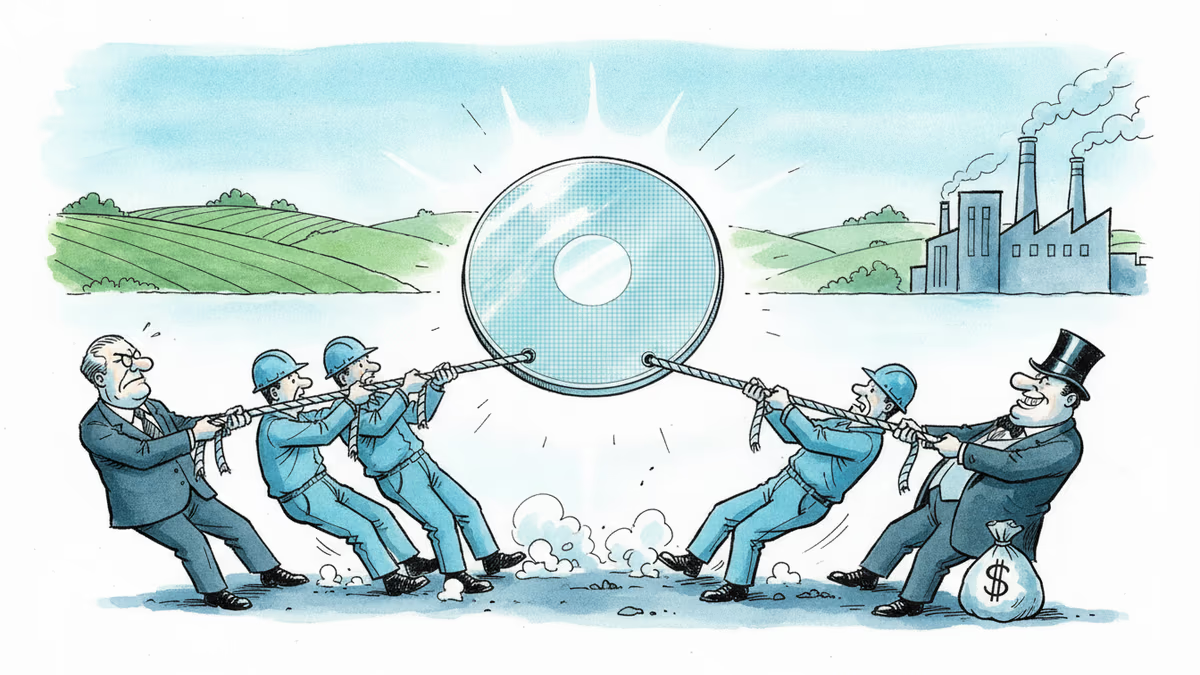
Samsung Electronics' union branch revealed that 84% of survey respondents oppose the government's roughly $290 billion (₩400 trillion) semiconductor megaproject in Gwangju. Government, management, the union and shareholders are all reading the same national project in sharply different ways.
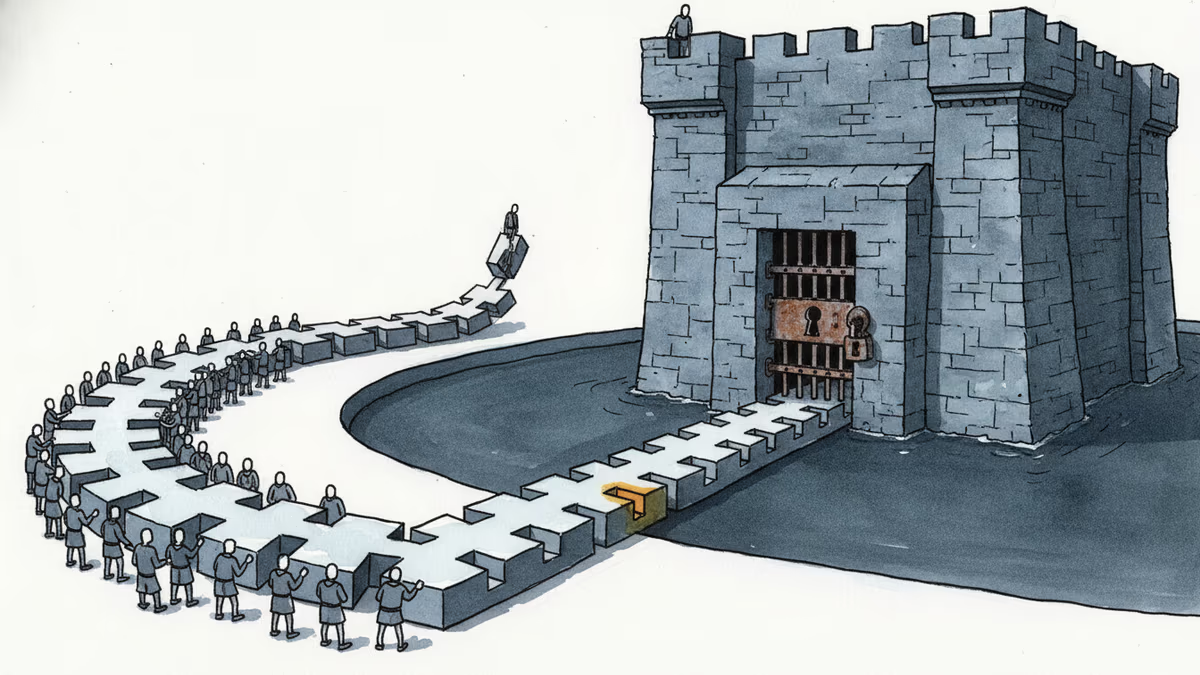
Nvidia shipped roughly a billion RISC-V cores in 2024, then announced it would run CUDA on the open standard. We break down how royalty-free instruction sets and open software stacks are trying to route around CUDA's lock-in. Part 2 of the Semiconductor Sovereignty series.
Five stories from late September, traced to where the paper trail stops: Korea's export record, Nvidia's Hugging Face 8-K, a US-China AI channel, the UN on AI, and rising births.
Huawei's CANN is open source under a license barring software for non-Ascend chips. Inside China's second CUDA, and the two links still outside it: pre-training compute and 5nm capacity.
Samsung Electronics' union branch revealed that 84% of survey respondents oppose the government's roughly $290 billion (₩400 trillion) semiconductor megaproject in Gwangju. Government, management, the union and shareholders are all reading the same national project in sharply different ways.
Nvidia shipped roughly a billion RISC-V cores in 2024, then announced it would run CUDA on the open standard. We break down how royalty-free instruction sets and open software stacks are trying to route around CUDA's lock-in. Part 2 of the Semiconductor Sovereignty series.
Thoughts
Share your thoughts on this article
Sign in to join the conversation