
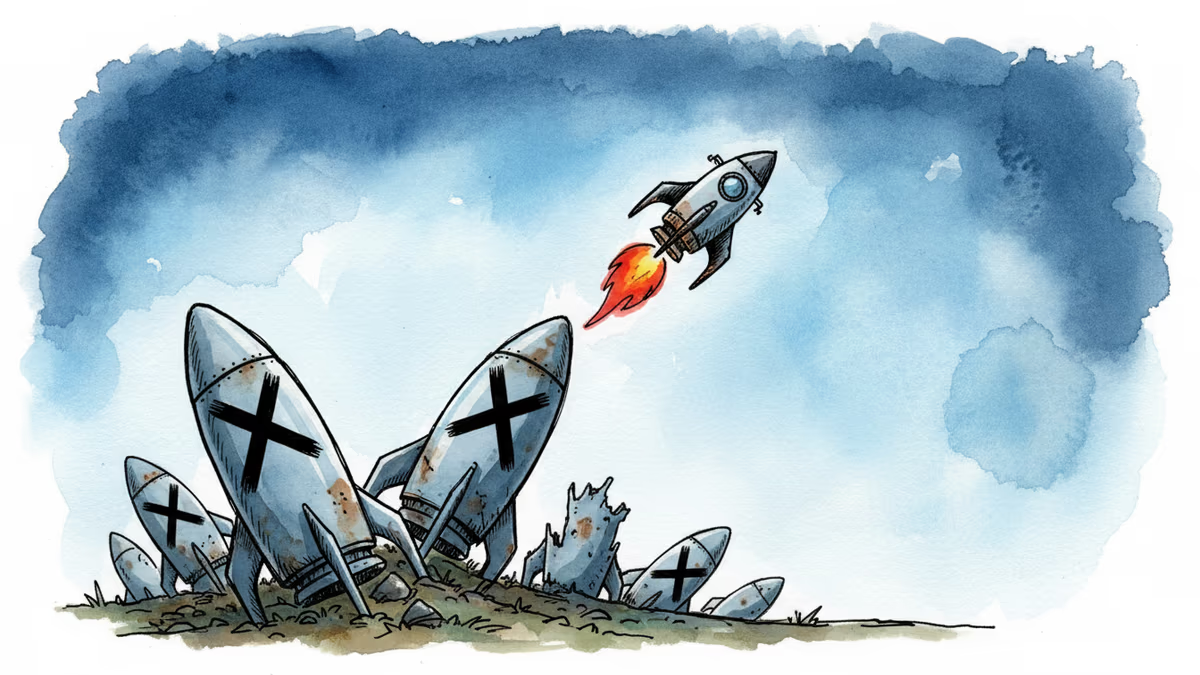
Firefly's Alpha Is Back. Does Anyone Notice?
Firefly Aerospace's Alpha rocket returned to flight after a 10-month hiatus, nailing orbit and demonstrating engine restart capability. Here's why this quiet success matters more than it looks.
Seven Flights. One Failure. One Quiet Comeback.
No confetti. No celebrity cameos. No Elon posting memes. On March 11, Firefly Aerospace's Alpha rocket lifted off from Vandenberg Space Force Base, arced southwest over the Pacific, and slipped into orbit in roughly 8 minutes. Then the upper stage relit its engine—quietly proving something that matters more than the launch itself.
This was Alpha's seventh flight. The sixth ended in failure, 10 months ago. The industry barely blinked.
That indifference is worth examining.
What Actually Happened—and Why the Restart Matters
The mission was classified as a technology demonstration, which in rocket industry shorthand means: we're testing our own hardware, not delivering a paying customer's satellite. That framing matters. Firefly used this flight to prove engine restart capability on the upper stage.
Restart sounds like a footnote. It isn't. Without the ability to reignite an upper-stage engine mid-flight, a rocket can only reach one specific orbital plane per launch. With restart, the rocket can perform multiple burns, placing payloads into precise orbits on demand. It's the difference between a taxi that only drives straight and one that can actually take you where you need to go.
For Alpha—capable of hauling more than 1 metric ton to low-Earth orbit—this capability unlocks a broader commercial manifest. Small satellite operators, defense contractors running responsive launch programs, and Earth observation companies all need this. Without it, you're leaving contracts on the table.
Ten Months Is Both Long and Short

A 10-month stand-down after a launch failure is a brutal stretch for a startup burning cash. Competitors don't pause. Investors don't pause. Customer confidence erodes with every month of silence.
And yet, in the sweep of rocket history, recovering in 10 months is genuinely fast. SpaceX lost three consecutive Falcon 1 vehicles before reaching orbit—and that process took years. Rocket Lab grounded its Electron after a failure and returned to flight in roughly five months, setting a pace that became an industry benchmark.
Firefly lands somewhere in the middle. The comeback wasn't instant, but it wasn't drawn out. The more telling detail: before the successful liftoff, there were multiple scrubbed attempts. Each scrub chips away at the narrative of reliability that commercial launch customers need before they'll commit a multi-million-dollar satellite to your rocket.
This flight doesn't erase the scrubs. But it changes the conversation.
The Competitive Landscape Firefly Is Flying Into
The small-to-medium launch market is getting crowded—and unforgiving. Rocket Lab's Electron has now flown more than 50 times, building a reliability record that justifies premium pricing. SpaceX's rideshare program offers cheap access to orbit on Falcon 9, squeezing the economics for anyone in the 500kg–2,000kg payload class.
Where does Alpha fit? The pitch has always been dedicated launches at competitive prices—meaning a small satellite operator doesn't have to share a rocket, wait for a rideshare slot, or accept whatever orbit SpaceX happens to be heading to that month. Dedicated access, on your schedule, to your orbit. That's the value proposition.
The restart demonstration strengthens that pitch considerably. But Firefly still needs to build cadence. One successful flight after a failure is a data point. Three or four is a pattern. Customers and investors are watching for the pattern.
Defense and National Security: The Quiet Tailwind
One dimension of Alpha's market that rarely gets headline attention: the U.S. defense sector's appetite for responsive launch. The Space Force and various defense agencies have been vocal about wanting the ability to rapidly replace satellites on orbit—whether due to technical failure or, in a more sobering scenario, adversarial action.
For that mission, you don't want to wait 18 months for a rideshare slot. You want a rocket that can be ready quickly, reach a specific orbit, and carry a meaningful payload. Alpha's profile—dedicated, medium-small lift, with restart capability now demonstrated—fits that requirement.
Firefly has already worked with defense customers. This flight likely strengthens those conversations.
Authors
Related Articles
SpaceX's upgraded Starship V3 completed its first test flight, deploying 20 Starlink simulators but losing the Super Heavy booster. With an IPO weeks away, the stakes just got higher.
Blue Origin's New Glenn nailed its second booster landing, but AST SpaceMobile's BlueBird 7 satellite ended up in the wrong orbit—effectively useless. What this split outcome reveals about the space race.
Blue Origin's Endurance and China's Chang'e 7 are both headed to the Moon's south pole this year. The race for lunar water ice is no longer theoretical.

The Artemis II crew broke Apollo 13's distance record from Earth, traveling over 248,655 miles into lunar orbit. Here's why this moment is more complicated than it looks.
SpaceX's upgraded Starship V3 completed its first test flight, deploying 20 Starlink simulators but losing the Super Heavy booster. With an IPO weeks away, the stakes just got higher.
Blue Origin's New Glenn nailed its second booster landing, but AST SpaceMobile's BlueBird 7 satellite ended up in the wrong orbit—effectively useless. What this split outcome reveals about the space race.
Blue Origin's Endurance and China's Chang'e 7 are both headed to the Moon's south pole this year. The race for lunar water ice is no longer theoretical.
The Artemis II crew broke Apollo 13's distance record from Earth, traveling over 248,655 miles into lunar orbit. Here's why this moment is more complicated than it looks.
Thoughts
Share your thoughts on this article
Sign in to join the conversation