
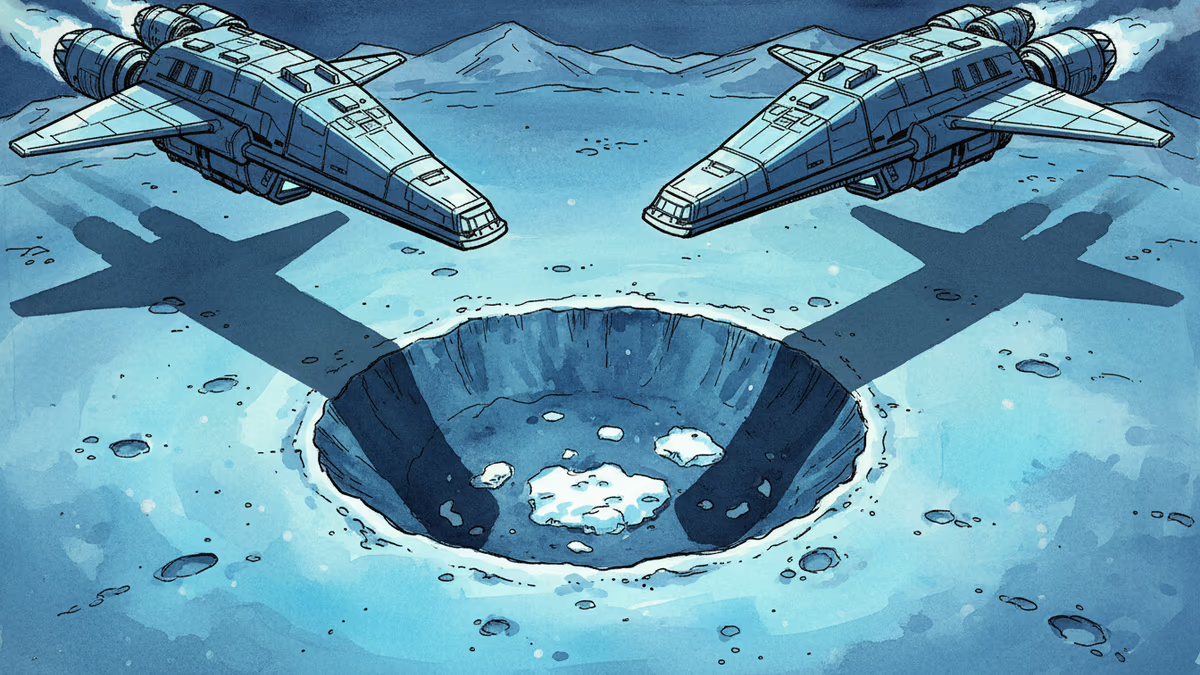
Two Spacecraft, One Crater, One Prize
Blue Origin's Endurance and China's Chang'e 7 are both headed to the Moon's south pole this year. The race for lunar water ice is no longer theoretical.
The Moon has water. Everyone agrees on that. What nobody has settled yet is who gets there first — and what that means when they do.
Sometime later this year, two of the most ambitious robotic landers ever built will attempt to touch down near the rim of Shackleton Crater, a shadowed impact basin near the Moon's south pole sitting atop what scientists believe is an enormous reservoir of water ice. One is American. One is Chinese. Both launched within days of each other beginning final preparations this week.
The Biggest Lander Ever Built vs. A Five-Piece Fleet
Blue Origin's Endurance lander left NASA's Johnson Space Center in Houston on Saturday, loaded onto a barge bound for Cape Canaveral. It had just completed a rigorous thermal test — simulating the brutal temperature swings of the airless lunar surface — and will now be mated with Blue Origin's own heavy-lift rocket, the New Glenn, for launch.
Here's the scale of it: Endurance will be the largest lunar lander in history, bigger than the Apollo Lunar Module that carried astronauts to the surface more than 50 years ago. That machine was built for humans. This one is a robot — and it's larger.
China's approach is different in character. Chang'e 7 isn't a single lander. It's a five-piece ensemble: an orbiter, a lander, a rover, and a hopper drone designed to fly into permanently shadowed craters — places no wheeled rover can reach — to sniff out ice deposits directly. The mission arrived at the Wenchang spaceport on Hainan Island just two days before Endurance's departure, and is now being integrated with China's Long March 5 heavy-lift rocket.
Two spacecraft. Two rockets. One target.

Why Shackleton, Why Now
Shackleton Crater is roughly 21 km wide and 4 km deep. Its interior hasn't seen sunlight in billions of years. That perpetual darkness is exactly why scientists want to go there: it's a cold trap, preserving water ice that has accumulated over geological timescales.
This isn't just scientific curiosity. Water on the Moon means drinking water for future crews. Split it with electricity, and you get liquid hydrogen and liquid oxygen — rocket propellant. The Moon stops being a destination and becomes a refueling depot for missions deeper into the solar system. Both NASA's Artemis program and China's International Lunar Research Station (ILRS) plan to build permanent outposts at the south pole. The water is the reason.
The timing of these two missions — nearly simultaneous, both targeting the same crater rim — is not coincidental. It reflects a broader dynamic that has been building for years.
Three Ways to Read This Race
For the space industry: Endurance is part of NASA's Commercial Lunar Payload Services (CLPS) program, which pays private companies to deliver cargo to the Moon rather than building government landers. If Blue Origin succeeds, it changes the company's trajectory dramatically. Jeff Bezos' space venture has spent years trailing SpaceX in public perception and contract wins. A successful lunar landing — with the largest lander ever flown — would be a meaningful reset.
For geopolitics: The Moon is already split into two camps. The U.S.-led Artemis Accords now have over 50 signatory nations. China's ILRS has attracted Russia, Pakistan, the UAE, and others. These aren't just scientific partnerships — they're alignment signals. Which framework a country joins for lunar exploration increasingly reflects its broader geopolitical orientation.
For space law: The 1967 Outer Space Treaty says no nation can claim sovereignty over the Moon. But it says nothing clear about resource extraction. The U.S. passed a law in 2015 allowing American citizens to own resources they extract in space. China is writing its own rules. When the first lander actually drills into lunar ice and brings it to the surface, the legal ambiguity stops being theoretical.
Authors
Related Articles
SpaceX's upgraded Starship V3 completed its first test flight, deploying 20 Starlink simulators but losing the Super Heavy booster. With an IPO weeks away, the stakes just got higher.
NASA's Artemis III has been redesigned as an Earth-orbit mission. SpaceX and Blue Origin say their landers won't be ready until late 2027. What does this mean for the future of lunar exploration?
Blue Origin's New Glenn nailed its second booster landing, but AST SpaceMobile's BlueBird 7 satellite ended up in the wrong orbit—effectively useless. What this split outcome reveals about the space race.
Blue Origin successfully reflew an orbital-class booster for the first time, but New Glenn's upper stage failed on its third mission — raising questions about NASA's Artemis timeline.
SpaceX's upgraded Starship V3 completed its first test flight, deploying 20 Starlink simulators but losing the Super Heavy booster. With an IPO weeks away, the stakes just got higher.
NASA's Artemis III has been redesigned as an Earth-orbit mission. SpaceX and Blue Origin say their landers won't be ready until late 2027. What does this mean for the future of lunar exploration?
Blue Origin's New Glenn nailed its second booster landing, but AST SpaceMobile's BlueBird 7 satellite ended up in the wrong orbit—effectively useless. What this split outcome reveals about the space race.
Blue Origin successfully reflew an orbital-class booster for the first time, but New Glenn's upper stage failed on its third mission — raising questions about NASA's Artemis timeline.
Thoughts
Share your thoughts on this article
Sign in to join the conversation