
5 Things This Week — US, China Extend Pauses 2 Months
The US and China extended pauses on port fees, export controls and countermeasures, plus tariff exclusions, by two months. TSMC's October revenue rose 59.7% year on year.
On November 9–10, the US and China each extended their suspensions of port fees, export controls and countermeasures, along with tariff exclusions, by two more months. Three of the four documents we cover set the next deadline at January 10, 2027 (11:59 p.m. ET on January 9 in the US documents); the one concerning Hanwha Ocean says only "two months." For this seventh issue, we picked one item each from trade, diplomacy, prices, semiconductors and entertainment, drawn from releases dated November 7–13 that we could verify against the original documents. Figures we confirmed only through media reports, and PRISM's own calculations, are marked as such.
1. US and China Extend Pauses on Tariffs and Export Controls Aimed at Each Other by Two Months
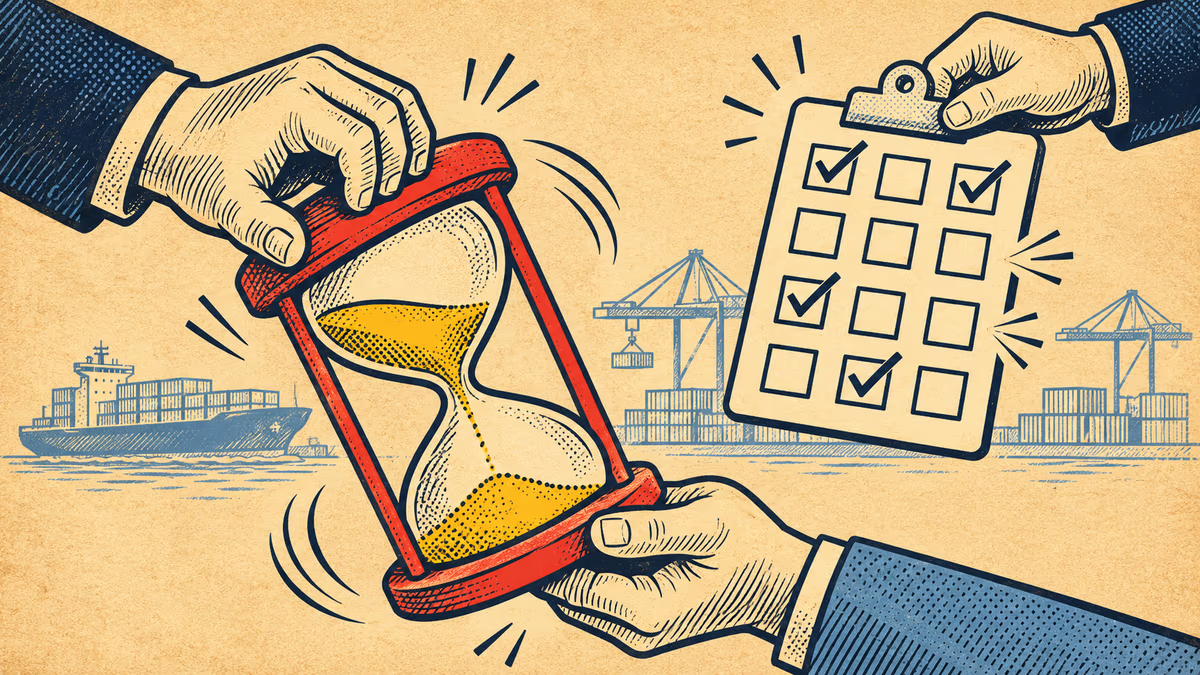
After the Busan agreement, the US and China suspended measures they'd taken against each other, and on November 9–10 the four suspensions covered in this issue were each extended by two more months. The Office of the US Trade Representative (USTR) published a notice in the Federal Register on November 10 extending its suspension of maritime and shipbuilding actions, including port fees, under Section 301 (the US provision for responding to unfair trade practices) until January 10, 2027 (11:59 p.m. ET on January 9). The same day, it extended the exclusions for 178 products exempted from its tariffs on China to the same deadline. China's Ministry of Commerce and General Administration of Customs kept six 2025 announcements (export controls on rare earths, lithium batteries, graphite and more, according to media reports) suspended until January 10, 2027. The commerce ministry also extended, from November 10, its suspension of countermeasures (retaliation against another country's measures) targeting five US-related subsidiaries of Hanwha Ocean for another two months, without giving an end date. According to an announcement by the State Council's Customs Tariff Commission (the body that adjusts China's tariffs), as republished by Chinese media, the suspension of a 24% portion of China's additional tariffs on US goods continues for two months, and the 10% portion stays in place. As reasons for the extensions, USTR wrote "To allow for further discussion with China" and "In light of ongoing discussions with China," and China's commerce ministry order cited the need "to implement the consensus of the China-US economic and trade consultations" (PRISM translation). The previous suspension of the maritime and shipbuilding actions ran for a year; this one runs two months. USTR wrote that it "will consider whether it is appropriate to continue the suspension period or whether further action is appropriate" before the January 10 deadline.
2. Ahead of APEC in Shenzhen, China's Foreign Ministry Says It's "Maintaining Communication"
Going by China's foreign ministry transcripts, it still isn't settled whether the US and Chinese leaders will meet before the January 10 deadline. Asked on November 10 about a US-China leaders' meeting, the ministry replied only that "the two sides are maintaining communication on arrangements for interactions between the two heads of state within this year" (PRISM translation). Ahead of the 33rd APEC leaders' summit in Shenzhen on November 18–19 (a foreign ministry announcement relayed by Xinhua), reporters also asked about a US-China-Russia meeting. On both November 9 and 10, the ministry said that "China is maintaining communication with the relevant parties on a China-Russia-US leaders' meeting" and that "regarding the specific issue you mentioned, I have no information to offer at the moment" (PRISM translation). The schedule the ministry announced on November 11 covered Premier Li Qiang's official visit to Thailand (November 13–15) and the China-ASEAN leaders' meeting in Manila (November 15–16). On the US side, Reuters reported on November 5 that President Trump is expected to meet President Xi Jinping on the occasion of this APEC summit (as republished by The Korea Times), and PRISM couldn't find an official White House schedule. Up to the November 12 briefing PRISM checked, there's been no list of summit attendees and no confirmed announcement of a US-China summit.
3. US October Inflation Comes Only Month Over Month; China's Producer and Consumer Prices Diverge

In its October consumer price index release, the US Bureau of Labor Statistics (BLS) couldn't publish 12-month changes for most indexes, so this month's official US inflation numbers have to be read month over month. BLS said that's because it didn't collect survey data for October 2025 due to a lapse in appropriations. The CPI for All Urban Consumers (CPI-U) rose 0.4% from the previous month on a seasonally adjusted basis, a smaller gain than September's 0.6%, and core inflation, which excludes food and energy, held at 0.3%, the same as in August and September. The BLS release alone can't tell us how these numbers will factor into interest-rate decisions. In the October price data from China's National Bureau of Statistics (NBS), the producer price index (PPI), which tracks factory-gate prices, rose 5.7% from a year earlier, a pace 0.7 percentage point faster than in September. The consumer price index (CPI) rose 0.7%, with the increase narrowing by 0.2 percentage point (core CPI, excluding food and energy, rose 0.8%). The NBS listed imported and seasonal factors, including rising international energy prices, as the first reason for the PPI's 0.7% month-on-month rise.
4. TSMC's October Revenue Up 59.7% From a Year Earlier
In the October revenue report TSMC filed with the US Securities and Exchange Commission (SEC) on November 10, October revenue came to approximately NT$586.89 billion, up 14.7% from September and 59.7% from a year earlier. January–October revenue totaled NT$4,485.62 billion, up 43.3% from the same period last year. In its third-quarter earnings materials on October 15, the company said it expects fourth-quarter revenue of $52.3–54.3 billion, based on an exchange rate assumption of US$1 = NT$31.8. Converted at that assumed rate, October revenue comes to about $18.46 billion, or roughly 34.0–35.3% of the fourth-quarter guidance range (PRISM calculation; we didn't calculate it at the actual exchange rate), close to one-third (about 33.3%), one month's share of a three-month quarter. September revenue (NT$511.857 billion) fell 0.6% from August (NT$514.806 billion). The 59.7% year-over-year gain and the 43.3% year-to-date gain show the size of the growth, and September's 0.6% dip, just one month earlier, shows the month-to-month swings. Whether TSMC hits its fourth-quarter guidance can't be judged until November and December revenue is out. The "monthly record" label comes from a report by Taiwan's Central News Agency (CNA); the text of the company's filing (Form 6-K) states the amounts and percentage changes.
5. The Same Show Tops Netflix's South Korea TV Chart and Its Global Non-English Chart
In Netflix's official charts for the week of November 2–8, a Korean drama (according to media reports) ranked No. 1 on both the South Korea TV list and the global non-English TV list. The show is "Dead-End Job: Limited Series." Korean outlet Ilgan Sports reported that it's "Kkul Alba," starring Lee Jae-wook, and Netflix's charts list no Korean title or country of origin. It drew 8.7 million views (Netflix's unit of measure), up from 5 million the previous week (October 26–November 1), when it ranked No. 4. Still, its 8.7 million as this week's No. 1 is lower than the 10.8 million drawn by the previous week's No. 1, "Lupin: Part 4." Lupin: Part 4 placed third this week with 6.1 million, and "A Couple of Lies" was second (7.2 million). No. 2 in South Korea and No. 4 on the global non-English list (3.7 million) was "Doctor X: Mafia in White," which we covered in issue 6.
What to Watch in the Next Two Weeks
On Saturday, November 14, PRISM will publish a story on how to read the statistics on South Koreans visiting Japan. On November 15, public comments close on China's draft revision of its list of technologies banned or restricted from export (Announcement No. 48) (see our November 11 story). At the APEC summit in Shenzhen on November 18–19, we'll watch for an announcement of a US-China leaders' meeting. And we'll check Dead-End Job's ranking again against Netflix's next weekly chart (the week of November 9–15).
This content is AI-generated based on source articles. While we strive for accuracy, errors may occur. We recommend verifying with the original source.
Related Articles

Each country strips different items from core inflation, so September 2026's US core CPI (2.6%) and Japan's core (2.1%) aren't like for like.

The Fed held 10-2 and the BOJ 8-1. US Q3 growth hit a 3.4% annual rate, with September PCE inflation at 3.6%. Samsung's chip unit earned 106.5 trillion won.
Taiwan covers about 34.6¢ and Japan 27.1¢ per liter of gasoline (PRISM calculation), while Korea's refiners pay first and await settlement. Five countries, five bills.

Korea's Oct. 1–20 exports rose 105.4%, China's Jan.–Sept. exports 16.4%. China's retail sales and Korea's youth jobs didn't keep up. Plus BOK and JNTO updates.
Each country strips different items from core inflation, so September 2026's US core CPI (2.6%) and Japan's core (2.1%) aren't like for like.
The Fed held 10-2 and the BOJ 8-1. US Q3 growth hit a 3.4% annual rate, with September PCE inflation at 3.6%. Samsung's chip unit earned 106.5 trillion won.
Taiwan covers about 34.6¢ and Japan 27.1¢ per liter of gasoline (PRISM calculation), while Korea's refiners pay first and await settlement. Five countries, five bills.
Korea's Oct. 1–20 exports rose 105.4%, China's Jan.–Sept. exports 16.4%. China's retail sales and Korea's youth jobs didn't keep up. Plus BOK and JNTO updates.
Thoughts
Share your thoughts on this article
Sign in to join the conversation