
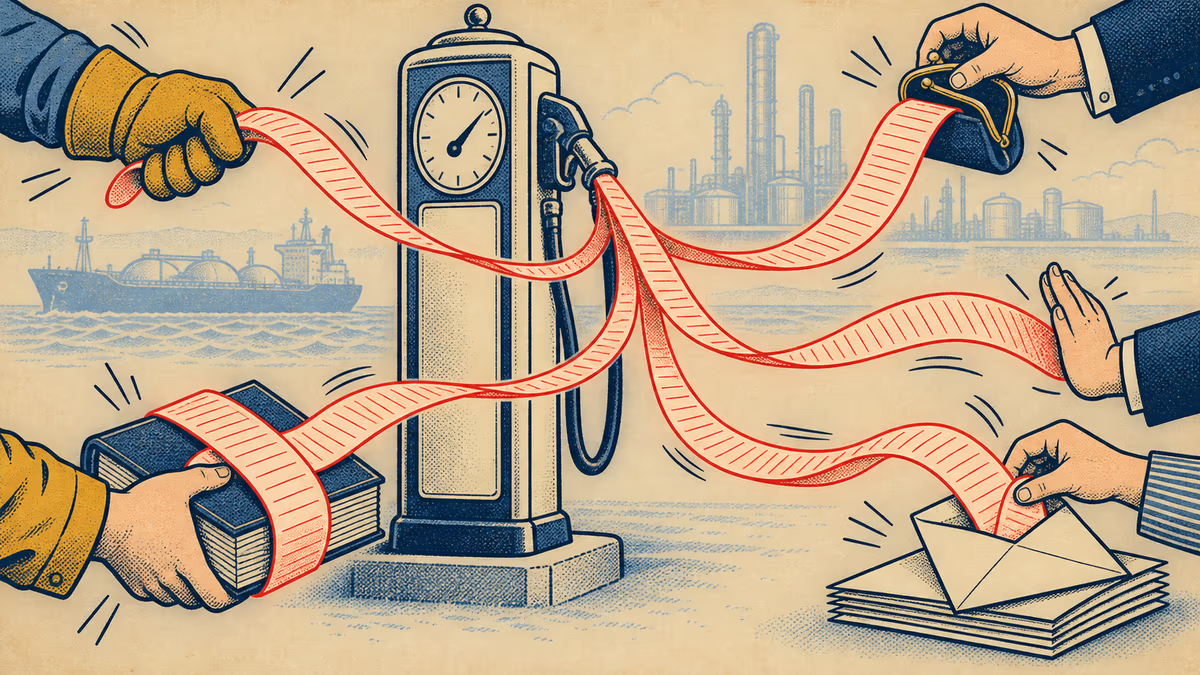
Taiwan Covers 34.6¢ a Liter of Gasoline, Japan 27.1¢
Taiwan covers about 34.6¢ and Japan 27.1¢ per liter of gasoline (PRISM calculation), while Korea's refiners pay first and await settlement. Five countries, five bills.
34.6 cents and 27.1 cents a liter. That's how much Taiwan (Oct. 26–Nov. 1) and Japan (Oct. 22–28) are covering on every liter of gasoline this week so drivers don't have to, converted to U.S. dollars (PRISM calculation, Fed H.10 rates as of Oct. 16). Korea can't give a number in the same unit. Its refiners have absorbed the losses up front, the government plans to settle and pay them back within the year, and no per-liter amount has been published. China hasn't said who's covering the gap. The U.S. has left prices to the market while directing a deferral of some diesel tax payments. So who's paying how much per liter, and until when?
The shock started in the same place. Fighting between the U.S. and Iran flared up again. Brent crude's weekly average climbed from $89.50 a barrel in the fourth week of August to $105.80 in the third week of September (per Korean media reports). Brent futures settled at $116.72 on Oct. 23, the highest close since April 29 (as reported by CNBC). The average U.S. on-highway diesel price hit $6.529 a gallon on Sept. 21 (U.S. Energy Information Administration, EIA).
PRISM reviewed government documents and disclosures from all five countries through Oct. 27. For Korea, we relied on press and clarification materials from the Ministry of Trade, Industry and Resources. For Japan, we used the official fuel subsidy website run by the Agency for Natural Resources and Energy, plus Cabinet decision documents from the Ministry of Finance. For Taiwan, we used Central News Agency (CNA) reports on the weekly price announcements of state-run refiner CPC Corp., Taiwan. For China, we used Xinhua and other outlets that carried announcements from the National Development and Reform Commission (NDRC). For the U.S., we used the original text of the executive order in the Federal Register, an Internal Revenue Service (IRS) news release and EIA data.
All dollar conversions are PRISM calculations, using Fed H.10 rates as of Oct. 16 (details below the comparison table). We don't judge which country's approach is better. We lay out what each one costs, side by side.
South Korea: refiners pay first, the government pays "within the year"
On Sept. 18, the nationwide average gasoline price at Korean gas stations was 1,858.52 won a liter (media reports citing Opinet, the official fuel price tracker). The same day, the Ministry of Trade, Industry and Resources announced the 10th round of oil price caps: 1,784 won for gasoline, 1,773 won for diesel and 1,380 won for kerosene. The caps apply for four weeks from 12 a.m. Sept. 19, holding the ninth-round levels unchanged.
Those two numbers come from different stages of the supply chain. The cap is a ceiling on the supply (wholesale) price that Korea's four refiners charge gas stations. It doesn't directly set what drivers pay at the pump. Station prices move separately, on top of it.
The 10th-round caps ran until 12 a.m. Oct. 17. On Oct. 16, the ministry froze the 11th-round caps at the same levels as the 10th round, and they apply for four weeks from 12 a.m. Oct. 17. The ninth, 10th and 11th rounds were all announced on a Friday and took effect at 12 a.m. Saturday. As of Oct. 27, no schedule for the 12th round had been announced.
The program began on March 13 under a regulation on setting maximum oil selling prices and restricting excessive exports. It also capped monthly exports of gasoline, automotive diesel and indoor kerosene at 100% of the same month a year earlier (reports). Refiners are asking for those export limits to be eased. The government said it would look for ways to manage export volumes without putting domestic supply at risk (Ministry of Trade, Industry and Resources, Oct. 16). The ministry estimates the program lowered consumer price inflation by an average of 0.6 percentage points from March through August. Its effect on September inflation was covered in PRISM's 5 Things, Issue 2.
The cost moves in sequence. Refiners first absorb the losses from selling fuel below the cap, and the government reimburses them later through a settlement. In a Sept. 2 clarification, the ministry said losses would be covered "based on costs and other factors." It called the question of allowing each company an appropriate profit margin "a matter not yet decided." A Sept. 14 clarification laid out the process: refiners submit cost data, a price-cap settlement committee reviews it, and the government plans to "pay within the year."
The first settlement covers March 13 through June 30 (reports). The government plans to collect industry data by the end of September and calculate settlement amounts by the end of November (reports). Money Today reported on Sept. 16 that, six months into the program, the four refiners still hadn't received their first compensation payment. According to the report, there are about 100 disputed points, and the two sides disagree over which costs should anchor the compensation. The ministry's Oct. 17 clarification still gave no payment amount or date. It said the settlement committee is reviewing each refiner's second-quarter applications for financial support on a cost basis and will pay out after deliberation.
The money sits in a supplementary budget. The extra budget bill, approved by the Cabinet on March 31, added 5 trillion won to a special-purpose reserve fund managed by the Ministry of Planning and Budget. The Kyunghyang Shinmun reported on April 2 that the increase was for "compensating refiners' losses from the oil price cap, among other things." Asia Business Daily reported on March 31 that 4.2 trillion won (about $3.15 billion, PRISM calculation) of that was earmarked for the price cap. The planning and budget minister at the time said the figure was based on six months' worth of volume (reports). The National Assembly passed the supplementary budget at 26.2 trillion won on April 10. Both the 5 trillion and 4.2 trillion won figures are as reported; PRISM hasn't checked them against the ministry's original budget tables. On Oct. 17, the Ministry of Trade, Industry and Resources said it believes it can fund loss compensation "within the current budget." In an Oct. 26 clarification, it said it had secured 4.2 trillion won from this year's reserve fund and 1.45 trillion won (about $1.09 billion, PRISM calculation) in next year's budget for loss compensation.
The end date is defined only by conditions. On Sept. 14, the ministry rejected as "not true" reports that the government had set a six-month limit. It said it would consider ending the program once the Middle East situation and international oil prices stabilize and tanker traffic moves smoothly.
Japan: everything above 170 yen comes out of reserve funds
Japan's gasoline price chart has two lines. As of Oct. 19, the national average for regular gasoline was 170.2 yen a liter; without the subsidy, it would have been 213.2 yen. For diesel, the figures were 159.7 yen and 202.7 yen. That's from a chart updated Oct. 21 on the official fuel subsidy website (nenryo-teigakuhikisage.go.jp) run by the Agency for Natural Resources and Energy. The 43.0-yen gap between the two lines matches the subsidy rate applied that week (Oct. 15–21).
The program began on the prime minister's instruction on March 11 and applied to shipments from March 19. Its official name is "emergency measures to ease drastic price changes in light of the Middle East situation." When the national average gasoline price rises above roughly 170 yen, the program covers the entire excess. Diesel, kerosene and heavy fuel oil get the same per-liter amount. The money goes to Japan's moto-uri, the refiners and primary wholesalers that supply the market, and they cut their wholesale prices by that amount.
The subsidy rate is reset every week by formula: next week's projected retail price minus the 170-yen benchmark. According to the same official site, the rate for Oct. 22–28 is 42.8 yen a liter, down 0.2 yen from 43.0 yen the previous week (Oct. 15–21). That's about 27.1 cents (PRISM calculation).
Japan cut taxes first, then layered the subsidy on top. According to the same chart materials, the provisional surcharge rate on gasoline was abolished on Dec. 31, 2025, and the one on diesel on April 1, 2026. Japan also subsidized fuel in 2022, but every figure in this article comes from the new program launched this March.
The money comes from reserve funds. Ministry of Finance Cabinet decision documents show that on March 24, about 794.8 billion yen from the fiscal 2025 general reserve was allocated to the fuel program. On Sept. 1, about 613.6 billion yen from the fiscal 2026 "reserve for responding to the Middle East situation and other matters" went to the fuel program. Including support for LPG-fueled taxis, the total that day came to about 616 billion yen. It was the first draw on that reserve, which the June supplementary budget created at a size of 2.5 trillion yen. Adding the fuel portions of the two decisions from the raw figures, which are stated in thousands of yen, gives about 1.4085 trillion yen, or about $8.91 billion (PRISM calculation; because of rounding, this is 100 million yen more than the sum of the two figures above).
Japanese media read the same decision differently. NHK on Sept. 1 focused on the government "continuing" to hold down fuel prices. Kyodo News, the same day, framed it as spending to keep the fund from running dry, citing the Ministry of Economy, Trade and Industry (METI) as saying the fund's balance stood at about 210 billion yen at the end of July.
Taiwan: state-run CPC absorbs it, and the bill goes to the legislature
For Oct. 26–Nov. 1, Taiwanese drivers pay NT$32.7 a liter for 95-octane unleaded gasoline and NT$29.9 for premium diesel. It's the sixth straight weekly freeze (by udn's count). CPC, the state-run refiner, announces the following week's prices around Friday or Saturday, effective 12 a.m. Monday.
According to CNA's report on the Oct. 24 announcement, NT$11.2 comes off the price of every liter of gasoline this week: NT$3.7 from a government commodity-tax cut and NT$7.5 in additional absorption by CPC. For diesel, it's NT$11.4: NT$2.1 from the government and NT$9.3 from CPC. In dollar terms, that's about 34.6 cents a liter for gasoline and about 35.2 cents for diesel (PRISM calculation). For the previous week (Oct. 19–25), absorption was NT$10.6 for gasoline and NT$10.9 for diesel.
CPC cites two justifications: keeping prices "the lowest among neighboring Asian economies," and a "dedicated stabilization mechanism for the U.S.-Iran war." From Feb. 28 through Oct. 25, its cumulative absorption for gasoline and diesel combined came to about NT$30.37 billion (about $0.94 billion). CNA's report alone doesn't make clear whether that figure includes the government's commodity-tax cut.

CPC's books are already strained. The Ministry of Economic Affairs expects CPC's debt ratio to hit 98% by year-end (Liberty Times, Oct. 2). On Sept. 3, the Executive Yuan, Taiwan's cabinet, approved a record NT$607.63 billion supplementary budget bill. Its largest item is a NT$233.83 billion capital injection into CPC, about 40% of the total (CNA). The same bill also includes NT$172.535 billion in Ministry of Economic Affairs subsidies for CPC and Taiwan Power Co., or Taipower, according to the Legislative Yuan's Budget Center (udn, Oct. 23, single report).
The capital injection is stuck at the Legislative Yuan. The supplementary budget bill passed its first reading and went to committee; as of Oct. 27, it hadn't passed. The Budget Center noted that NT$50.807 billion of the CPC capital injection covers needs for fiscal 2027 and beyond. In other words, it questioned pulling that portion forward into this supplementary budget (udn, Oct. 23, single report). The Directorate-General of Budget, Accounting and Statistics (DGBAS) has said the supplementary budget will lapse if lawmakers don't finish reviewing it by Dec. 31. Premier Cho Jung-tai is hoping for final passage on third reading before the end of November.
The parties are split three ways. The ruling Democratic Progressive Party (DPP) says the government has a duty to shield the public from the cost shocks hitting CPC and Taipower. The opposition Kuomintang (KMT) wants the capital injection reviewed formally in the 2027 general budget (Republic of China year 116) and says it "doesn't rule out cutting it entirely." The Taiwan People's Party (TPP) questions whether CPC, which has posted losses six years in a row, meets the requirements for a supplementary budget. Some in the opposition have also floated giving every person NT$20,000 in cash instead of the injection (Liberty Times, single report).
China: smaller price hikes, tighter export permits
830 yuan a ton. That's how much Chinese gasoline prices should have risen on Sept. 24 under the existing formula. The actual increase was 395 yuan. Diesel rose just 385 yuan instead of 800 (Jiemian, Xinhua). That's the result of the NDRC, China's top economic planner, leaving the pricing mechanism intact while applying "temporary regulation." On Sept. 11, it had also trimmed the gasoline increase from 435 yuan to 260 yuan and the diesel increase from 420 yuan to 250 yuan (NDRC announcement carried by Xinhua).
Per liter, the Sept. 24 increase works out to 0.31 yuan for No. 92 gasoline and 0.33 yuan for No. 0 diesel (as converted in media reports). Working backward from those reported figures to liters per ton, the amount held back in this round comes to about 0.34 yuan (about 5.1 cents) a liter for gasoline and about 0.36 yuan (about 5.4 cents) for diesel (PRISM calculation). The two rounds' suppressed amounts should be read separately. The announcement doesn't say whether the Sept. 24 "original increase" included the amount held back on Sept. 11.
The NDRC announcement, as carried by Xinhua, described the step as a temporary measure to "cushion the domestic impact of rising international oil prices." What it left out: who bears the difference, and whether there's any fiscal subsidy. The view that state-owned refiners such as Sinopec and PetroChina are absorbing it through their margins is still speculation, unconfirmed by primary documents. Gasoline and diesel prices stayed put in the Oct. 15 round (NDRC announcement). That announcement noted only that international crude prices had dipped briefly before climbing considerably again. It didn't give the formula-implied adjustment or say whether temporary regulation was applied.
Exports are the other lever. The NDRC reportedly told refiners verbally in March to temporarily stop new fuel exports (multiple foreign outlets, including Reuters-affiliated ones). In May, it loosened some categories, including jet fuel. In late September, reports said export permits for destinations other than Hong Kong and Macau hadn't been issued before the National Day holiday, effectively halting October exports (Hydrocarbon Processing and others). PetroChina canceled some October gasoline and jet fuel cargoes. On Oct. 9, reports said October exports had resumed. Reuters, citing industry sources, put the approved October volume at about 3.7 million metric tons. S&P Global Platts reported that multiple analysts based in China estimated October exports at a minimum of 3.5 million metric tons. Both the halt and the resumption rest on source-based reporting. PRISM found no official NDRC or Commerce Ministry documents, and no direct state-media reports, on either.
United States: prices left to the market, tax payments pushed back
Executive Order 14435, signed Oct. 5, is titled "Emergency Tax Relief on Diesel Fuel." Its text, published in the Federal Register on Oct. 9 (91 FR 64747), is narrower than the title. It directs the Treasury secretary to determine within five days whether the conditions for relief under 26 U.S.C. 7508A are met. It then directs that payment of taxes under Section 4041(a)(1)(A) and (b)(1)(B) arising from Oct. 5 through Dec. 31 be deferred, without penalties or interest. The stated rationale is the burden on farmers and truckers.
Section 4041 taxes kick in when dyed diesel is used on highways. Diesel for off-road use, such as in farm equipment, is sold tax-free and dyed red so it can be told apart. Putting that fuel in an on-road vehicle triggers federal excise tax and exposes the user to a penalty under Section 6715. The order also directs an announcement that this penalty won't be imposed during the same period. The clear diesel sold at ordinary gas stations is taxed under Section 4081 when it leaves the refinery or terminal, and Section 4081 doesn't appear in the order. Industry groups including the Energy Marketers of America (EMA) read the deferral as covering on-highway use of dyed diesel. Pump prices for diesel at ordinary stations fall outside the order's direct scope.
Under Section 4041(a)(1)(C)(i), the diesel rate for Section 4041 is the same as the Section 4081 diesel rate: 24.3 cents a gallon, or about 6.4 cents a liter (PRISM calculation). That amount applies only to people who use dyed diesel on highways. The White House estimate cited by EMA puts the relief at about $60 on a 250-gallon fill-up. At a rally in Nebraska, President Trump said he'd let anyone buy tax-free dyed diesel. The White House fact sheet describes something narrower (multiple reports).
Forgiveness is still at the "explore" stage. Section 4 of the order directs officials to "explore" ways, including legislation, to eliminate the obligation to pay the deferred taxes. In an Oct. 14 news release (IR-2026-122), the IRS said it wouldn't impose excise tax penalties related to on-highway use of dyed diesel. That relief is retroactive to Oct. 1 and runs through Dec. 31, a different start date from the order's payment deferral, which begins Oct. 5. The IRS followed up with an Oct. 21 news release (IR-2026-125). It covers the return-filing, reporting and recordkeeping requirements (Form 720 and others) for Section 4041(a) tax arising from dyed diesel use over the same period. The IRS said it "will not challenge temporary failures" to meet those requirements, and it won't require catch-up filing or reconstructed records after Dec. 31. The release is limited to filing and recordkeeping, and it contains no language eliminating the tax. On the payment deferral under 7508A, the Oct. 14 release said only that the IRS expects to issue "further guidance." As of Oct. 27, PRISM had found no guidance setting a payment due date.
States moved first. North Carolina decided not to penalize on-road use of dyed diesel stockpiled for agriculture through Dec. 31. Iowa declared a disaster and allowed on-road use through Feb. 4, 2027, limited to hauling designated farm products. The Iowa Department of Transportation said federal relief doesn't override the state's own restrictions.
Diesel prices came down from their peak, then turned back up. EIA's average on-highway diesel price peaked at $6.529 a gallon on Sept. 21 and fell to $6.179 by Oct. 12, before rising to $6.276 on Oct. 19. Regular gasoline kept falling, averaging $4.284 the same day. President Trump said he "won't" ban diesel exports (Al Jazeera, Oct. 3).
Five countries, one table
Only two cells can be compared directly in the same unit: Japan and Taiwan. Both publish, per liter, the gap between the formula price and the actual selling price. The other three either have no number or have a number of a different kind.
| South Korea | Japan | Taiwan | China | United States | |
|---|---|---|---|---|---|
| Price measure | Cap on the refinery-to-station supply price (11th round, from Oct. 17; 10th-round levels kept) | Full subsidy of gasoline costs above 170 yen (paid to moto-uri wholesalers) | CPC freezes weekly prices | Smaller price hikes (Sept. 11, Sept. 24) + curbs on export permits; no change in the Oct. 15 round | No price intervention; order directs deferral of federal tax on on-highway use of dyed diesel (penalty relief and filing/recordkeeping relief announced; awaiting payment-deferral guidance) |
| Who's covering it now | Four refiners (up front) → government (after settlement) | Taxpayers (reserve funds) | CPC (state-run) + government (commodity-tax cut) | Not disclosed | The affected taxpayers themselves (payment deferral directed) |
| Per liter (local currency) | Not comparable | 42.8 yen (Oct. 22–28) | Gasoline NT$11.2 · diesel NT$11.4 (Oct. 26–Nov. 1) | Gasoline ~0.34 · diesel ~0.36 yuan (Sept. 24 round, back-calculated from reported conversions; for reference) | 24.3 cents a gallon (eligible users only) |
| U.S. dollar equivalent (PRISM calculation) | — | ~27.1¢/liter | Gasoline ~34.6¢ · diesel ~35.2¢/liter | ~5.1¢ · 5.4¢/liter (for reference) | ~6.4¢/liter (tax rate, converted) |
| Cumulative / funding | 4.2 trillion won (~$3.15B) from this year's reserve fund plus 1.45 trillion won (~$1.09B) in next year's budget for loss compensation (Oct. 26 government clarification). No payment amount or date disclosed; government says it can pay "within the current budget" | Reserve funds for fuel: 1.4085 trillion yen (~$8.91B) | Cumulative absorption ~NT$30.37B (~$0.94B); NT$233.83B CPC capital injection pending in the Legislative Yuan | Not disclosed | Not disclosed (awaiting payment-deferral guidance) |
| Deadline | No end date; 11th round runs four weeks from Oct. 17 | Not disclosed | Set weekly; supplementary budget lapses if not reviewed by Dec. 31 | Oct. 15 round: no change; next window 24:00 Oct. 29 (industry outlook) | Covers taxes arising through Dec. 31; payment due date not set |
Exchange rates are the Federal Reserve's H.10 noon buying rates in New York for Oct. 16, 2026 ($1 = 1,334.03 won, 158.00 yen, NT$32.40 and 6.6861 yuan), and one gallon is 3.78541 liters. All dollar equivalents and cumulative conversions are PRISM calculations. Korea's column reads "not comparable" for two reasons. The government hasn't published a per-liter loss, and whether the cost basis for compensation should be international product prices (MOPS, the Mean of Platts Singapore benchmark) or actual costs is itself a point of dispute in the settlement. In the U.S. column, where there's no subsidy, we've entered the Section 4041 diesel tax rate (which follows the Section 4081 rate). It's the tax the executive order directs be deferred, and it applies only to people using dyed diesel on highways. The China column reflects the price-hike suppression from a single round on Sept. 24 (the Oct. 15 round brought no adjustment), so its level can't be compared with the other columns. Japan's rate changes every week.
Looking only at gasoline over the same period, Taiwan comes to about 34.6 cents a liter and Japan about 27.1 cents. The makeup differs. Taiwan's figure mixes a NT$3.7 government tax cut with NT$7.5 absorbed by a state-owned company. Japan's is entirely a fiscal subsidy, added after taxes had already been cut.
Same shock, different costs
The more fuel you use, the more you get
Covering the same amount per liter means whoever fills up more gets more in absolute terms. In Korea, that criticism has been raised. Lee Hong, an associate research fellow at the Korea Institute for Industrial Economics and Trade, pointed out that higher-income households, which burn more fuel, benefit more in absolute terms. The Narasallim Research Institute, a public-finance think tank, found that 66.7% of households in the bottom 20% by income have no fuel spending at all (HuffPost Korea). On the government's side, the figure is the inflation estimate mentioned earlier (an average of 0.6 percentage points over March–August).
Japan and Taiwan also cover a flat amount per liter, so the same structure applies: the more you pump, the bigger your share. PRISM couldn't confirm whether a similar debate exists in Japan or Taiwan. The U.S. narrowed eligibility to people using dyed diesel on highways. The IRS has already announced penalty relief and said it won't challenge temporary failures to file or keep records; the guidance that would set a payment due date hasn't come out yet.
Public finances: money spent, money set aside, money deferred
Japan has allocated 1.4085 trillion yen from reserve funds to fuel subsidies. Taiwan's government covers NT$3.7 per liter of gasoline by collecting less commodity tax, while the capital injection that would cover CPC's share awaits a vote in the Legislative Yuan. In Korea, 4.2 trillion won was reported as funding for the price cap, with payment slated for within the year. The National Assembly Budget Office judged the permitted uses of this special-purpose reserve to be broad. Beyond loss compensation, "nearly all high-oil-price spending," from supply-chain financing to fuel costs for vulnerable households to strategic oil purchases, could be carried out under this one item (cited by the Kyunghyang Shinmun, April 2). The U.S. has directed that tax collection be pushed back. The IRS has said it won't challenge temporary failures to file or keep records during this period, and it won't require catch-up filing after year-end. When and how the deferred tax gets collected depends on 7508A guidance that hasn't come out yet. If Congress forgives the tax, that's when it becomes a cost to the federal budget. The size of the deferral hasn't been disclosed.
Corporate books: industry estimates vs. the government's position
Korean refiners' losses exist only as estimates so far. The industry estimated that losses had topped 4 trillion won by the end of May, measured against international product prices (MOPS) (Herald Business, among others). Reports on Oct. 16 put the industry's estimate of cumulative losses at 7 trillion to 8 trillion won (Maeil Business Newspaper, Seoul Economic Daily). The next day, the Ministry of Trade, Industry and Resources pushed back in a clarification, calling that figure an opportunity cost estimated from expected selling prices and saying it differs from the government's cost-based settlement amount. The industry estimates and the 4.2 trillion won the government has secured from this year's reserve fund are separate calculations.
Taiwan's CPC is heading toward a 98% debt ratio at year-end, and the TPP keeps pointing to its six straight years of losses. The share carried by China's state-owned refiners remains a "not disclosed" cell in the table.
The share that crosses borders
Blocking exports protects domestic supply, but it leaves less fuel for the countries that used to buy it. Foreign media covered reports of China's halt to October exports as a move to defend inventories, and as a blow to importers such as Bangladesh. Korea, too, has capped monthly exports of key fuels at the previous year's level for the same month. On Oct. 2, the Group of Seven (G7) agreed to release 100 million barrels of strategic oil and diesel over four months and to refrain from restricting exports to one another (Al Jazeera). Country-by-country shares weren't disclosed. The U.S. has ruled out a diesel export ban.
What to watch next
As of Oct. 27, these are the next dates on the five countries' bills.
- 24:00 Oct. 29 (Beijing time): The NDRC's next price adjustment window (industry outlook). After no change on Oct. 15, will China raise prices, and will it say who covers the difference?
- Around Nov. 13: Korea's 12th price-cap decision, as the 11th round's four weeks run out (PRISM estimate, no government notice). Also worth watching: when refiners receive their first compensation payment.
- Every Friday or Saturday: CPC's weekly price announcement in Taiwan. Prices for Nov. 2–8 should come out around Oct. 31. The Legislative Yuan has until Dec. 31 to finish reviewing the supplementary budget.
- Treasury and IRS guidance: guidance on the payment deferral under 7508A, and the payment due date for the deferred taxes. Penalty relief was announced on Oct. 14, and filing and recordkeeping relief on Oct. 21.
- Japan's weekly subsidy rate: the rate for Oct. 29–Nov. 4 is due to be published around Oct. 28 (based on the recent publication cycle).
This content is AI-generated based on source articles. While we strive for accuracy, errors may occur. We recommend verifying with the original source.
Related Articles

In July, PRISM relayed Epoch AI's call that Big Tech free cash flow would hit zero in Q3 2026. SEC filings show -$31.8 billion as AI capex ran ahead of trend.

Each country strips different items from core inflation, so September 2026's US core CPI (2.6%) and Japan's core (2.1%) aren't like for like.

The Fed held 10-2 and the BOJ 8-1. US Q3 growth hit a 3.4% annual rate, with September PCE inflation at 3.6%. Samsung's chip unit earned 106.5 trillion won.

South Korea's Q3 GDP grew 1.0%. Exports added 1.1pp, imports took 1.0pp, leaving net exports at 0.1pp. Equipment investment and GDI rose; consumption fell.
In July, PRISM relayed Epoch AI's call that Big Tech free cash flow would hit zero in Q3 2026. SEC filings show -$31.8 billion as AI capex ran ahead of trend.
Each country strips different items from core inflation, so September 2026's US core CPI (2.6%) and Japan's core (2.1%) aren't like for like.
The Fed held 10-2 and the BOJ 8-1. US Q3 growth hit a 3.4% annual rate, with September PCE inflation at 3.6%. Samsung's chip unit earned 106.5 trillion won.
South Korea's Q3 GDP grew 1.0%. Exports added 1.1pp, imports took 1.0pp, leaving net exports at 0.1pp. Equipment investment and GDI rose; consumption fell.
Thoughts
Share your thoughts on this article
Sign in to join the conversation