

DeepSeek Users in Korea and China's AI Export Draft
Korean firms using models like DeepSeek may run into China's draft AI export list in on-premises deals. We check its 10^26 bar, the U.S. rule and GAO's view.
The number the U.S. government set as a threshold for AI models in January 2025 now appears in a Chinese export-control draft from October 2026. On October 16, China's Ministry of Commerce (MOFCOM) and Ministry of Science and Technology issued Announcement No. 48, which seeks public comment on revisions to China's Catalogue of Technologies Prohibited or Restricted from Export. Its annex lists, as candidates for export restriction, the weights (the numerical values a model settles on through training), source code and other core technology of large models that meet any one of three conditions. Training compute of 10^26 operations or more is one of them. Korean companies that use Chinese models such as DeepSeek could encounter this list when they sign installation or licensing contracts with Chinese suppliers.
10^26 means 10 to the 26th power: a 1 followed by 26 zeros, counted in computing operations. The U.S. Commerce Department's January 2025 rule, the AI Diffusion Rule (formally the Framework for Artificial Intelligence Diffusion), used the same number as its license threshold for exporting closed model weights, meaning weights that aren't published. The U.S. government gave its reasons at the time. Weights of models trained with less compute were already stored around the world, so controlling them "would be ineffective," while the next generation of models, trained on 10^26 operations, "will significantly reduce the barriers to enabling activities that threaten U.S. national security and foreign policy." Neither China's announcement nor the commerce ministry's accompanying Q&A explains why it picked this number. China's commerce ministry said the revision "does not target any specific country, region or entity" (PRISM translation).
As of November 11, no government has said it's enforcing export licensing for model weights at this threshold. Because the item is still out for comment, China only requires registration before export, and the U.S. has announced it won't enforce its rule. In a May 2026 decision, however, the U.S. Government Accountability Office (GAO), Congress's audit agency, wrote that the U.S. rule remains legally in effect.
What changes for Korean companies
The obligations fall on Chinese technology exporters. Neither the announcement nor the commerce ministry's Q&A places any obligation on users in Korea. The ministry said exporters must judge for themselves whether a technology falls under the registration requirement.
- Downloading and using weights that are already public: In its AI section, the announcement excludes from control any technology that has already entered the public domain through open-source release, academic papers or similar means (the key phrase in the Chinese original is 进入公共领域). There are models such as DeepSeek-V4.1-Flash, whose weights DeepSeek has published under the MIT License, but the announcement doesn't rule on which models fall into this category.
- Using models via API or SaaS: Answering a question about what happens after the list formally takes effect, the ministry said that when companies use restricted large models to offer API calls, app or web interaction, SaaS, or lightweight on-device deployment, this falls outside the scope of large-model technology export control.
- On-premises installation and licensing deals with Chinese suppliers: If the technology is on the annex list, the supplier already has to register before exporting it, and licensing a technology for use abroad is one of the forms that require registration. The registration covers basic information on the Korean company receiving the technology, the destination country, the intended use and the expected value. Once the list takes effect, the supplier needs an export license for restricted technology. For that stage, the ministry classes "overseas localized deployment" (installing and running a model on servers outside China) as within the scope of technology export control (PRISM translation). It added that automatic licensing, under which technology can in effect be exported as soon as it's reported, "may apply" to setups such as an "overseas self-owned cloud" (PRISM translation). So for annex-listed technology, an on-premises deal goes through the supplier's registration now and its export license once the list takes effect.
- What's still unknown: Neither the announcement nor the Q&A says whether a Chinese company newly publishing weights during the interim registration period has to register. There's also no way to tell whether a given model ranks in the global top 10. No evaluator is specified, and the annex sets the ranking as of when the export activity takes place. The Q&A doesn't say whose cloud an overseas self-owned cloud is, either, or whether a Korean customer's servers count. The new-release and cloud questions can be settled when the final announcement and registration-system guidance come out after the November 15 comment deadline.
What the two documents control, and how
The overlap is model weights. Only China's draft has a training-data criterion, and only the U.S. controls physical chips.
China's draft revision vs. U.S. rules

| Item | China's draft (Announcement No. 48 annex, open for comment) | U.S. rules (Export Administration Regulations, EAR) |
|---|---|---|
| Model weights (China 266504X / U.S. ECCN 4E091) | Candidate for restriction. Any one of: 10^26 or more operations, 2 trillion or more parameters, or a global top-10 ranking (no evaluator specified). Covers weights, checkpoints (copies saved during training), source code and architecture, plus training-optimization and inference-acceleration technology | License required for closed weights of models trained on 10^26 or more operations, to all destinations worldwide (regulatory text). License condition in the January 2026 chip rule (IaaS, or cloud infrastructure services): weights trained on licensed chips may not go to end users not disclosed on the license without authorization from BIS (the Commerce Department's Bureau of Industry and Security) |
| Training data | Models trained on China's core data: candidate for prohibition. Important data: candidate for restriction | Not in the weights entry's text |
| Chip design technology | Candidate for restriction. AI chip designs with any one of several features, such as 14nm-or-below processes or 2.5D/3D advanced packaging; memory chip design | Outside the scope of this comparison |
| Physical chips | Out of scope (the Q&A says products made using the related technologies aren't within the scope of control) | Advanced-chip licensing enforced. Covers destinations in certain U.S.-defined country groups, and companies headquartered, or with an ultimate parent headquartered, in a particular one of those groups or in Macau, wherever the company is located. Headquarters test introduced November 17, 2023. Nvidia H200 and equivalent or less advanced chips: exports to China and Macau under conditional "case-by-case review" since January 2026 |
| Approach | Prohibited and restricted lists. Once the list takes effect, restricted technology requires a license (automatic licensing in some cases) | Licenses by item classification × destination |
| Status on November 11 | Open for comment (through November 15). Pre-export registration since October 16 | Text of the weights entry remains in the Code of Federal Regulations. Non-enforcement announced May 2025; no rescission rule found in the Federal Register. Chip licensing enforced |
Sources: Announcement No. 48 and its annex; MOFCOM Q&A; January 2025 rule; Electronic Code of Federal Regulations (eCFR); July 2026 BIS rule; January 2026 chip rule; BIS guidance of May 31. For details of the January chip rule, see Nvidia export controls, Part 4.
The unit of control differs, too. China's announcement makes transfers subject to registration: assigning a technology abroad, licensing it for use abroad, or a change of owner or actual controller to a foreign entity. The U.S. EAR groups items by classification and destination, putting physical chips and weights in the same framework.
What can be confirmed as of November 11
The case that no one has announced enforcement rests on the two governments' own wording. China's announcement takes comments on the list through November 15 and, from its issue date (October 16), only requires pre-export registration (summary in PRISM's November 6 article). On the U.S. side, the evidence is the Commerce Department's own announcement. In a press release on May 13, 2025, the department announced it was rescinding the rule and said it had instructed BIS enforcement officials "not to enforce" it. It also said it would publish a regulation formalizing the rescission, but when PRISM searched the Federal Register for "Artificial Intelligence Diffusion" and "4E091" on the morning of November 11 (Korea time), no such regulation came up. And in guidance dated May 31, 2026, after the GAO decision, BIS again noted: "In May 2025, BIS announced that it would not be enforcing the AI Diffusion Rule's new compliance requirements."
GAO's decision spells out the U.S. rule's legal status. In a decision dated May 12, 2026, GAO wrote that Commerce had announced it would not enforce the rule even though the rule "remains legally in effect until Commerce completes its planned rulemaking to rescind it." GAO also concluded that the press release can't take effect until it's submitted to Congress and the Comptroller General, who heads GAO. GAO didn't, however, write that exporters need a license now. The regulatory text still carries the license requirement (per the Code of Federal Regulations and GAO), and the Commerce Department has said it won't enforce it. Since the two documents read differently on whether exporters actually need a license, PRISM is withholding judgment. A BIS rescission rule appearing in the Federal Register could settle the question. PRISM couldn't confirm whether Commerce submitted the press release to Congress after the GAO decision.
China's registration-only treatment also applies just to the new items. The current catalogue (Announcement No. 57 of 2023, partly adjusted by No. 28 of 2025; reprinted by Hong Kong's Trade and Industry Department) already restricts some AI-adjacent technologies, such as AI interaction interface technology designed specifically for Chinese and ethnic-minority languages.
What to watch
- China's final announcement and effective date after comments close on November 15, plus any changes to the annex wording.
- Publication in the Federal Register of the rescission and replacement rules BIS has said it plans to issue.
- January 10, 2027, the new expiry date for the suspension of the U.S. expansion of end-user controls to affiliates of certain listed entities (extended in the November 9 Federal Register; related documents in our Busan truce article).
- November 12: Part 2 (China) of PRISM's series on labeling AI-generated content.
Documents as checked by PRISM on the morning of November 11, Korea time. Quotes from English-language documents are in their original wording; English renderings of Chinese documents are PRISM translations (originals at each link).
This content is AI-generated based on source articles. While we strive for accuracy, errors may occur. We recommend verifying with the original source.
Related Articles

China's rules in force since Sept 2025 require 'AIGC' file metadata and platform checks. EU code signatories voluntarily pledge metadata plus a watermark for images, video and audio.

Korea's October exports rose 93.7% to $115.28 billion. Apple said its 47.9% gross margin included about 1 percentage point from tariff refunds. Plus China's draft tech export list.

Huawei's CANN is open source under a license barring software for non-Ascend chips. Inside China's second CUDA, and the two links still outside it: pre-training compute and 5nm capacity.
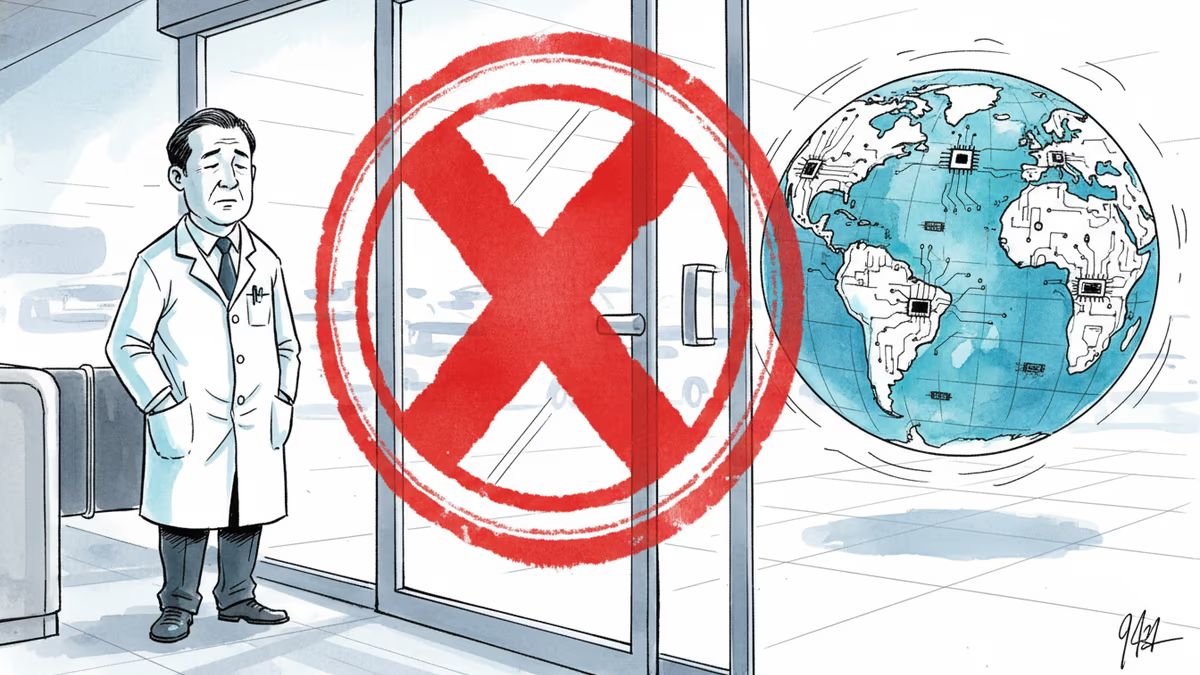
China is restricting AI researchers and startup founders from traveling abroad as the U.S.-China AI performance gap narrows to just 2.7%. What Beijing's talent lockdown means for the global AI race.
China's rules in force since Sept 2025 require 'AIGC' file metadata and platform checks. EU code signatories voluntarily pledge metadata plus a watermark for images, video and audio.
Korea's October exports rose 93.7% to $115.28 billion. Apple said its 47.9% gross margin included about 1 percentage point from tariff refunds. Plus China's draft tech export list.
Huawei's CANN is open source under a license barring software for non-Ascend chips. Inside China's second CUDA, and the two links still outside it: pre-training compute and 5nm capacity.
China is restricting AI researchers and startup founders from traveling abroad as the U.S.-China AI performance gap narrows to just 2.7%. What Beijing's talent lockdown means for the global AI race.
Thoughts
Share your thoughts on this article
Sign in to join the conversation