
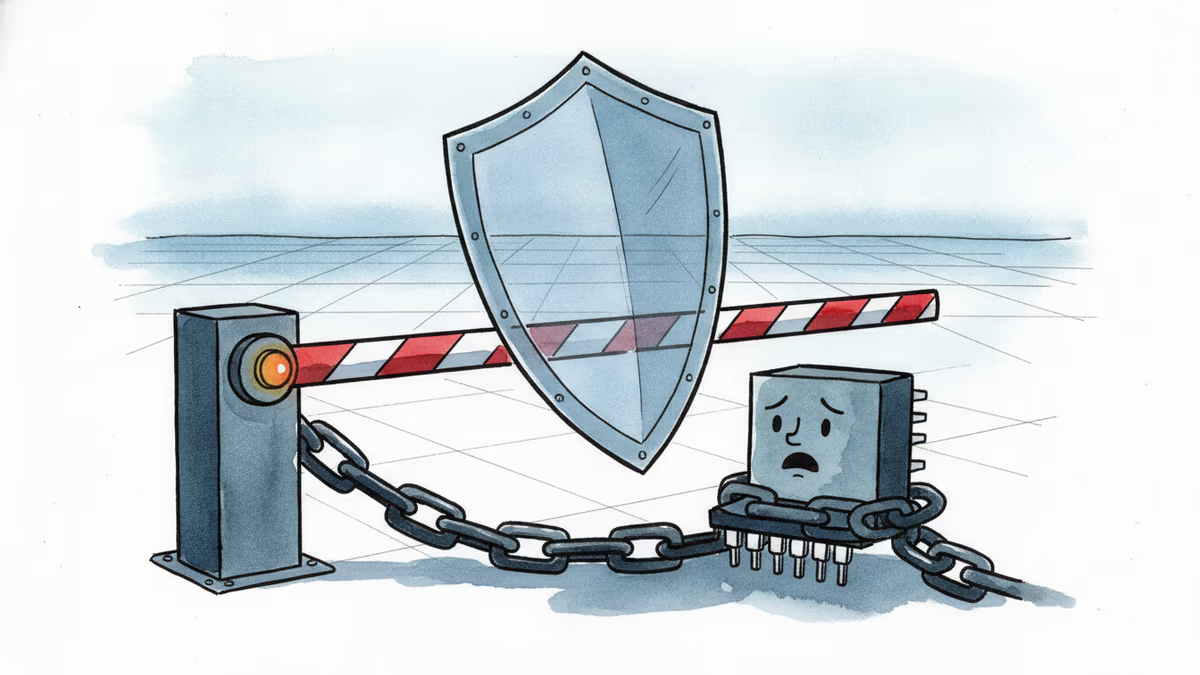
Nvidia Wrote Off China and Still Hit a Record Quarter. The Export Controls Behind It Are a Shield and a Cage
US AI-chip export controls split into three layers in the first half of 2026 — January easing, a May crackdown on circumvention, and a pending bill. Nvidia erased China from its guidance and still posted a record $81.6 billion quarter. A look at the export policy that both shields and cages it.
On its May earnings call, Nvidia stripped China's data-center compute revenue out of its forward guidance entirely. On the same call, the company reported $81.6 billion in quarterly revenue and $75.2 billion from its data-center segment — both records. Data-center sales climbed 92% year over year (Nvidia Q1 FY2027 results, May 20, 2026).
Read together, those two facts look like a contradiction. Nvidia zeroed out one of the world's largest markets on paper and posted its best quarter ever in the same breath. The hinge is US export controls on advanced AI accelerators. The rules themselves live in the Bureau of Industry and Security (BIS) — the arm of the US Commerce Department that polices strategic exports — and in the Federal Register, and their fallout shows up in Nvidia's SEC filings. Earlier in this series we looked at the CUDA software moat, the first line of defense that the market itself built over two decades. Export controls are the second layer, drawn by Washington rather than by the market. And this line of defense protects Nvidia and pens it in at the same time.
The Controls Didn't All Tighten in One Direction
A common read is that export controls only got tougher in 2026. The actual picture is messier. In the first half of the year alone, three forces pulled in opposite directions at once.
The first is easing. BIS issued a rule on January 13 and published it in the Federal Register on January 15, effective immediately (document number 2026-00789). It moved exports of H200-class chips to China from a "presumption of denial" to case-by-case review. The scope covers chips with total processing performance (TPP) under 21,000 and total DRAM bandwidth under 6,500 GB/s — Nvidia's H200 and AMD's MI325X both qualify. Easing didn't throw the door open, though. Exporters can't divert foundry capacity away from US customers. Shipments to China are capped at 50% of what a company sells to its US customers. And a chip has to clear pre-shipment testing at an independent US lab before a license issues.
The second is a crackdown on circumvention. On May 31, BIS guidance shifted the licensing test from a company's registered address to its "ultimate parent." Route a shipment through a shell subsidiary in Singapore or Malaysia, and if the ultimate parent sits in China or Macau, the presumption of denial still holds. This net covers Blackwell, Rubin, and AMD's MI350x (BIS guidance, May 31, 2026). January cracked the front door open; May locked the back one.
The third is pressure from Congress, and this is where the confusion creeps in. The AI OVERWATCH Act would ban sales of Blackwell-class chips to China for two years. The House Foreign Affairs Committee advanced it 42-2 on January 21, and a Senate version (S.4456) was introduced in May (congress.gov). But it isn't law. It's a pending bill that hasn't reached a floor vote. So "Blackwell is already banned" gets the facts wrong — a ban is being pushed, and it hasn't passed.
Put it together and a hand loosening the wall (January's easing) and a hand tightening it (May's crackdown) sit inside the same administration, while Congress moves separately to tighten it harder still. Compress all of that into "the US tightened its controls" and the tension vanishes.
Nvidia: "The Controls Backfired"
The bill for the controls arrived as numbers. On April 9, 2025, the US government told Nvidia that exporting its H20 chip to China would now require a license (Nvidia 10-Q). The hit landed fast. In the first quarter of fiscal 2026, Nvidia took a $4.5 billion charge on excess H20 inventory and purchase obligations, and it forecast an $8.0 billion loss in H20 revenue the following quarter (Nvidia Q1 FY2026 results, May 28, 2025).
CEO Jensen Huang aims his fire at the policy itself. He says Nvidia has effectively handed China's AI-chip market to Huawei — "we've evacuated that market," in his words (CNBC, May 21, 2026). He's also argued that the controls have "already largely backfired" (Tom's Hardware, May 2026). The logic runs like this: empty the market and Huawei fills the space, and all Washington has done is shrink the global reach of the American AI stack.

When Huang describes Nvidia's China share as "zero," that reads as rhetoric more than a measurement. Independent estimates land elsewhere. Bernstein pegs Nvidia's share of China's AI-chip market as falling from roughly 66% in 2024 to the single digits. The direction of that drop is what the earlier installment covered; the exact floor varies by who's counting. What's solid is that the revenue really did get cut, and that the company blames the controls for it.
Washington and the Hawks: "Like Selling Nuclear Weapons"
BIS starts from the opposite premise. Advanced AI accelerators are strategic goods close to weapons, the argument goes, and the aim is to cut off the path into China's military and state AI labs. Even the January rule was written as conditional permission rather than a giveaway. Exporters have to show they aren't shrinking the global chip-production capacity available to US customers, that they screen Chinese buyers, and that the chips pass third-party testing inside the US (BIS press release, January 13, 2026).
Outside the industry, the hawks push harder. Dario Amodei, CEO of the AI company Anthropic, has compared selling high-end chips to China to "selling nuclear weapons to North Korea" (quoted in Bloomberg, January 2026). One side calls the same policy a backfire; the other calls it something close to proliferation. Nvidia leans on revenue to argue for easing; the security camp leans on the risk of military diversion to argue for tightening. Neither has moved the other, and the policy keeps swinging between easing and crackdown.
China: The Crackdown That Sped Up Self-Sufficiency
The blowback shows up most clearly on the Chinese side. Huawei is reported to be planning roughly 600,000 units of its Ascend 910C AI chip in 2026, about double the prior year (Bloomberg, September 29, 2025). That figure is a production plan, not a shipment count. The performance gap is real, too. The 910C is built on SMIC's improved 7nm process, and its throughput is assessed at about one-third of Nvidia's B200, which uses TSMC's 4nm.
The Chinese math still works. If a single chip is slow, you wire many of them together horizontally into a cluster and get the compute that way. Alibaba, Tencent, and DeepSeek are all leaning harder on domestic hardware — the combined result of export controls and government pressure. This is the outcome Huang warns about. Once a model like DeepSeek is tuned to Huawei's architecture, unwinding it stops being a question of buying different chips and turns into a question of rewriting software. It's the mirror image of the CUDA lock-in from the earlier installment. This time China is walking away from CUDA and building its own lock-in on the other side.
Why the Crisis and the Record Quarter Ride Together
From an investor's angle, the earlier paradox resolves. Nvidia has already booked China risk at zero in its guidance. That means one more regulatory headline has that much less room to knock the outlook down further. The company chose to draw its growth without China. Blackwell and Rubin demand is filling the gap, and data-center revenue jumped 92% year over year.
There are weak links in the picture. If the AI OVERWATCH Act becomes law, it closes off Blackwell sales to China for two years and cuts the workaround revenue along with them. There's an allied variable, as well. On June 24, the Netherlands lobbied Washington not to widen controls on ASML's equipment sales to China (Bloomberg, June 24, 2026) — the point where security coordination collides with a country's own revenue. Japan sits in the same bind over equipment makers such as Tokyo Electron. And South Korea's Samsung and SK Hynix ride the Nvidia boom through their HBM memory while sitting in the indirect blast radius of equipment and memory controls aimed at China.
The Border Is Still Being Drawn
The first half of 2026 doesn't fold into a single line. BIS opened the door to H200-class chips conditionally in January and locked the workaround in May, while Congress pushes a separate bill to shut Blackwell out for good. In between, Nvidia erased its China revenue from guidance and still earned $81.6 billion for the quarter, and Huawei is eyeing the empty seat with a plan to make 600,000 units of the 910C. The forces point every which way.
What's clear is that the policy isn't settled. The administration pulls toward easing, Congress toward tightening. The next phase turns on a few concrete markers. First, whether the OVERWATCH Act becomes law. Second, whether H200 exports to China materialize at scale under a 25% tariff and testing requirements. A January presidential proclamation under Section 232 put a 25% tariff on imports of certain advanced chips, and the White House cited the H200 as an example. Law firm Gibson Dunn reads that proclamation together with BIS's January rule. By the firm's reading, H200s headed to China must pass through the US, pay the tariff and clear testing before they ship. Nvidia's separate deal to pay the US government 15% of its H20 sales in China was announced verbally in August 2025. Third, how close Huawei's real 910C shipments come to that 600,000-unit plan. Which way those markers move is the thread the Semiconductor Sovereignty series keeps pulling.
This content is AI-generated based on source articles. While we strive for accuracy, errors may occur. We recommend verifying with the original source.
Related Articles

Five stories from late September, traced to where the paper trail stops: Korea's export record, Nvidia's Hugging Face 8-K, a US-China AI channel, the UN on AI, and rising births.

Huawei's CANN is open source under a license barring software for non-Ascend chips. Inside China's second CUDA, and the two links still outside it: pre-training compute and 5nm capacity.
Nvidia shipped roughly a billion RISC-V cores in 2024, then announced it would run CUDA on the open standard. We break down how royalty-free instruction sets and open software stacks are trying to route around CUDA's lock-in. Part 2 of the Semiconductor Sovereignty series.
AMD's MI325X matches or beats Nvidia on memory and bandwidth — yet Nvidia's 86-92% share holds. The real moat is CUDA, 20 years in the making. Part 1 of 4.
Five stories from late September, traced to where the paper trail stops: Korea's export record, Nvidia's Hugging Face 8-K, a US-China AI channel, the UN on AI, and rising births.
Huawei's CANN is open source under a license barring software for non-Ascend chips. Inside China's second CUDA, and the two links still outside it: pre-training compute and 5nm capacity.
Nvidia shipped roughly a billion RISC-V cores in 2024, then announced it would run CUDA on the open standard. We break down how royalty-free instruction sets and open software stacks are trying to route around CUDA's lock-in. Part 2 of the Semiconductor Sovereignty series.
AMD's MI325X matches or beats Nvidia on memory and bandwidth — yet Nvidia's 86-92% share holds. The real moat is CUDA, 20 years in the making. Part 1 of 4.
Thoughts
Share your thoughts on this article
Sign in to join the conversation