

The $6B Deal That's Really About Dethroning Nvidia
Snowflake's new $6 billion AWS contract is about more than cloud spending. It signals a shift in AI infrastructure—away from Nvidia GPUs and toward cheaper, homegrown chips for the agent era.
In 13 years, Snowflake generated a cumulative $7 billion through the AWS Marketplace. Its new contract commits to $6 billion in just five. That's not a renewal. That's a statement.
What the Contract Actually Says
Snowflake is where enterprise data lives. Hundreds of thousands of companies store their structured data there, which makes it a natural launchpad for AI tools that need to actually know something. Two years ago, Snowflake launched Cortex AI—letting employees query databases in plain English, auto-generate summary reports, and build AI-powered workflows on top of their existing data. The pitch is simple: your data is already here, so why move it?
It's working. Snowflake customers spent $2 billion on AWS in 2025 alone—double the prior year. That acceleration is what underwrites a $6 billion forward commitment.
But the dollar figure isn't the most interesting clause in this deal. Buried in the announcement is Snowflake's explicit commitment to expand its use of AWS's homegrown ARM-based CPU chip: Graviton.
Why a CPU Deal Matters in a GPU World
The AI narrative has been dominated by GPUs—and by Nvidia. But that framing is increasingly incomplete.
AI workloads have phases. Training large models demands massive GPU clusters. Inference—running those models for billions of daily queries—is more mixed. But the next phase, agentic AI, is where the economics shift dramatically. AI agents that autonomously browse, decide, call APIs, and orchestrate multi-step tasks run enormous volumes of ordinary computation. That's CPU territory.

As AWS CEO Andy Jassy put it last month, Graviton offers better price-performance than Nvidia's offerings for these workloads. Amazon, characteristically cost-obsessed, says it passes those savings to customers. Apparently, customers are listening: last month, AWS inked a deal to supply Meta with millions of Graviton chips for AI compute—notable because Meta had signed a $10 billion deal with Google Cloud just months earlier.
Microsoft launched its own AI chip, Maia, in January. Google has operated its TPU line for years. All three cloud giants are now in the homegrown chip business, and all three are landing multi-billion-dollar contracts on the back of it.
Nvidia's Counterargument
None of this means Nvidia is losing. Last week, Jensen Huang reported another record quarter and declared that Vera—the company's new AI-specific CPU—represents a brand-new $200 billion market. He's already sold $20 billion worth.
The deeper moat isn't the silicon. It's the software. The entire AI development ecosystem—frameworks, libraries, model architectures—has been optimized for Nvidia's CUDA platform over more than a decade. Cloud providers can price-compete on chips all they want; the switching cost embedded in software compatibility is a different kind of barrier.
Even AWS acknowledges this implicitly: Graviton is being positioned for inference and agent workloads, not as a wholesale replacement for Nvidia GPUs in training. The two chip types are running in parallel on the same cloud.
The Stakeholder Map
For enterprise buyers like Snowflake's customers, this is straightforwardly good news. More chip competition means lower compute costs over time, and lower compute costs mean AI agents become economically viable at scale—not just for the hyperscalers, but for mid-market companies too.
For investors watching Nvidia, the picture is more nuanced. GPU demand for training and frontier reasoning isn't going away. But if the fastest-growing segment of AI workloads—agents running 24/7 automation—gets absorbed by Graviton, Maia, and TPU, then Nvidia's total addressable market may be smaller than the current narrative assumes.
For cloud providers, every homegrown chip deployed is a margin improvement and a lock-in mechanism. When your AI runs on AWS Graviton specifically, migrating to Azure or Google Cloud gets harder.
This content is AI-generated based on source articles. While we strive for accuracy, errors may occur. We recommend verifying with the original source.
Related Articles

Five stories from late September, traced to where the paper trail stops: Korea's export record, Nvidia's Hugging Face 8-K, a US-China AI channel, the UN on AI, and rising births.

Nvidia shipped roughly a billion RISC-V cores in 2024, then announced it would run CUDA on the open standard. We break down how royalty-free instruction sets and open software stacks are trying to route around CUDA's lock-in. Part 2 of the Semiconductor Sovereignty series.
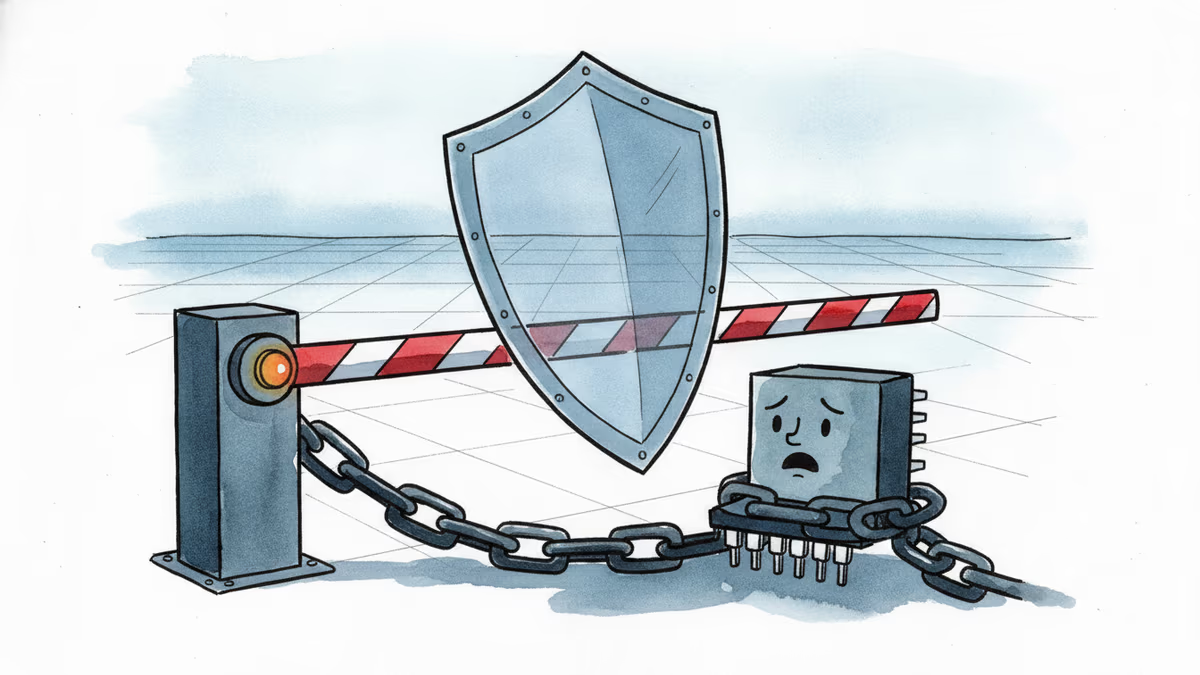
US AI-chip export controls split into three layers in the first half of 2026 — January easing, a May crackdown on circumvention, and a pending bill. Nvidia erased China from its guidance and still posted a record $81.6 billion quarter. A look at the export policy that both shields and cages it.
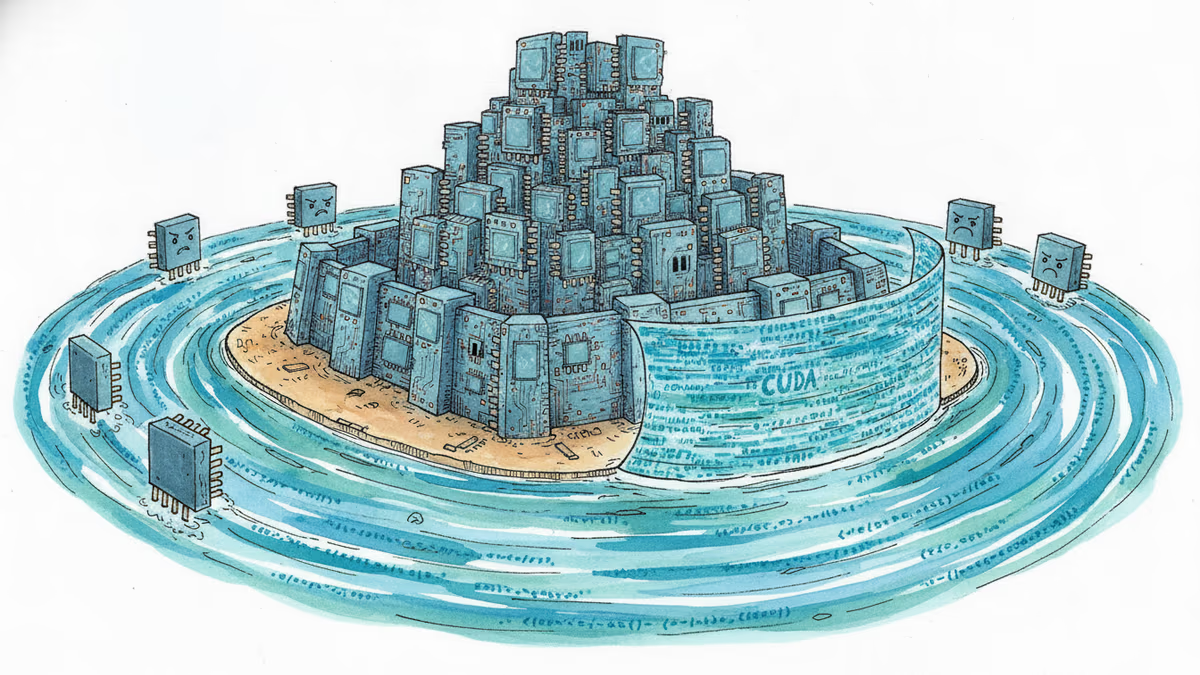
AMD's MI325X matches or beats Nvidia on memory and bandwidth — yet Nvidia's 86-92% share holds. The real moat is CUDA, 20 years in the making. Part 1 of 4.
Five stories from late September, traced to where the paper trail stops: Korea's export record, Nvidia's Hugging Face 8-K, a US-China AI channel, the UN on AI, and rising births.
Nvidia shipped roughly a billion RISC-V cores in 2024, then announced it would run CUDA on the open standard. We break down how royalty-free instruction sets and open software stacks are trying to route around CUDA's lock-in. Part 2 of the Semiconductor Sovereignty series.
US AI-chip export controls split into three layers in the first half of 2026 — January easing, a May crackdown on circumvention, and a pending bill. Nvidia erased China from its guidance and still posted a record $81.6 billion quarter. A look at the export policy that both shields and cages it.
AMD's MI325X matches or beats Nvidia on memory and bandwidth — yet Nvidia's 86-92% share holds. The real moat is CUDA, 20 years in the making. Part 1 of 4.
Thoughts
Share your thoughts on this article
Sign in to join the conversation