
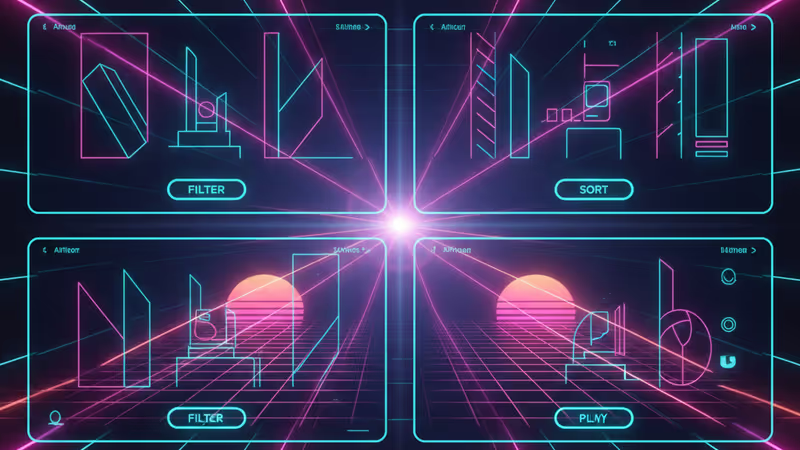
YouTube Search Filters Update 2026: Separating Shorts from Longform
YouTube introduces new search filters to separate Shorts and longform content. Learn more about the YouTube Search Filters Update 2026 and retired features.
Stop scrolling past what you didn't ask for. According to The Verge, YouTube is rolling out refined search filters that finally allow users to specifically toggle between Shorts and longform videos. It's a move aimed at ending the frustration of seeing mixed content formats when you're looking for something specific.
YouTube Search Filters Update 2026: More Control for Users
The updated search interface introduces distinct categories among its filtering options. In testing, selecting the 'Videos' filter exclusively displayed longform content, effectively hiding the vertical Shorts that usually clutter results. Conversely, the 'Shorts' filter focuses purely on short-form content, allowing creators and viewers to dive straight into the vertical feed without distractions.

Retiring Broken Features
Alongside these additions, YouTube is axing several legacy filters. The 'Upload Date - Last Hour' and 'Sort by Rating' options are being removed. The platform admitted these features weren't performing as expected and had led to significant user complaints. By removing these, Google-owned YouTube is streamlining its search engine to be more reliable in 2026.
Authors
Related Articles
In a post-Google I/O interview, Sundar Pichai acknowledged flawed search results, real AI anxiety, and an AGI timeline that makes the label irrelevant. Here's what he said — and what it means.
Google is building AI agents that search the web proactively, without user prompting. That's not just a product update — it's a fundamental shift in who controls the information you receive.
Google unveiled the 'Googlebook' platform to replace Chromebook and ChromeOS—but revealed zero hardware specs. What's the strategy, and what does it mean for users, manufacturers, and the education market?
After 15 years of fragmented mobile messaging, Apple and Google are rolling out end-to-end encrypted RCS messaging between iPhones and Android devices. Here's what changed, why it took so long, and what it means for your privacy.
In a post-Google I/O interview, Sundar Pichai acknowledged flawed search results, real AI anxiety, and an AGI timeline that makes the label irrelevant. Here's what he said — and what it means.
Google is building AI agents that search the web proactively, without user prompting. That's not just a product update — it's a fundamental shift in who controls the information you receive.
Google unveiled the 'Googlebook' platform to replace Chromebook and ChromeOS—but revealed zero hardware specs. What's the strategy, and what does it mean for users, manufacturers, and the education market?
After 15 years of fragmented mobile messaging, Apple and Google are rolling out end-to-end encrypted RCS messaging between iPhones and Android devices. Here's what changed, why it took so long, and what it means for your privacy.
Thoughts
Share your thoughts on this article
Sign in to join the conversation