
Google's Quiet Dictation App Could Upend a Crowded Market
Google launched Google AI Edge Eloquent, an offline-first AI dictation app for iOS. Built on Gemma, it strips filler words and polishes speech in real time — and it's free.
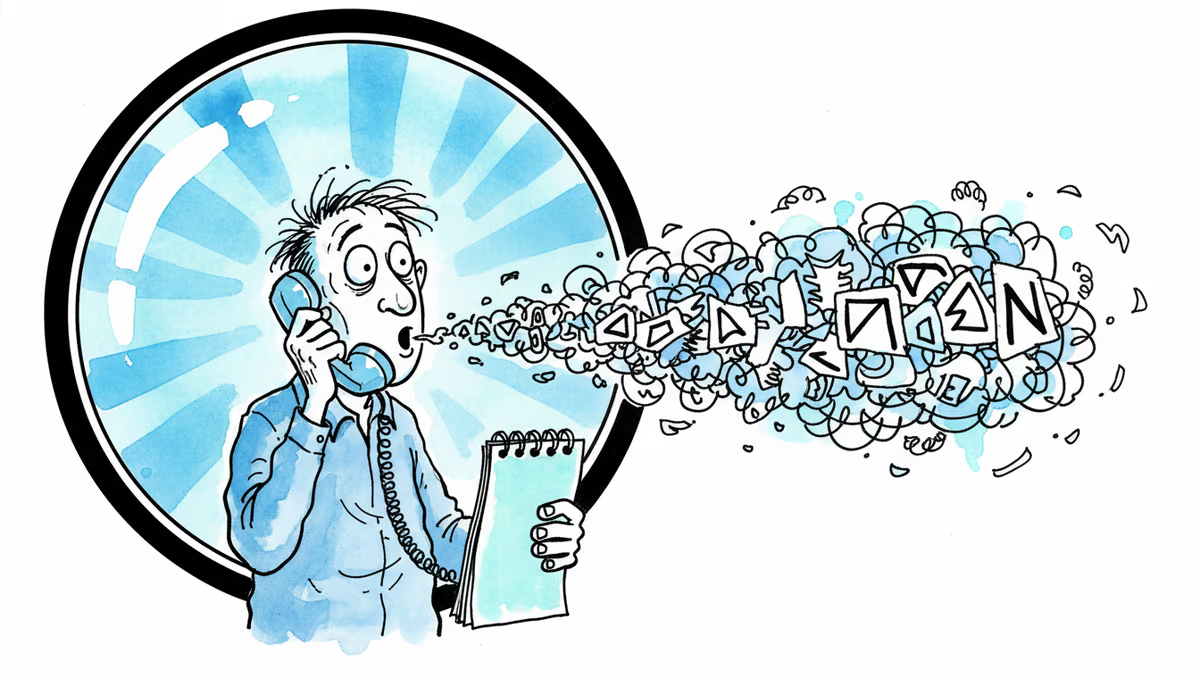
You're mid-sentence in a voice memo, stumbling over your own words. "So, uh, the — the key point here is, um, basically..." By the time you've transcribed and cleaned it up, you've spent more time editing than thinking. Google thinks that's a problem worth solving — and it just shipped an answer.
What Google Actually Built
Last week, Google quietly dropped Google AI Edge Eloquent on the iOS App Store. No press event, no blog post — just an app. But the technical decisions baked into it tell a deliberate story.
The app is built around two core ideas. First, offline-first processing. It downloads Gemma-based automatic speech recognition (ASR) models directly to your device, meaning transcription works without an internet connection. A cloud mode exists — when enabled, Gemini models handle text cleanup — but turn it off and everything stays on your phone. Second, intent over verbatim. When you pause speaking, the app automatically strips filler words like "um," "uh," and mid-sentence corrections, outputting clean prose. From there, you can reshape the same transcript into "Key points," "Formal," "Short," or "Long" versions with a tap.
The supporting features are worth noting too. The app can pull frequently used keywords, names, and jargon from your Gmail account to sharpen recognition accuracy, and you can add custom vocabulary manually. It also tracks words-per-minute speed and total words spoken per session — the kind of stats that matter to writers, journalists, and power users.
Currently iOS-only, the App Store description already references Android. On Android, Eloquent is planned to work as a default keyboard — system-wide, across any text field — plus a floating button for on-demand access, mirroring how Wispr Flow operates today.
Why This Matters Now

This isn't Google inventing a new category. Wispr Flow, SuperWhisper, and Willow have been quietly building loyal user bases among writers, developers, and knowledge workers who've discovered that speaking is faster than typing — if the transcription is clean enough. That last condition is the key: speech-to-text models have finally crossed a quality threshold where real habits are forming around them.
For Google, this market is too close to its core to ignore. Gboard and Google Docs already have voice input, but neither delivers the polished, intent-aware experience that the dedicated apps do. Eloquent is Google's attempt to close that gap — and simultaneously a real-world stress test for Gemma as an on-device AI model.
The timing also carries competitive weight. OpenAI's Advanced Voice Mode and Apple's deepening Siri integrations are all circling the same space: making voice a first-class input method on mobile. Google can't afford to cede that ground to anyone, including smaller startups that are currently eating its lunch in the productivity niche.
The Case For and the Case Against
The offline-first design is a genuine differentiator for privacy-conscious users. Lawyers reviewing case notes, doctors dictating patient summaries, executives discussing unreleased strategy — these are users who've historically avoided cloud-based transcription tools. An on-device option changes the calculus.
For everyday users, the filler-word removal alone could be transformative. The average person speaks at roughly 130 words per minute but types at 40. If voice-to-clean-text becomes seamless, the way people draft emails, messages, and documents could shift meaningfully.
But skepticism is warranted. This is explicitly an experimental app — Google's track record of quietly sunsetting experimental products is long. The Gmail integration raises a reasonable question: how much of your personal data is being accessed, and on what terms? And for non-English speakers, the filler-word filtering and natural language cleanup are likely trained primarily on English, which means accuracy in other languages is an open question.
The bigger concern for Wispr Flow and its peers isn't this app specifically — it's the scenario where Google decides to bake this functionality directly into Android's keyboard layer. At that point, the competition isn't a feature comparison; it's a distribution problem that no startup can easily solve.
Authors
Related Articles

In a post-Google I/O interview, Sundar Pichai acknowledged flawed search results, real AI anxiety, and an AGI timeline that makes the label irrelevant. Here's what he said — and what it means.
Google is building AI agents that search the web proactively, without user prompting. That's not just a product update — it's a fundamental shift in who controls the information you receive.

Google's Gmail Live lets you ask your inbox questions out loud. Announced at I/O 2026, it's AI's pitch to skeptics — and a reminder of how much Google already knows about you.
Google unveiled the 'Googlebook' platform to replace Chromebook and ChromeOS—but revealed zero hardware specs. What's the strategy, and what does it mean for users, manufacturers, and the education market?
In a post-Google I/O interview, Sundar Pichai acknowledged flawed search results, real AI anxiety, and an AGI timeline that makes the label irrelevant. Here's what he said — and what it means.
Google is building AI agents that search the web proactively, without user prompting. That's not just a product update — it's a fundamental shift in who controls the information you receive.
Google's Gmail Live lets you ask your inbox questions out loud. Announced at I/O 2026, it's AI's pitch to skeptics — and a reminder of how much Google already knows about you.
Google unveiled the 'Googlebook' platform to replace Chromebook and ChromeOS—but revealed zero hardware specs. What's the strategy, and what does it mean for users, manufacturers, and the education market?
Thoughts
Share your thoughts on this article
Sign in to join the conversation