
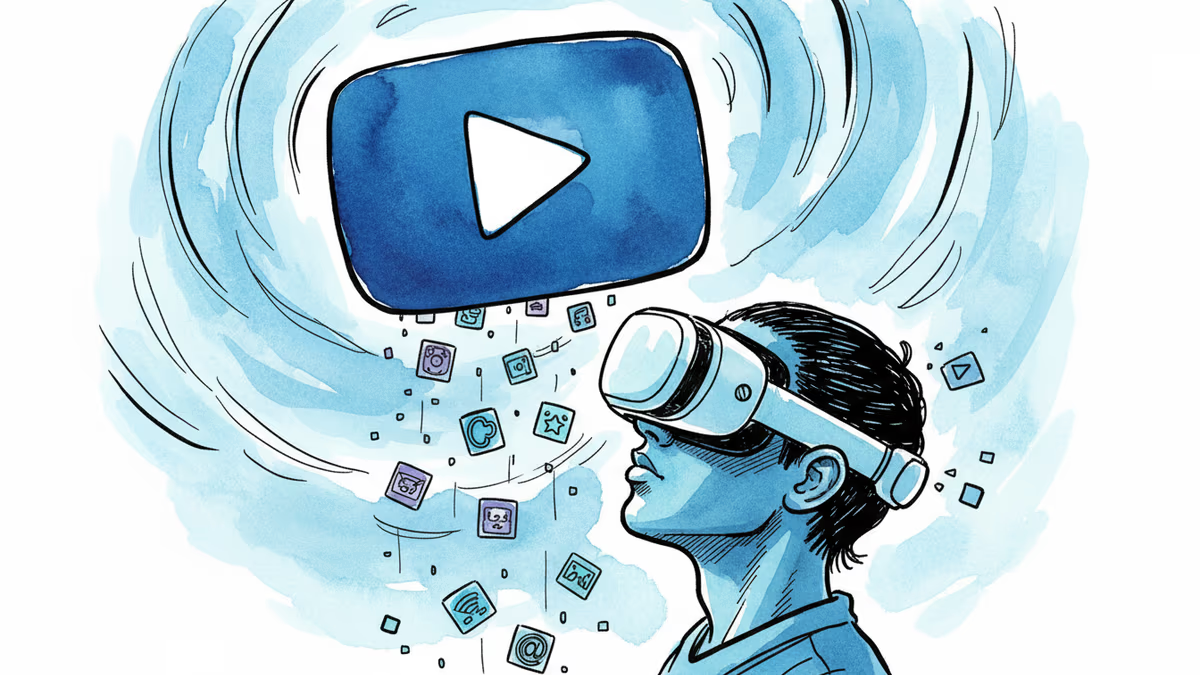
YouTube Finally Arrives on Vision Pro After Two-Year Wait
YouTube's official Vision Pro app launches Thursday, ending a contentious two-year standoff. What does this mean for Apple's spatial computing ambitions?
The $3,500 Headset That Couldn't Play YouTube
For two years, Apple Vision Pro owners have lived with a peculiar reality: they could manipulate 3D objects in virtual space, collaborate in immersive environments, and experience cutting-edge spatial computing—but they couldn't officially watch YouTube videos.
That changes Thursday, when YouTube finally launches its native visionOS app for Apple's premium headset. The app will support the full spectrum of YouTube content: standard videos, Shorts, 3D content, 360-degree videos, and VR180 experiences.
The Standoff That Shaped Spatial Computing
This wasn't a technical limitation—it was a strategic chess match. When the Vision Pro launched in early 2024, YouTube initially declined to build a native app, forcing users to rely on the Safari browser experience. The message was clear: Google wasn't ready to validate Apple's spatial computing platform.
But market dynamics shifted quickly. Just days after the Vision Pro hit store shelves, YouTube reversed course, announcing that a Vision Pro app was "on our roadmap." The timing wasn't coincidental—early adopters were vocal about the missing piece in their $3,500 puzzle.

Beyond the App Store Politics
This delay reveals deeper tensions in the spatial computing ecosystem. YouTube's hesitation wasn't just about development resources—it was about platform control. Google has its own AR/VR ambitions and wasn't eager to strengthen Apple's position in the emerging market.
For Apple, the YouTube gap represented a credibility problem. How could the company convince mainstream consumers to embrace spatial computing when the world's largest video platform was missing? The Vision Pro's mixed reality capabilities meant little if users couldn't access their daily content diet.
The Consumer Perspective Shift
Vision Pro owners developed workarounds—using Safari, third-party apps, and browser bookmarks. But these solutions highlighted a fundamental question: should premium hardware buyers accept compromised experiences due to corporate standoffs?
The arrival of official YouTube support changes the value proposition. 360-degree and VR180 content will finally have a proper home on Apple's platform, potentially driving more creators to experiment with immersive formats.
Authors
Related Articles

YouTube's 2025 ad revenue hit $40.4B, surpassing Disney, NBC, Paramount, and Warner Bros. Discovery combined. What this means for advertisers, creators, and the future of media.
ByteDance's Pico unveils OS 6 and Project Swan to challenge Apple Vision Pro, but analysts question the timing in an increasingly crowded XR market.
Apple's spring video podcast launch isn't just a feature update. It's a strategic play for the **$51 billion** podcasting market that could reshape how creators monetize content.
Apple adds seamless audio-video switching to Podcasts app, challenging YouTube's dominance in video podcasting. What this means for creators, listeners, and the streaming wars.
YouTube's 2025 ad revenue hit $40.4B, surpassing Disney, NBC, Paramount, and Warner Bros. Discovery combined. What this means for advertisers, creators, and the future of media.
ByteDance's Pico unveils OS 6 and Project Swan to challenge Apple Vision Pro, but analysts question the timing in an increasingly crowded XR market.
Apple's spring video podcast launch isn't just a feature update. It's a strategic play for the **$51 billion** podcasting market that could reshape how creators monetize content.
Apple adds seamless audio-video switching to Podcasts app, challenging YouTube's dominance in video podcasting. What this means for creators, listeners, and the streaming wars.
Thoughts
Share your thoughts on this article
Sign in to join the conversation