
When Your Countryside Becomes Silicon Valley's Backyard
As the UK fast-tracks AI infrastructure by relaxing green belt rules, rural communities face an uncomfortable question: Is their way of life worth sacrificing for technological progress?
$5 Billion Can't Buy You Love
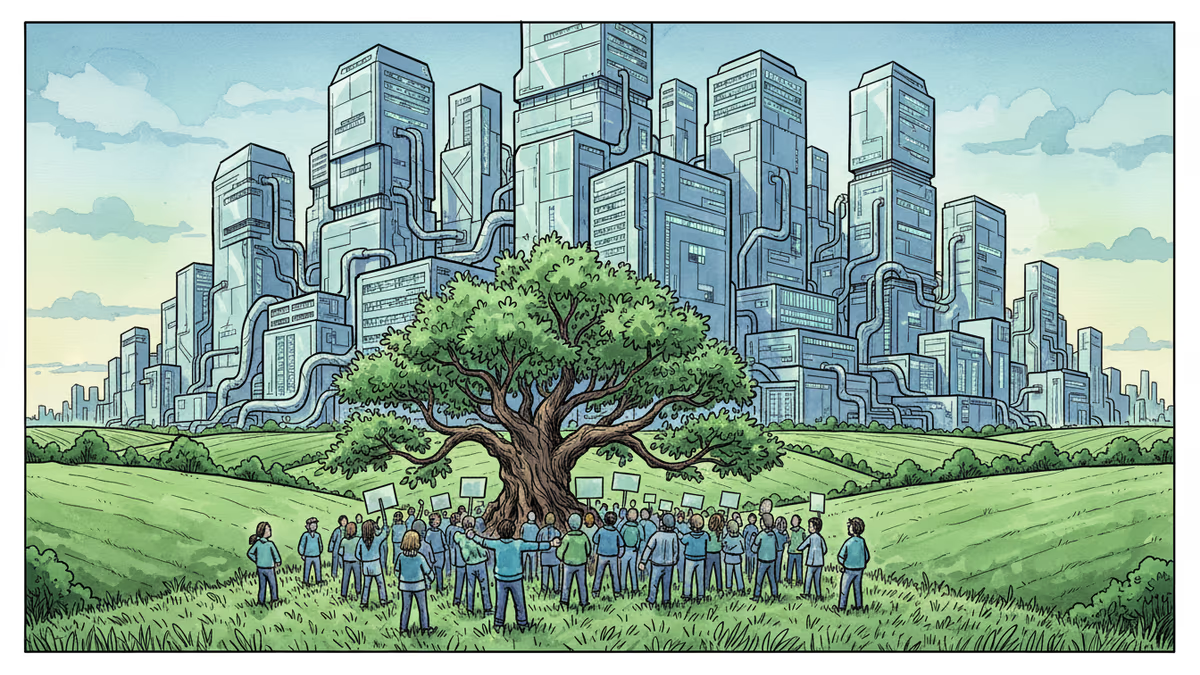
A lone oak tree stands in an 85-acre field outside London, its trunk adorned with a simple poster: "NO TO DATA CENTRE." Soon, this farmland will house one of Europe's largest data centers. The locals organized, protested, and gathered over 1,000 signatures against it.
They lost anyway.
In January 2025, the local council approved the project. By October, global data center operator Equinix had acquired the land. Construction starts this year. The story of Potters Bar reveals something uncomfortable about our AI-powered future: someone always pays the price, and it's rarely the ones making the decisions.
The Great Green Belt Gambit
For decades, London has been ringed by "green belt"—protected countryside where development requires "very special circumstances." It's been the UK's sacred cow of urban planning, preserving rural character and preventing cities from becoming sprawling megalopolises.
Then AI happened.
In 2024, the new government introduced "grey belt"—a designation for "underperforming" green belt land where construction should be easier. Simultaneously, they declared data centers "critical national infrastructure." Translation: the old rules don't apply anymore.
"People have this slightly romantic idea that all green belt land comprises pristine, rolling green fields," says Jeremy Newmark, leader of Hertsmere Borough Council. "The reality is that this site is anything but that."

But residents see a double standard. The same council recently blocked housing development on neighboring farmland to preserve "green belt and agricultural land." How can one field be dispensable while the adjacent plot is invaluable?
Silicon Valley Logic Meets Village Life
Equinix's pitch is compelling by Silicon Valley standards: $5+ billion investment, 2,500 construction jobs, 200 permanent positions, and $27 million in annual property taxes. Half of those taxes stay local, funding frontline services.
"If we want to continue to have the UK being a world player, absolutely data centers have to be built," says Andrew Higgins, Equinix's global head of masterplanning. The company promises to preserve half the site as green space, adding ponds, wetlands, and meadows to increase biodiversity.
Yet for Janet Longley, who's walked her dogs across these fields for decades, the economic arguments feel hollow. "I don't like the idea of being a NIMBY, because we need these things," she admits. "I use the internet all the time." Still, she can't help wishing this particular piece of infrastructure would be built somewhere else.
The protest group has tried everything: multiple objection letters, appeals to ombudsmen, complaints against council leaders. Nothing worked. "Get with the program," Newmark advised them.
The Filibuster Strategy
Faced with inevitable defeat, the protesters have adopted a different approach: delay tactics. They're objecting at every stage of the planning process, hoping to slow construction until political winds change. It's a long shot, but sometimes persistence pays off.
"The whole idea of public objection is writ large in the planning system in Britain," notes Michael Batty, emeritus professor of planning at University College London. "The pressure group, depending how well-organized it is, can make a big difference."
Equinix has three years from final approval to begin construction. Every month of delay costs money and momentum.
Authors
Related Articles

xAI's 27 temporary turbines in Mississippi are tormenting residents with constant noise. A look at the unexpected costs of AI infrastructure development.

OpenAI partners with Tata Group for 1-gigawatt AI infrastructure in India, targeting 100 million weekly users. Why India is becoming the third pillar of global AI competition.

Samsung Electronics' union branch revealed that 84% of survey respondents oppose the government's roughly $290 billion (₩400 trillion) semiconductor megaproject in Gwangju. Government, management, the union and shareholders are all reading the same national project in sharply different ways.
Nvidia shipped roughly a billion RISC-V cores in 2024, then announced it would run CUDA on the open standard. We break down how royalty-free instruction sets and open software stacks are trying to route around CUDA's lock-in. Part 2 of the Semiconductor Sovereignty series.
xAI's 27 temporary turbines in Mississippi are tormenting residents with constant noise. A look at the unexpected costs of AI infrastructure development.
OpenAI partners with Tata Group for 1-gigawatt AI infrastructure in India, targeting 100 million weekly users. Why India is becoming the third pillar of global AI competition.
Samsung Electronics' union branch revealed that 84% of survey respondents oppose the government's roughly $290 billion (₩400 trillion) semiconductor megaproject in Gwangju. Government, management, the union and shareholders are all reading the same national project in sharply different ways.
Nvidia shipped roughly a billion RISC-V cores in 2024, then announced it would run CUDA on the open standard. We break down how royalty-free instruction sets and open software stacks are trying to route around CUDA's lock-in. Part 2 of the Semiconductor Sovereignty series.
Thoughts
Share your thoughts on this article
Sign in to join the conversation