
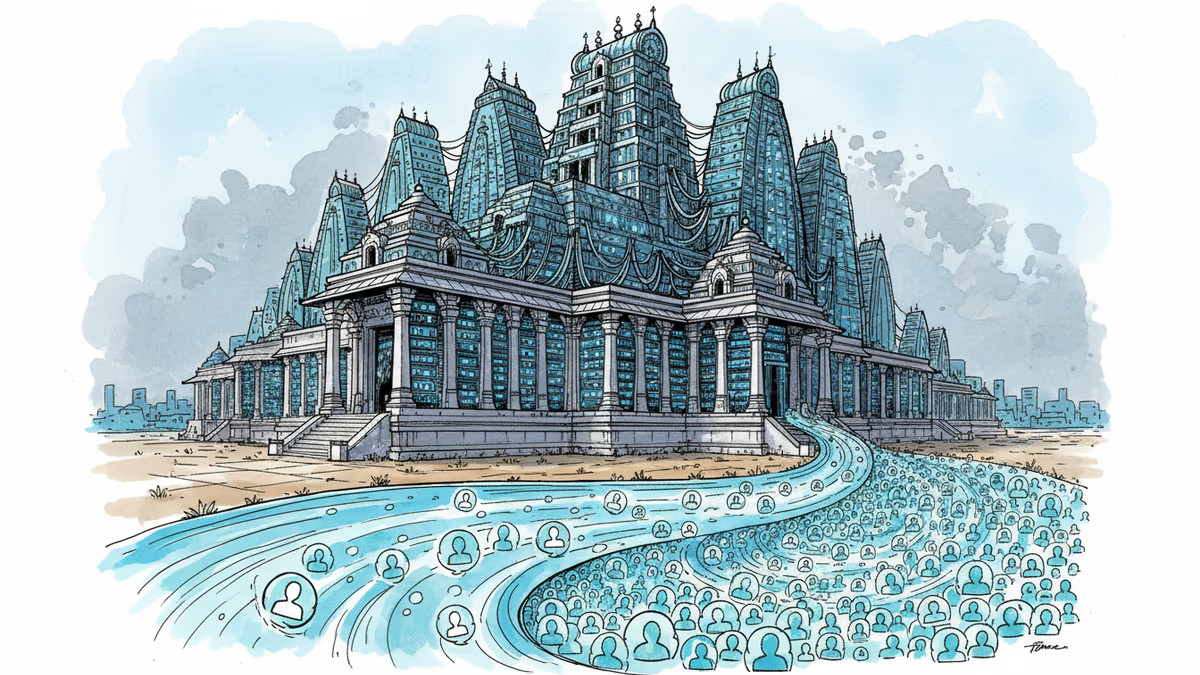
OpenAI Bets $2B on India as AI's Next Superpower
OpenAI partners with Tata Group for 1-gigawatt AI infrastructure in India, targeting 100 million weekly users. Why India is becoming the third pillar of global AI competition.
100 Million Weekly Users Can't Be Wrong
When Sam Altman drops a number like 100 million weekly ChatGPT users in India, the market listens. That's not just adoption—that's a digital revolution happening in real-time. Now OpenAI is putting its money where its mouth is: a $2 billion infrastructure bet with India's Tata Group that starts at 100 megawatts and scales to 1 gigawatt.
This isn't about renting server space. OpenAI is building its own AI fortress in one of the world's fastest-growing digital economies. The question isn't whether this move makes sense—it's whether other AI giants can afford not to follow.
The Data Residency Gambit
Here's what the press releases won't tell you: India's data localization laws are forcing OpenAI's hand. Financial services, healthcare, government agencies—they all need AI, but they can't send sensitive data overseas. OpenAI had a choice: lose the enterprise market or build local infrastructure.
They chose to build. And they're starting big.
Tata Consultancy Services will deploy ChatGPT Enterprise to hundreds of thousands of employees, making it one of the largest corporate AI rollouts globally. TCS engineers will standardize AI-native development using OpenAI's Codex tools. This isn't just a customer win—it's a template for how enterprise AI adoption scales in emerging markets.
The Talent Arbitrage Nobody Talks About

India produces more English-speaking software engineers than any other country. Silicon Valley's C-suites are packed with Indian-born leaders. Now OpenAI is betting that the next wave of killer AI applications will come from Indian developers who understand both cutting-edge technology and local market needs.
The timing isn't coincidental. As AI development costs soar and talent becomes scarce in the US, India offers a massive pool of skilled developers at a fraction of Silicon Valley wages. OpenAI isn't just building infrastructure—it's building a talent pipeline.
What This Means for Global Competition
Microsoft and Google are watching this closely. Both have significant Indian operations, but neither has made such a direct infrastructure commitment to AI workloads. OpenAI is essentially forcing their hand: match the investment or risk losing enterprise customers who need local data processing.
Amazon Web Services and Microsoft Azure have been the go-to choices for Indian enterprises. Now they face a competitor with purpose-built AI infrastructure and direct partnerships with local giants like Tata.
The ripple effects extend beyond cloud computing. Semiconductor demand will surge—good news for NVIDIA and memory manufacturers. Local startups will gain access to cutting-edge AI capabilities without the latency and compliance issues of overseas processing.
The Geopolitical Chess Move
While the US and China battle for AI supremacy, India is quietly positioning itself as the third pillar of global AI power. This isn't just about market size—though 1.4 billion people matter. It's about creating an alternative to the US-China AI duopoly.
Indian-born CEOs like Sundar Pichai and Satya Nadella are already steering major AI investments toward their home country. OpenAI's move legitimizes India as a strategic AI hub, not just a cost-effective development center.
The announcement comes during India's AI Impact Summit in New Delhi, where Altman is sharing the stage with Anthropic's Dario Amodei and Pichai. The symbolism is clear: India isn't just consuming AI—it's helping shape its future.
Authors
Related Articles

SolarSquare is raising $55-60M at a $450-500M valuation, more than doubling its worth in 18 months. Here's what's driving investor conviction in India's residential solar market.
Indian venture capital has quietly displaced Silicon Valley in its own backyard. Only one American VC made India's top 10 investor list last year. Here's why that matters beyond India.

OpenAI has reorganized for the second time in a month, merging ChatGPT and Codex into a single agentic platform under president Greg Brockman's unified product leadership.
After two weeks of witnesses calling him a liar, OpenAI CEO Sam Altman testified in his own defense, claiming Elon Musk tried to kill the company twice.
SolarSquare is raising $55-60M at a $450-500M valuation, more than doubling its worth in 18 months. Here's what's driving investor conviction in India's residential solar market.
Indian venture capital has quietly displaced Silicon Valley in its own backyard. Only one American VC made India's top 10 investor list last year. Here's why that matters beyond India.
OpenAI has reorganized for the second time in a month, merging ChatGPT and Codex into a single agentic platform under president Greg Brockman's unified product leadership.
After two weeks of witnesses calling him a liar, OpenAI CEO Sam Altman testified in his own defense, claiming Elon Musk tried to kill the company twice.
Thoughts
Share your thoughts on this article
Sign in to join the conversation