
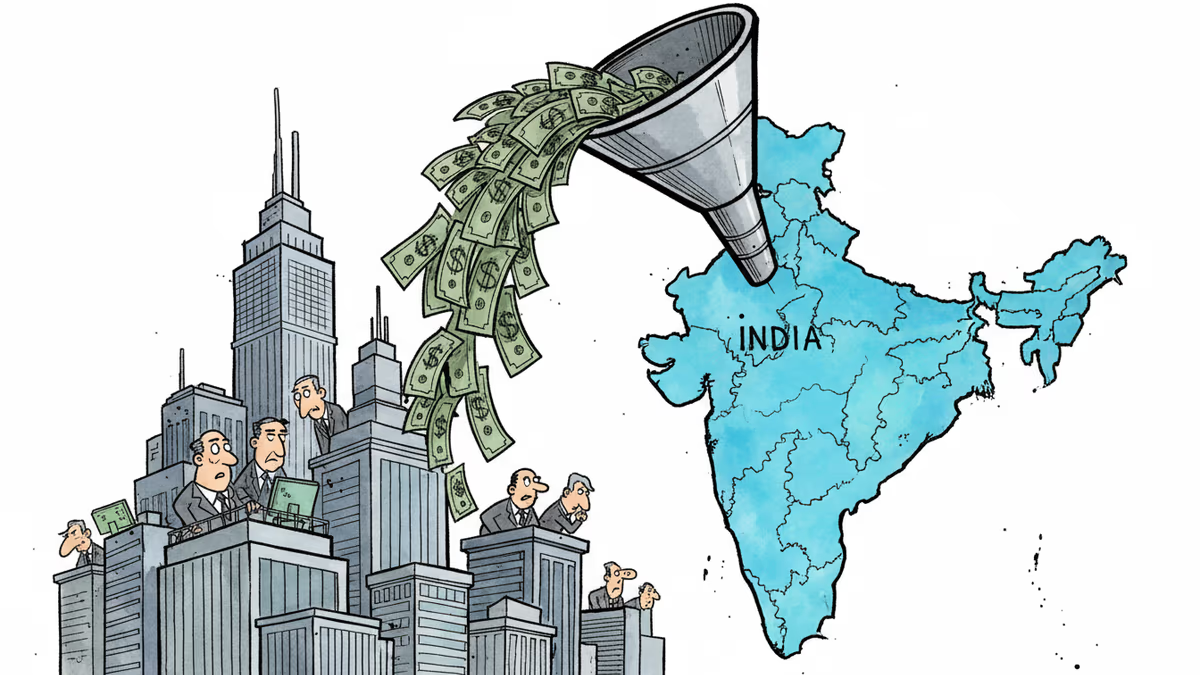
Why $5 Billion Just Followed the Crowd to India
General Catalyst's $5B India commitment signals a massive shift in global tech investment. What Silicon Valley sees in India's AI boom that others might be missing.
$5 Billion Just Changed Direction
When General Catalyst announced it's pumping $5 billion into India over five years—a 5x increase from its original plan—it wasn't just making headlines. It was following a pattern. Adani Group and Reliance Industries committed over $200 billion for AI infrastructure. OpenAI partnered with Tata Group for a 100-megawatt data center. Amazon, Google, and Microsoft outlined tens of billions more.
That's a lot of zeros pointing in one direction. But why India, and why now?
The Deployment Advantage
General Catalyst CEO Hemant Taneja didn't mince words: "India will build the next generation of global platform companies." But here's the twist—he's not betting on India to create the next ChatGPT or breakthrough AI model. He's betting on something arguably more valuable: massive real-world deployment.
India has 1.4 billion people and 1 billion internet users. More importantly, it has government-built digital infrastructure that processes 13 billion UPI transactions monthly. That's not just scale—it's a testing ground for AI applications that need to work for enormous populations.
Consider Zepto, the 10-minute delivery startup now valued at $2 billion. It's not revolutionary technology, but revolutionary execution at impossible scale. That's what has Silicon Valley's attention.
The Skeptics Have a Point

Not everyone's convinced this gold rush makes sense. Critics point to India's complex regulatory environment, infrastructure gaps outside major cities, and the challenge of monetizing services for price-sensitive consumers.
"We've seen this movie before," says one Silicon Valley veteran who requested anonymity. "Remember when everyone was going to crack the China market? Different challenges, same hype cycle."
There's also the talent paradox. India produces exceptional engineers, but many of the best ones leave for higher-paying jobs in the US or Europe. Can the ecosystem retain enough top talent to justify these massive investments?
What the Numbers Don't Tell You
Beyond the headline figures lies a more nuanced story. India's AI opportunity isn't just about market size—it's about market structure. Unlike mature economies where AI must displace existing solutions, India can leapfrog directly to AI-first approaches.
Take healthcare. While US companies struggle to integrate AI into complex existing systems, Indian startups can build AI-native solutions from scratch. The same logic applies to financial services, education, and logistics.
General Catalyst's Neeraj Arora emphasized this point: the firm is developing frameworks to "accelerate large-scale AI adoption" rather than just funding individual startups. They're betting on systemic transformation, not just unicorn hunting.
The Global Implications
This investment wave has implications far beyond India's borders. If India becomes the world's AI deployment laboratory, it could set global standards for how AI integrates with society at scale. That's a form of soft power that traditional tech hubs like Silicon Valley or Shenzhen can't easily replicate.
For global investors, the question isn't whether India will produce the next big AI breakthrough—it's whether India will define how AI actually gets used by billions of people. And in a world where deployment often matters more than innovation, that might be the more valuable bet.
Authors
Related Articles

SolarSquare is raising $55-60M at a $450-500M valuation, more than doubling its worth in 18 months. Here's what's driving investor conviction in India's residential solar market.

Indian venture capital has quietly displaced Silicon Valley in its own backyard. Only one American VC made India's top 10 investor list last year. Here's why that matters beyond India.

Emails revealed in the Musk v. Altman trial show Microsoft executives were deeply skeptical of OpenAI in 2017–2018. What actually changed their minds?
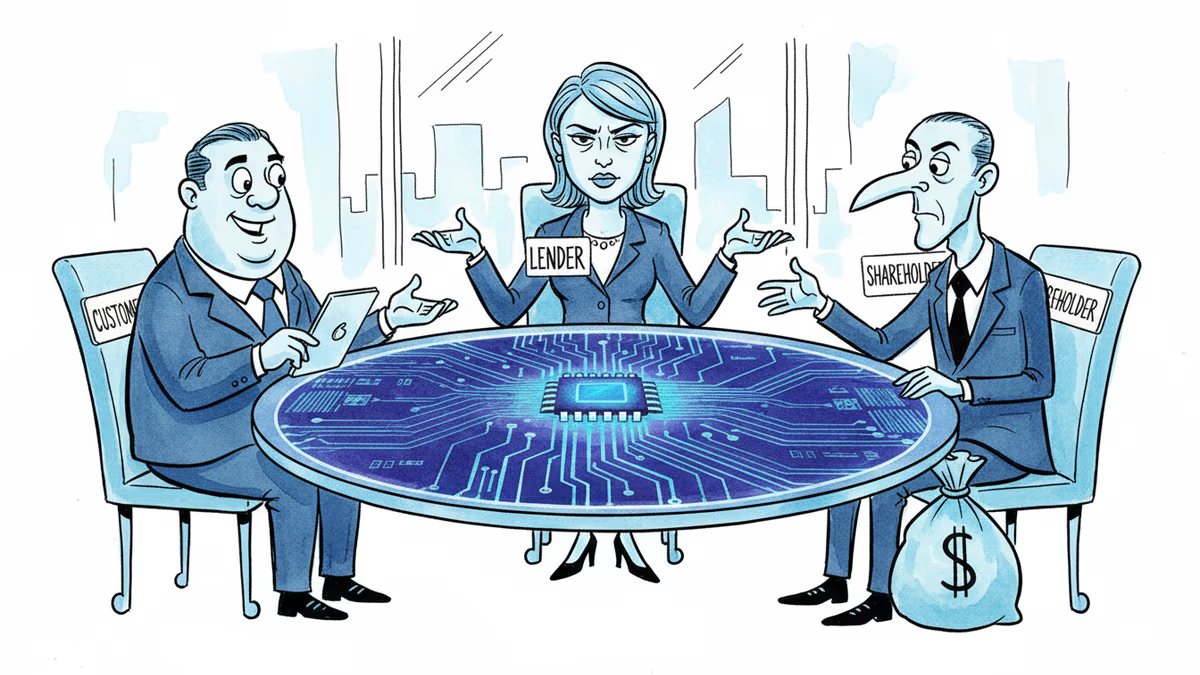
Cerebras Systems is targeting a $26.6B valuation in what could be 2026's largest tech IPO. But the real story is how deeply OpenAI is embedded in its capital structure—as customer, lender, and potential shareholder.
SolarSquare is raising $55-60M at a $450-500M valuation, more than doubling its worth in 18 months. Here's what's driving investor conviction in India's residential solar market.
Indian venture capital has quietly displaced Silicon Valley in its own backyard. Only one American VC made India's top 10 investor list last year. Here's why that matters beyond India.
Emails revealed in the Musk v. Altman trial show Microsoft executives were deeply skeptical of OpenAI in 2017–2018. What actually changed their minds?
Cerebras Systems is targeting a $26.6B valuation in what could be 2026's largest tech IPO. But the real story is how deeply OpenAI is embedded in its capital structure—as customer, lender, and potential shareholder.
Thoughts
Share your thoughts on this article
Sign in to join the conversation