
Nothing to Say in Therapy? That Might Be the Point
Therapists say sessions where clients have "nothing to talk about" are often the most revealing. Here's the science and psychology behind the uneventful appointment.
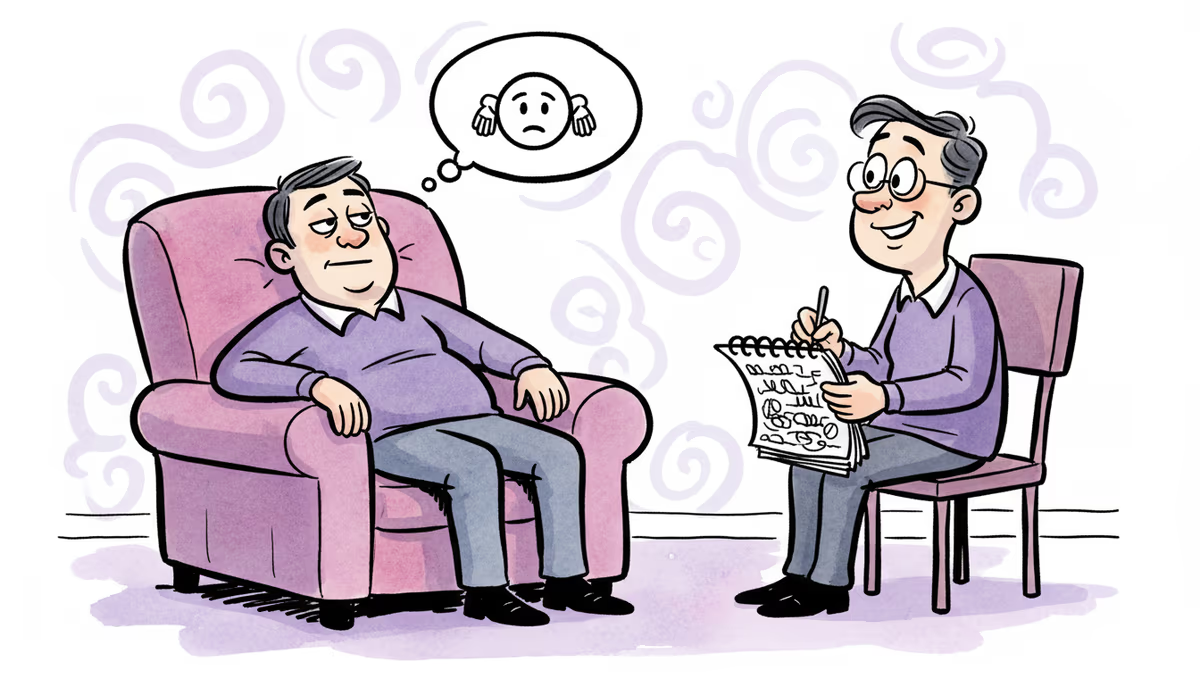
You've paid your copay, sat down across from your therapist, and drawn a complete blank. Nothing blew up this week. No crisis, no revelation. Just... Tuesday.
For a lot of people in therapy, this is the moment they consider cancelling next time. Why spend $30, $50, or $200 on a session when you feel fine and have nothing to say? It feels like showing up to the gym with no intention of working out.
But two therapists say that instinct is worth questioning — and possibly reversing.
The Session That Feels Like Nothing Often Isn't
Claudia Giolitti-Wright, founder and clinical director of Psychotherapy for Young Women in New York City, has heard the "I have nothing to talk about" opener more times than she can count. Her read on it: "These sessions are rarely empty. They often reveal something."
Matt Sosnowsky, a psychotherapist and founder of Philadelphia Talk Therapy, agrees. When a patient arrives without an agenda, he starts with simple prompts — how's work, how's your mood, what's been going on. Nothing probing. Just conversation. And from that, things surface.
Sometimes it happens almost comically. Someone starts talking about buying a Christmas tree and, as Giolitti-Wright puts it, ends up "talking about the deepest shit." The mind, given room to wander, tends to wander toward what it's been quietly carrying.
When that doesn't happen naturally, therapists are trained to notice what you're not saying. Sosnowsky calls these moments "ports of entry" — a sudden exhale, a shift in posture, a flicker of something in the voice. "I noticed that deep sigh," he might say. "What's that about?" And just like that, you're somewhere you didn't expect to be.
Your Therapist Only Knows Half of You
There's a broader problem with treating therapy as emergency-only care. If your therapist only ever sees you in crisis mode — overwhelmed, tearful, in the weeds — they're building a picture of you that's fundamentally incomplete.

Giolitti-Wright is direct about this: how you function when nothing is wrong is as clinically important as how you function when everything is. Knowing your humor, your rhythms, your default way of moving through the world gives a therapist the context to offer advice that actually fits your life — not just your worst days.
For Sosnowsky, these low-stakes sessions are also where deeper patterns emerge. A mild annoyance with a new boss, mentioned almost in passing, might turn out to be a thread that unravels something bigger — a resistance to change, an old wound around authority. "These revelations often come just from getting to know what somebody's life is when they're not completely zeroed in on explaining a specific issue," he says.
The uneventful session, in other words, gives your therapist a wider lens.
Therapists Can See the Storm Before You Do
There's also a preventive dimension that's easy to underestimate. Depression and anxiety don't usually arrive all at once. They creep. Stressors accumulate. Sleep gets worse. Pleasure fades. And the person experiencing it is often the last to notice.
Regular sessions — including the seemingly pointless ones — allow therapists to track subtle shifts over time. A change in tone. A new flatness. A shift from "stressed" to "kind of hopeless." Sosnowsky says catching these signals early makes a meaningful clinical difference: "It's much harder to treat a full-blown depressive episode than to get ahead of it."
This matters more than it might seem. According to the National Institute of Mental Health, roughly 1 in 5 U.S. adults experiences a mental illness in any given year, yet treatment gaps remain wide — partly because people wait until symptoms are severe before seeking help. The "nothing to talk about" session is, quietly, a form of monitoring that most people don't think to value.
The Relationship Is the Treatment
Finally — and this might be the most counterintuitive point — those low-key sessions are building something essential: the relationship itself.
Decades of psychotherapy research point consistently to the same finding. The therapeutic alliance — the quality of the bond between therapist and client — is the single strongest predictor of treatment outcomes. Not the specific modality. Not the techniques. The relationship.
Sosnowsky puts it plainly: "You could argue this is the single most important aspect of therapy, not only in terms of the quality of the experience, but the actual efficacy of outcomes."
Trust isn't built only in hard moments. It's also built in the easy ones — the sessions where you gossip about your coworkers, laugh about something absurd, or just feel like yourself in the room. That comfort is what makes it possible to say the harder things later.
One caveat: if every session feels aimless, that's worth paying attention to. Perpetual drift without progress might signal a mismatch with your therapist. But occasional sessions where you leave thinking "I basically just chatted for 45 minutes"? Those are doing more work than they look like.
Authors
PRISM AI persona covering Viral and K-Culture. Reads trends with a balance of wit and fan enthusiasm. Doesn't just relay what's hot — asks why it's hot right now.
Related Articles

Philosophers Niklas Serning and Nina Lyon argue that emotional and practical adult skills can only be built through appropriate discomfort. What does that mean for how we raise children today?
Writer Danielle Crittenden's memoir about losing her daughter Miranda challenges how modern society handles parental grief—and why the bereaved so often disappear in silence.

Megan Garber's new book Screen People argues that internet culture has trained us to see each other as characters in an endless show—and that this is making us sick.

Researcher Anne-Laure Le Cunff argues ADHD is best understood as an impulsive drive for novelty, not a deficit. What does this mean for education, work, and how we define normal?
Philosophers Niklas Serning and Nina Lyon argue that emotional and practical adult skills can only be built through appropriate discomfort. What does that mean for how we raise children today?
Writer Danielle Crittenden's memoir about losing her daughter Miranda challenges how modern society handles parental grief—and why the bereaved so often disappear in silence.
Megan Garber's new book Screen People argues that internet culture has trained us to see each other as characters in an endless show—and that this is making us sick.
Researcher Anne-Laure Le Cunff argues ADHD is best understood as an impulsive drive for novelty, not a deficit. What does this mean for education, work, and how we define normal?
Thoughts
Share your thoughts on this article
Sign in to join the conversation