
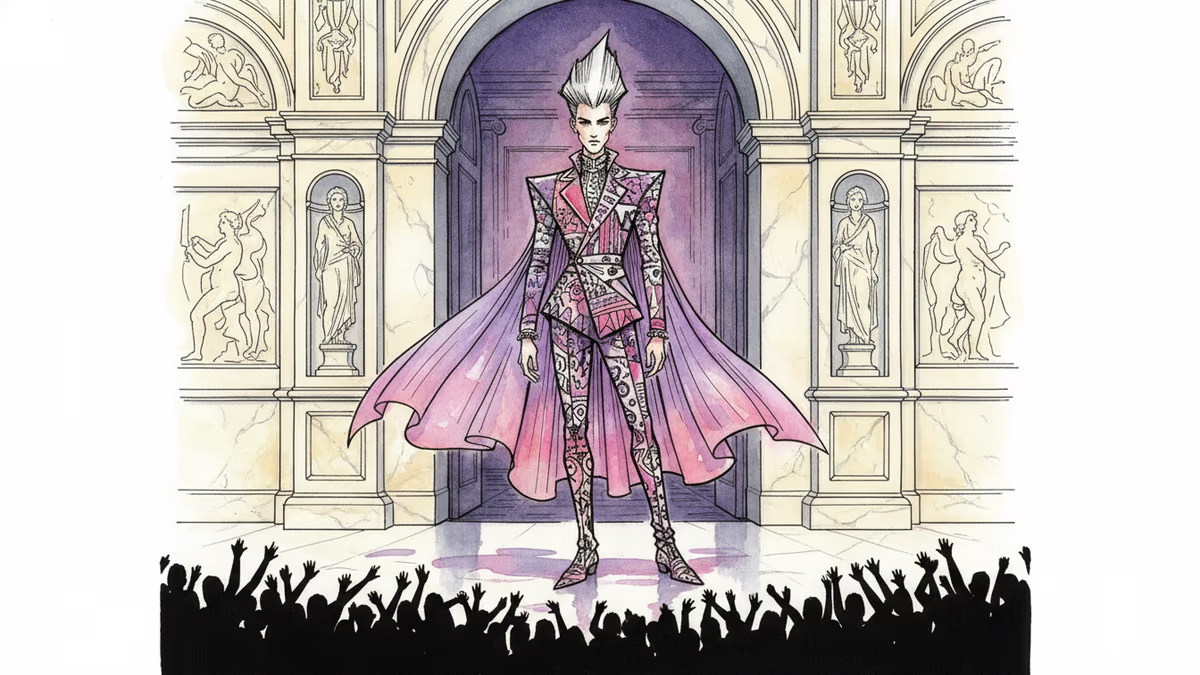
Yeonjun, Miu Miu, and the Architecture of Fandom Luxury
TXT's Yeonjun becomes Miu Miu's first official "Friend of the House" — a title that signals how luxury fashion is quietly restructuring its relationship with K-pop fandoms.
Five years ago, luxury houses debated whether K-pop fandoms were compatible with the idea of exclusivity. Today, Miu Miu is handing Yeonjun of TXT a title no one has held before.
This week, Miu Miu announced Yeonjun as its first-ever official "Friend of the House" — a designation the brand describes as reserved for partners who genuinely share its aesthetic values. The phrasing matters: this isn't "global ambassador" or "brand muse." It's a title the house is defining, in real time, around a single person.
What "Friend of the House" Actually Means
The term ami de la maison has floated around luxury fashion informally for decades — a softer way to describe celebrities who orbit a brand without a formal contract. Miu Miu making it an official, named first is a deliberate act of brand storytelling. It positions Yeonjun not as a hired face but as a creative peer, someone whose sensibility the house claims to recognize rather than simply purchase.
Whether that distinction holds up in practice is a separate question. But the framing itself tells us something about where luxury marketing is heading: away from transactional endorsement language, toward the vocabulary of artistic affinity. The goal is to make the partnership feel less like advertising and more like curation.
Why Yeonjun, Why Now
Yeonjun is arguably the member of TXT with the most legible fashion identity — gender-fluid styling, a physicality on stage that reads as performative art, and a reputation within the MOA fandom as the group's aesthetic anchor. Miu Miu's brand DNA — intellectually playful, deliberately unconventional, younger-skewing than parent brand Prada — maps onto that image with reasonable coherence.

The business logic runs deeper than aesthetics, though. Miu Miu has spent the last several years carving out a distinct identity from Prada Group's flagship: edgier, less heritage-dependent, more attuned to a consumer who finds traditional luxury slightly exhausting. Yeonjun's fanbase — largely in their late teens and twenties, digitally native, and demonstrably willing to spend on artist-adjacent products — is precisely the cohort Miu Miu needs to cultivate for the next decade.
The Five-Year Shift in Luxury × K-Pop
When Louis Vuitton signed all of BTS in 2021, skeptics raised two objections: that mass fandom would dilute luxury's scarcity mystique, and that idol careers were too volatile to anchor brand equity. Neither concern has materialized in the way critics predicted.
Across Louis Vuitton, Gucci, Burberry, and Celine, K-pop ambassador appointments have correlated with measurable upticks in Asian market performance. More structurally, the fandom practice of "certification purchasing" — buying and publicly documenting items worn by an ambassador — has functionally replaced significant portions of digital marketing spend. Fans generate the content; brands harvest the reach.
Miu Miu's move follows this validated playbook, but the "first" framing attempts to extract additional value from novelty. The question is how durable that novelty is. Once every major house has its own variation of a K-pop "Friend," the differentiation collapses back into category noise.
The Asymmetry Nobody Talks About
There's a structural imbalance worth naming. Luxury brands absorb fandom purchasing power and, over time, gain an association with youth cultural capital. The K-pop artist gains visibility in fashion media and access to a global brand platform — but rarely achieves parity of institutional standing with the house itself.
A handful of artists have begun to shift this dynamic. BLACKPINK's Jennie co-designing with Calvin Klein, or BTS's J-Hope moving from ambassador to Louis Vuitton runway presence, suggest the ceiling is rising. Whether Yeonjun's "Friend of the House" title represents a step toward genuine creative collaboration — or a more sophisticated version of the same transaction — will become clearer in how Miu Miu actually deploys the partnership over the next few seasons.
This content is AI-generated based on source articles. While we strive for accuracy, errors may occur. We recommend verifying with the original source.
Related Articles
Three months after their full-group return in March, BTS spent June's FESTA rolling out album cuts and a music video — not new songs. Come Over cracked a global top 5 with zero new music behind it. Did the play work?
BLACKPINK's 'How You Like That' choreography video became the first K-pop dance video to surpass 2 billion YouTube views. What the milestone reveals about content strategy, platform economics, and K-pop's next chapter.

&TEAM's 'We on Fire' debuted on the Billboard 200 for the first time. Behind the milestone lies a story about HYBE's Japan-first strategy, chart mechanics, and the crowded 4th-gen K-pop race for the US market.

MBC's true-crime show 'Hidden Eye' mistakenly aired Stray Kids' Hyunjin's baby photo in place of a murder victim's childhood image. Five months later, an apology. What does that timeline reveal?
Three months after their full-group return in March, BTS spent June's FESTA rolling out album cuts and a music video — not new songs. Come Over cracked a global top 5 with zero new music behind it. Did the play work?
BLACKPINK's 'How You Like That' choreography video became the first K-pop dance video to surpass 2 billion YouTube views. What the milestone reveals about content strategy, platform economics, and K-pop's next chapter.
&TEAM's 'We on Fire' debuted on the Billboard 200 for the first time. Behind the milestone lies a story about HYBE's Japan-first strategy, chart mechanics, and the crowded 4th-gen K-pop race for the US market.
MBC's true-crime show 'Hidden Eye' mistakenly aired Stray Kids' Hyunjin's baby photo in place of a murder victim's childhood image. Five months later, an apology. What does that timeline reveal?
Thoughts
Share your thoughts on this article
Sign in to join the conversation