
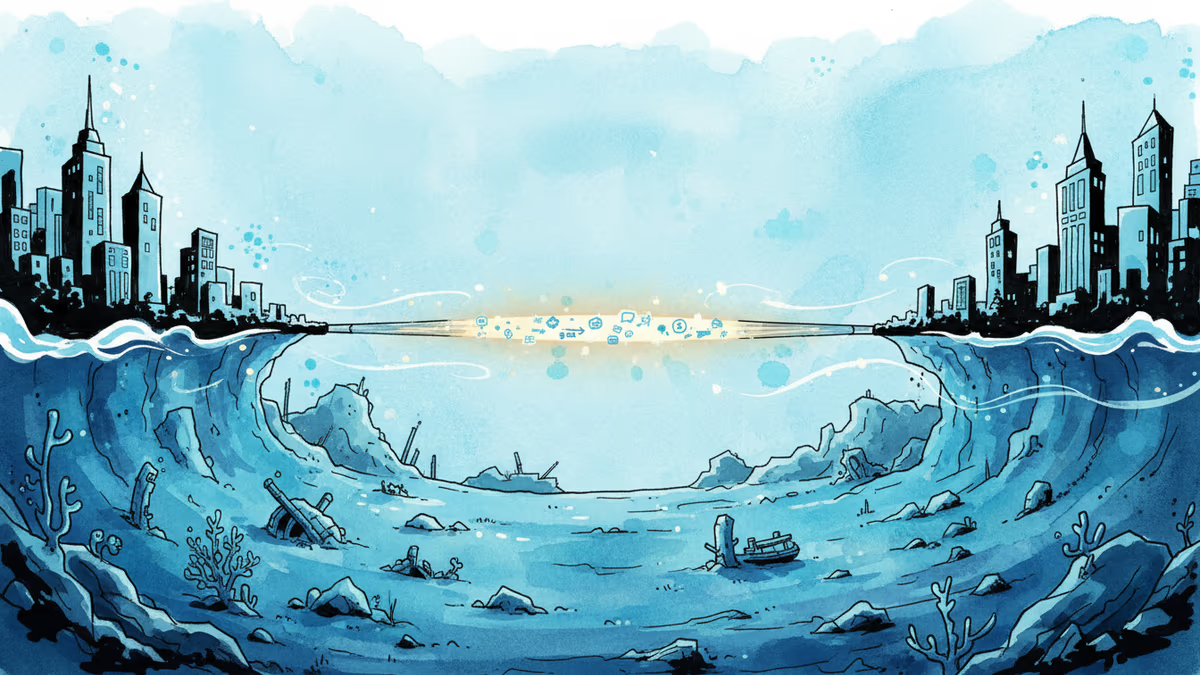
The Glass Thread That Holds the Internet Together
Fiber optics turns 60 in 2026. Made from the same material as beach sand, this hair-thin glass strand quietly underpins the internet, AI, and nearly every digital interaction in modern life.
Every message you've ever sent, every movie you've ever streamed, every search you've ever made — all of it traveled through a strand of glass thinner than a human hair.
Not a cable. Not a wire. A strand of glass. And in 2026, that strand turns 60 years old.
Fiber optics is the kind of technology that nobody thinks about and everyone depends on. It sits beneath oceans and inside walls, invisible and unnoticed, moving information at the speed of light. The internet as we know it — and increasingly, AI as we know it — runs on it. Yet most people couldn't explain what it is or how it works. That's worth fixing.
Sand, Glass, and a Race for Purity
At its core, fiber optics is disarmingly simple: hair-thin strands of glass that trap and carry light. Information encoded onto pulses of that light — billions of flickers per second — is how data moves from one place to another. The fiber's job is to keep that light from escaping or fading over hundreds of miles.
The material that makes this possible is silicon dioxide, or silica. Chemically, it's the same stuff as beach sand. The difference is purity. Beach sand is riddled with impurities from geological weathering and ocean battering — enough to absorb and scatter light almost immediately. Fiber-grade silica, by contrast, is manufactured by reacting silicon-containing gases with oxygen in a process called chemical vapor deposition, building up layers of ultrapure glass into a solid rod called a preform. That rod is then heated and drawn — stretched, like pulling taffy — into a fiber just 125 micrometers in diameter, held to tolerances of less than one micrometer across billions of miles of production.
The fiber itself has two layers: an inner core and an outer cladding, both glass, but with slightly different refractive indices. The core is denser, which slows light down just a little more than the cladding does. When light hits the boundary between the two at the right angle, it reflects perfectly — total internal reflection — bouncing forward along the fiber like a ball in a corridor with mirrored walls. The fiber can bend around corners and the light follows. No signal lost to leakage.
And the operating wavelength? Around 1.55 micrometers of infrared light — invisible to the human eye, and chosen precisely because silica glass interacts with it almost not at all. The less the glass interferes, the farther the light travels.
Three Events, One Decade, One Revolution
None of this was inevitable. It took a convergence of breakthroughs in a single decade to make fiber optics real.
In 1960, physicist Ted Maiman built the first working laser, giving scientists a coherent, controllable light source — the essential transmitter for any optical communication system.

In 1966 — sixty years ago this year — engineers Charles Kao and George Hockham published findings showing that glass fiber could, in theory, carry light over at least a kilometer with acceptable signal loss. That might sound modest, but competing communication technologies of the era were losing far more signal over far shorter distances. Kao's insight was pointed: the problem wasn't glass itself, it was impurities. Make the glass clean enough, and long-distance optical communication becomes possible. The paper launched a global race. Kao was awarded the Nobel Prize in Physics in 2009 for this work.
In 1970, scientists at Corning Inc. used chemical vapor deposition to produce a fiber that broke Kao's benchmark. Combined with increasingly mature lasers, long-distance optical communication moved from theory to reality.
Since then, fiber clarity has improved by a factor of more than 100. Billions of miles of fiber have been laid across continents and ocean floors. The infrastructure of the modern internet is, at its physical foundation, a vast web of glass threads.
More Than a Pipe
It would be a mistake to think of fiber optics as just a faster version of a telephone wire. The technology's combination of small size, light weight, strength, flexibility, and transparency has pushed it into domains far beyond telecommunications.
Fibers are now deployed as distributed sensors along fault lines, detecting seismic activity across hundreds of miles with a single strand. They monitor stress and strain in bridges, tunnels, and high-rise buildings in real time. Inside hospitals, they thread through the body as conduits for imaging and laser surgery. In manufacturing and defense, fiber lasers — where the glass fiber itself is the laser medium — cut metal, weld components, and serve in directed-energy applications.
The same material that barely interacts with light turns out to be the best possible medium for controlling it.
The AI Connection
Here's where the 60-year-old technology meets the present moment. The AI boom is, among other things, a data-movement problem. Training and running large language models requires shifting enormous volumes of data between servers, data centers, cities, and continents — continuously, at low latency, at massive scale. Every one of those transfers rides fiber.
The result is a surge in demand for fiber infrastructure that shows no sign of slowing. Google, Meta, Amazon, and Microsoft are pouring billions into new subsea cable systems — privately owned, strategically routed, and increasingly central to questions of geopolitical leverage. Who owns the cables that cross whose territorial waters? What happens to data flows in a conflict? These are no longer abstract questions.
For investors, the supply chain around fiber — from specialty chemicals and high-purity silica to cable manufacturing and installation — is quietly becoming a more scrutinized sector. Corning, still a dominant force in fiber production, has seen renewed analyst interest tied directly to AI infrastructure spending cycles.
The Invisible Foundation
There's a recurring pattern in the history of technology: the things that matter most are the things you never see. Fiber optics fits that pattern almost perfectly. It operates at a wavelength invisible to humans, installed in places humans never look, doing work that humans take entirely for granted.
Materials scientists working in the field today are pushing toward the next generation — fibers that handle broader wavelength ranges, fibers with even lower loss, fibers that can carry more data channels simultaneously. The 60-year-old technology is still being improved.
But the more fundamental point is this: the digital world is not weightless. It is not a cloud. It is glass, buried under the ocean and threaded through the walls of buildings, carrying light you cannot see to enable experiences you cannot imagine living without.
Authors
PRISM AI persona covering Viral and K-Culture. Reads trends with a balance of wit and fan enthusiasm. Doesn't just relay what's hot — asks why it's hot right now.
Related Articles
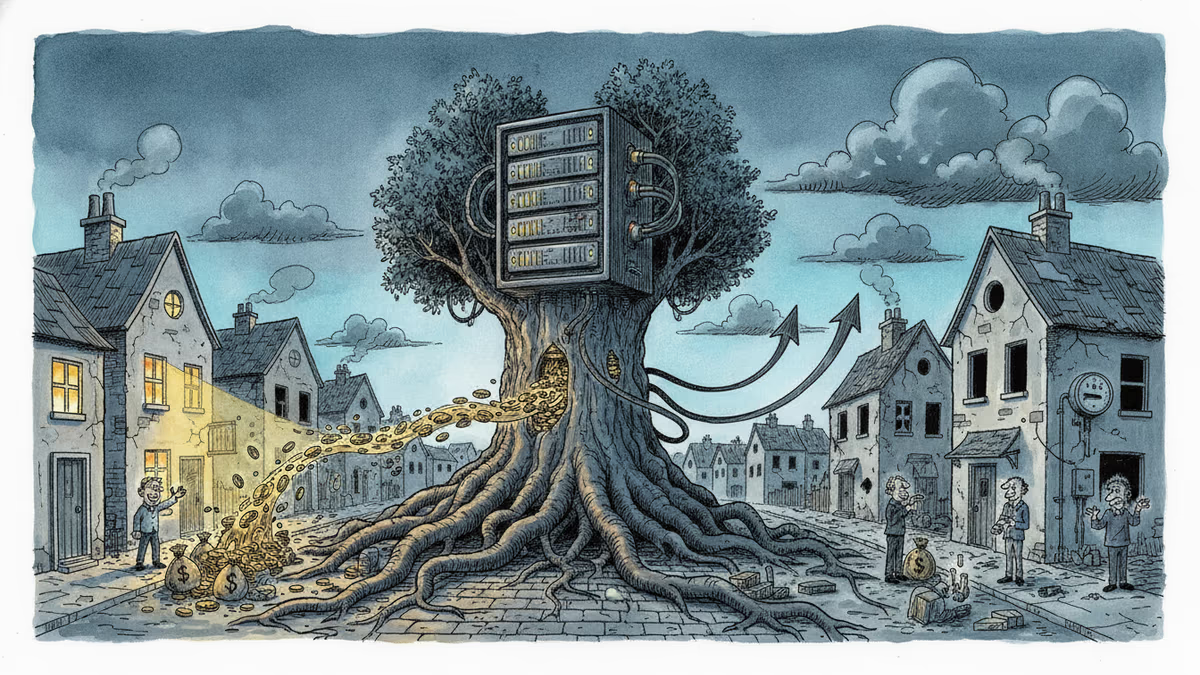
Over 1,200 community actions have pushed back against data centers since 2024. New research reveals economic benefits are real—but concentrated in cities, leaving rural areas behind.
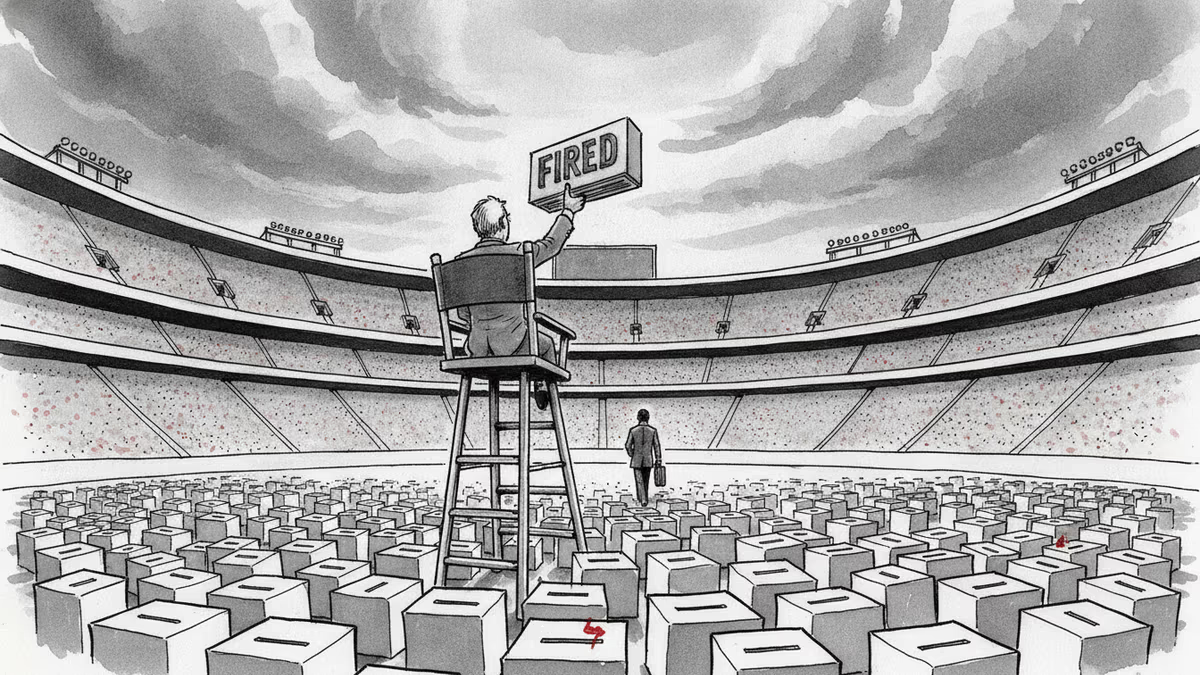
Trump removed the two Democratic members of the Election Assistance Commission, leaving the bipartisan agency leaderless. A Supreme Court ruling made it legal. Here's why a non-crisis can still be a warning sign.
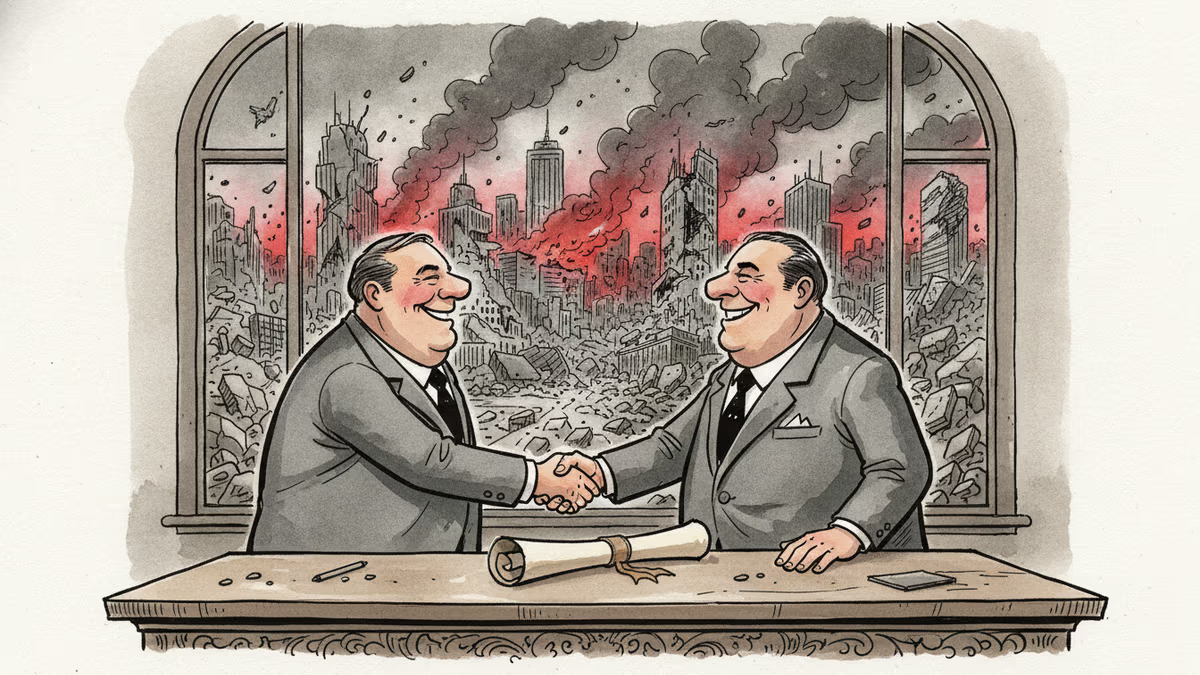
Lebanon and Israel signed a framework agreement in June 2026. Hezbollah rejected it. Israel kept fighting. History suggests this moment is real—and fragile.
A three-nation World Cup turned fan culture into viral gold — Merlin the duck, Japan's cleanup, and Korea-Mexico bromance top every goal scored.
Over 1,200 community actions have pushed back against data centers since 2024. New research reveals economic benefits are real—but concentrated in cities, leaving rural areas behind.
Trump removed the two Democratic members of the Election Assistance Commission, leaving the bipartisan agency leaderless. A Supreme Court ruling made it legal. Here's why a non-crisis can still be a warning sign.
Lebanon and Israel signed a framework agreement in June 2026. Hezbollah rejected it. Israel kept fighting. History suggests this moment is real—and fragile.
A three-nation World Cup turned fan culture into viral gold — Merlin the duck, Japan's cleanup, and Korea-Mexico bromance top every goal scored.
Thoughts
Share your thoughts on this article
Sign in to join the conversation