
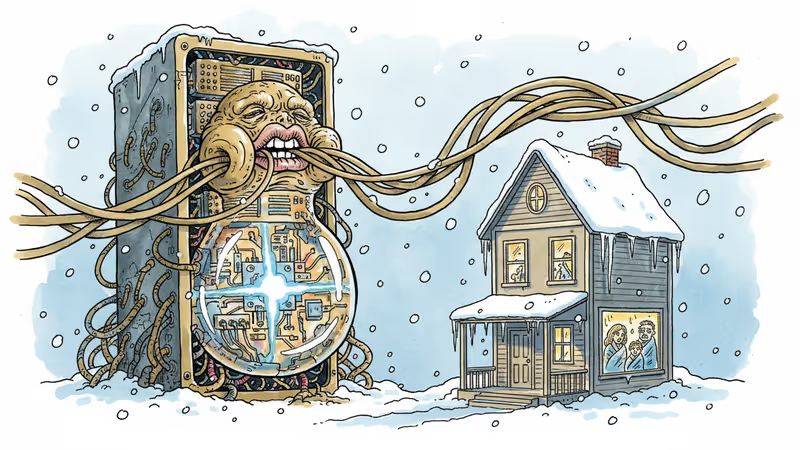
Winter Storm Exposes the Hidden Cost of AI's Power Hunger
A massive winter storm across 34 US states revealed power grid vulnerabilities as AI data centers strain electricity infrastructure, raising concerns about rising utility bills and blackout risks.
Hundreds of thousands of Americans spent the weekend in the dark after Winter Storm Fern swept across 34 states. But this wasn't just another weather-related blackout. The storm exposed a growing tension between our AI-powered future and the aging power grid struggling to keep up.
As bitter cold lingered after the storm, wholesale electricity prices in Virginia—home to the nation's largest concentration of data centers—soared to levels that would make even crypto miners wince. While winter demand spikes aren't unusual, the severity suggests something deeper is at play.
The Invisible Energy Appetite of AI
Every time you ask ChatGPT a question or generate an image with DALL-E, massive server farms spring into action. These AI data centers don't just sip electricity—they devour it. A single large facility can consume as much power as 100,000 homes, running 24/7 regardless of weather, economic conditions, or grid stress.
Amazon, Google, and Microsoft are pouring tens of billions into new data centers to fuel the AI arms race. The problem? They're building faster than utilities can upgrade the power infrastructure to support them. Grid operators who once planned decades ahead now find their forecasts obsolete within months.
"We're seeing demand growth we haven't experienced since the post-World War II industrial boom," says a utility executive who requested anonymity. "But back then, we had decades to build out capacity. Now we have years, maybe months."
Who Pays for the AI Revolution?
Here's where it gets personal for ordinary consumers. When data centers demand massive amounts of electricity, utilities must invest in new power plants, transmission lines, and grid upgrades. Those costs don't disappear—they show up in everyone's monthly bills.
Across the US, communities are pushing back. In Georgia, residents have filed lawsuits asking why they should subsidize Big Tech's electricity bills. In Virginia, some counties have imposed moratoriums on new data center construction. The message is clear: we want the benefits of AI, but not at any cost.

The math is stark. Data centers already consume about 4% of US electricity, and that figure could triple by 2030 if current trends continue. For context, that's equivalent to adding another California to the grid.
The Green AI Paradox
Ironically, AI is often touted as a solution to climate change. Smart grids optimize energy distribution, AI algorithms improve renewable energy forecasting, and machine learning helps reduce waste across industries. Yet the infrastructure powering these solutions is becoming a significant source of emissions.
Google's carbon emissions jumped 48% in 2023, primarily due to AI expansion. Microsoft faces similar challenges despite aggressive renewable energy investments. The companies are caught in a paradox: the faster they deploy AI to solve problems, the bigger their environmental footprint becomes.
Some are betting on breakthrough technologies like small modular nuclear reactors or advanced geothermal. Microsoft has even signed deals to restart shuttered nuclear plants. But these solutions are years away from meaningful deployment.
Beyond the Storm
Winter Storm Fern was a preview of coming attractions. As extreme weather becomes more frequent and AI demand continues its exponential growth, the collision between digital progress and physical infrastructure will intensify.
The question isn't whether we should embrace AI—that ship has sailed. Instead, we need to decide how to balance the incredible benefits of artificial intelligence with the very real costs of powering it. Some possibilities emerging include:
- Time-shifting AI workloads to periods of low grid demand
- Geographic load balancing to distribute power consumption
- Efficiency breakthroughs in chip design and cooling systems
- Direct renewable partnerships between tech companies and clean energy providers
Authors
Related Articles
Snowflake's new $6 billion AWS contract is about more than cloud spending. It signals a shift in AI infrastructure—away from Nvidia GPUs and toward cheaper, homegrown chips for the agent era.
At Milken 2026, five AI insiders—from the CEO of ASML to a quantum physicist challenging LLMs—laid out the physical, energy, and geopolitical limits the AI boom is running into.
Palantir co-founder Peter Thiel and other Silicon Valley investors have poured $140 million into Panthalassa, a startup building wave-powered floating AI data centers in the open ocean. Here's what that actually means.
40,000 Samsung union workers rallied at its Pyeongtaek chip plant, threatening an 18-day strike over wages. With AI-driven RAM shortages already lifting consumer prices, the timing couldn't be worse.
Snowflake's new $6 billion AWS contract is about more than cloud spending. It signals a shift in AI infrastructure—away from Nvidia GPUs and toward cheaper, homegrown chips for the agent era.
At Milken 2026, five AI insiders—from the CEO of ASML to a quantum physicist challenging LLMs—laid out the physical, energy, and geopolitical limits the AI boom is running into.
Palantir co-founder Peter Thiel and other Silicon Valley investors have poured $140 million into Panthalassa, a startup building wave-powered floating AI data centers in the open ocean. Here's what that actually means.
40,000 Samsung union workers rallied at its Pyeongtaek chip plant, threatening an 18-day strike over wages. With AI-driven RAM shortages already lifting consumer prices, the timing couldn't be worse.
Thoughts
Share your thoughts on this article
Sign in to join the conversation