

Why Nvidia's $2B CoreWeave Bet Isn't Just About Money
Nvidia's $2 billion investment in CoreWeave reveals a strategy to control AI infrastructure beyond just selling chips. Here's what it means for the AI ecosystem and market competition.
$2 billion into CoreWeave. That's not just an investment—it's Nvidia buying a seat at the table where AI's future gets built.
On Monday, the chipmaker announced it had purchased CoreWeave's Class A shares at $87.20 per share, doubling down on a company it already backed. But here's the twist: this isn't about financial returns. It's about controlling the entire AI infrastructure stack, from silicon to service.
Building 'AI Factories' Together
The partnership centers on what they're calling "AI factories"—data centers purpose-built for AI workloads. CoreWeave will integrate Nvidia's entire product lineup: the upcoming Rubin chip architecture (replacing Blackwell), Bluefield storage systems, and the new Vera CPU line.
But Nvidia isn't stopping at hardware. The company will help CoreWeave acquire land and power—two of the biggest bottlenecks in data center expansion. They'll also embed Nvidia's AI software and architecture into reference designs sold to cloud providers and enterprises.
This vertical integration strategy puts Nvidia in every layer of the AI stack, from the chip up to the customer.
CoreWeave's High-Stakes Gamble
CoreWeave has been walking a financial tightrope. The company carried $18.81 billion in debt as of September 2025, according to PitchBook, while reporting $1.36 billion in Q3 revenue. That's a lot of leverage for a company betting everything on AI demand.
CEO Michael Intrator has defended their model of using GPUs as collateral for debt financing, arguing that the "violent change in supply and demand" requires companies to "work together." Translation: the AI gold rush is so intense that normal business rules don't apply.

The strategy seems to be working. Since pivoting from crypto mining to AI infrastructure, CoreWeave has successfully ridden the wave. Their March 2024 IPO was followed by an acquisition spree: Weights & Biases, OpenPipe, Marimo, and Monolith—each adding pieces to their AI platform puzzle.
The Customer List That Matters
CoreWeave's client roster reads like a who's who of AI: OpenAI, Meta, Microsoft. These aren't just customers—they're validators. When the companies building tomorrow's AI choose your infrastructure, it sends a signal to the entire market.
The expanded OpenAI partnership is particularly telling. As OpenAI scales beyond ChatGPT, they need infrastructure partners who can match their ambitions. CoreWeave's ability to secure and maintain these relationships while carrying massive debt suggests the market sees real value in their approach.
Nvidia's Ecosystem Play
For Nvidia, this deal represents something bigger than another investment in their portfolio (they've made dozens in the past year). It's about creating dependencies that go far beyond selling chips.
By helping with land acquisition, power procurement, and software integration, Nvidia is positioning itself as the essential partner for anyone serious about AI infrastructure. They're not just the Intel of AI—they're trying to become the Amazon Web Services.
The 15% stock price jump following the announcement shows investors get it. This isn't about CoreWeave's balance sheet; it's about Nvidia's platform strategy.
The Circular Economy Question
Critics have raised concerns about "circular deals" in AI—companies investing in their own customers, creating artificial demand. Intrator's response that companies must "work together" doesn't fully address these concerns.
But perhaps that misses the point. In a market moving this fast, traditional arm's-length relationships might be too slow. The question isn't whether these partnerships create dependencies—it's whether they accelerate innovation or stifle competition.
Authors
Related Articles

Five stories from late September, traced to where the paper trail stops: Korea's export record, Nvidia's Hugging Face 8-K, a US-China AI channel, the UN on AI, and rising births.
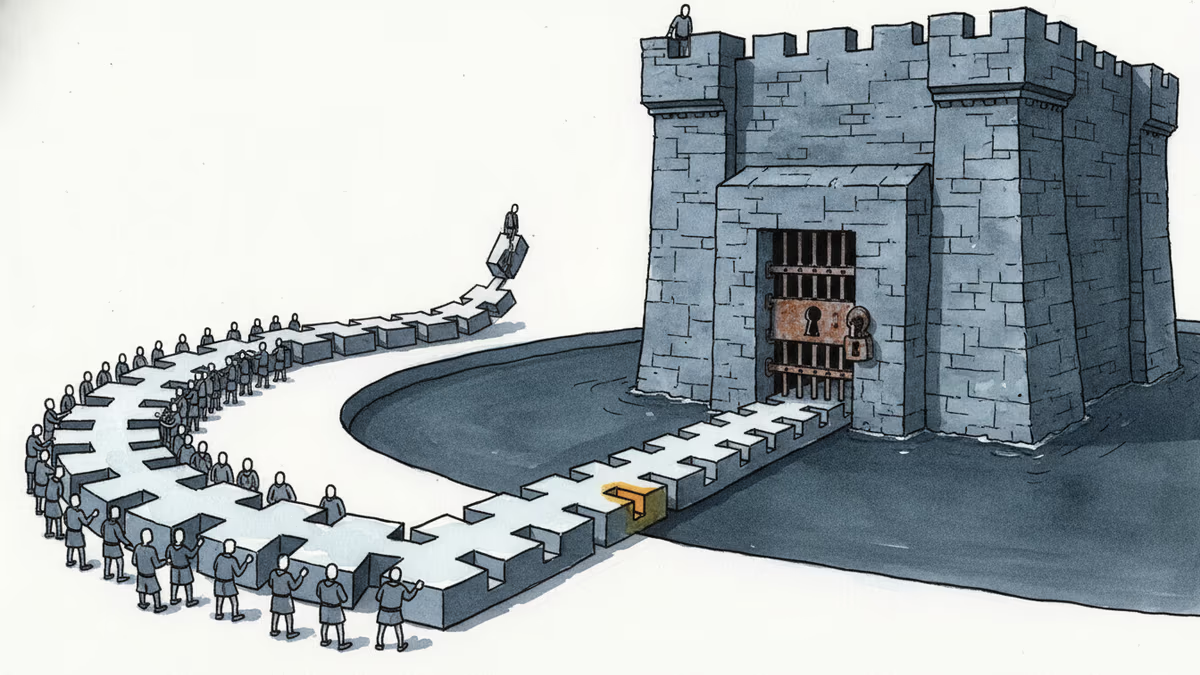
Nvidia shipped roughly a billion RISC-V cores in 2024, then announced it would run CUDA on the open standard. We break down how royalty-free instruction sets and open software stacks are trying to route around CUDA's lock-in. Part 2 of the Semiconductor Sovereignty series.
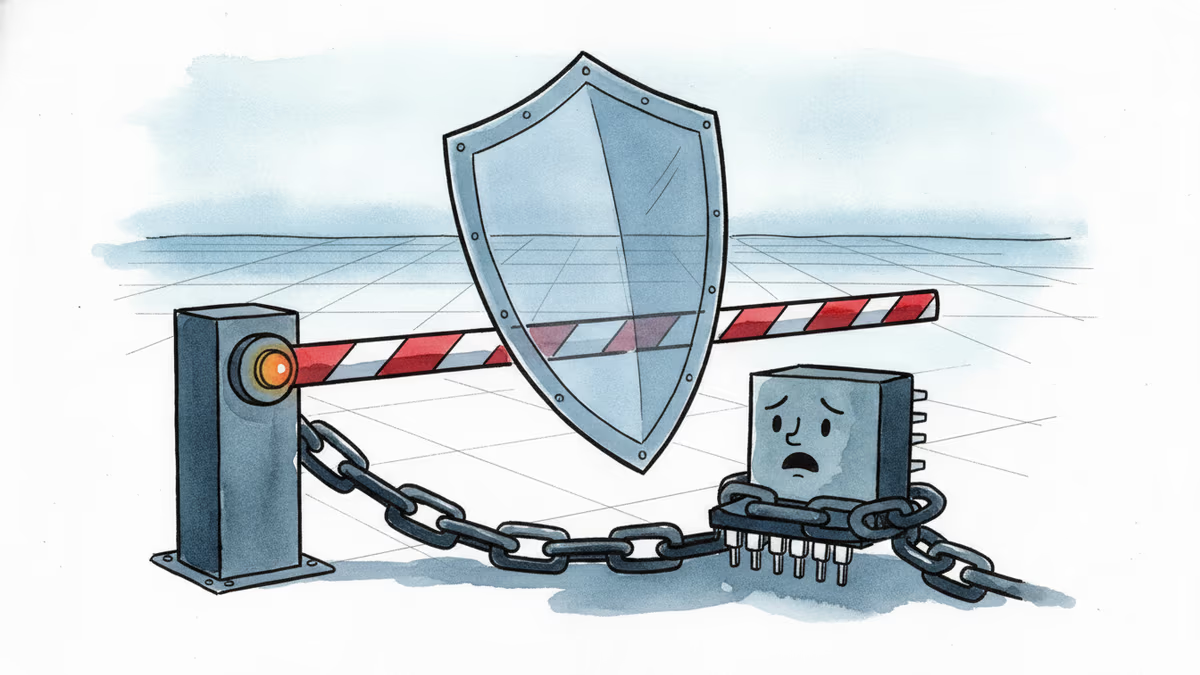
US AI-chip export controls split into three layers in the first half of 2026 — January easing, a May crackdown on circumvention, and a pending bill. Nvidia erased China from its guidance and still posted a record $81.6 billion quarter. A look at the export policy that both shields and cages it.
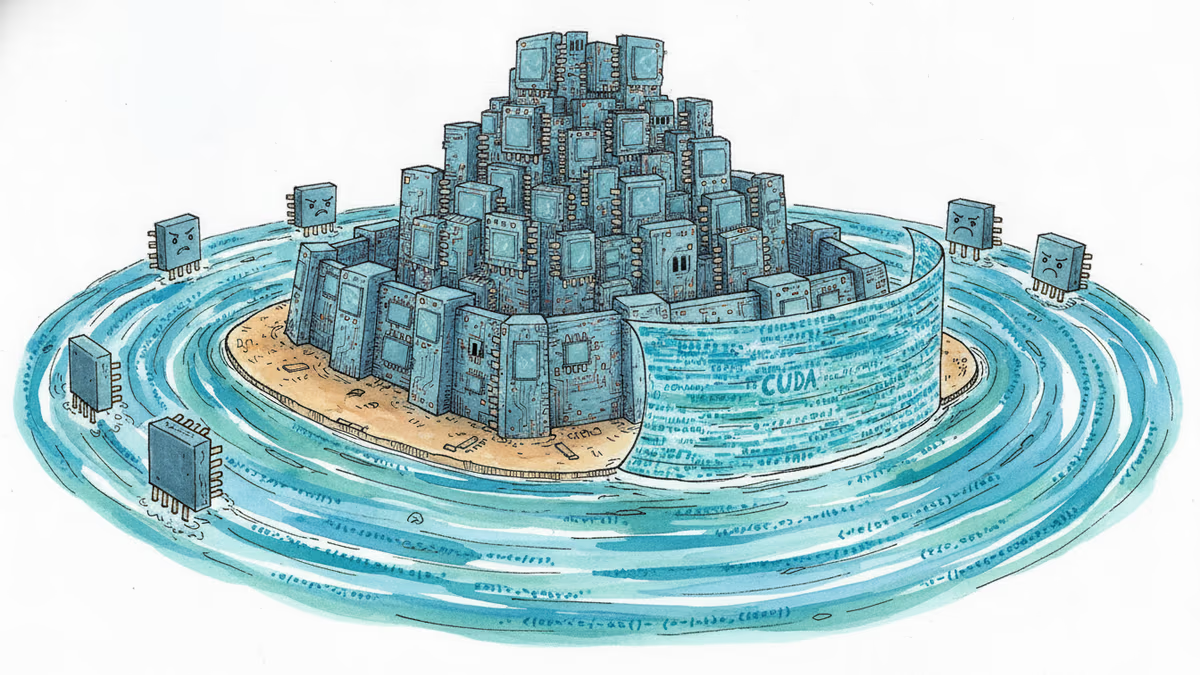
AMD's MI325X matches or beats Nvidia on memory and bandwidth — yet Nvidia's 86-92% share holds. The real moat is CUDA, 20 years in the making. Part 1 of 4.
Five stories from late September, traced to where the paper trail stops: Korea's export record, Nvidia's Hugging Face 8-K, a US-China AI channel, the UN on AI, and rising births.
Nvidia shipped roughly a billion RISC-V cores in 2024, then announced it would run CUDA on the open standard. We break down how royalty-free instruction sets and open software stacks are trying to route around CUDA's lock-in. Part 2 of the Semiconductor Sovereignty series.
US AI-chip export controls split into three layers in the first half of 2026 — January easing, a May crackdown on circumvention, and a pending bill. Nvidia erased China from its guidance and still posted a record $81.6 billion quarter. A look at the export policy that both shields and cages it.
AMD's MI325X matches or beats Nvidia on memory and bandwidth — yet Nvidia's 86-92% share holds. The real moat is CUDA, 20 years in the making. Part 1 of 4.
Thoughts
Share your thoughts on this article
Sign in to join the conversation