
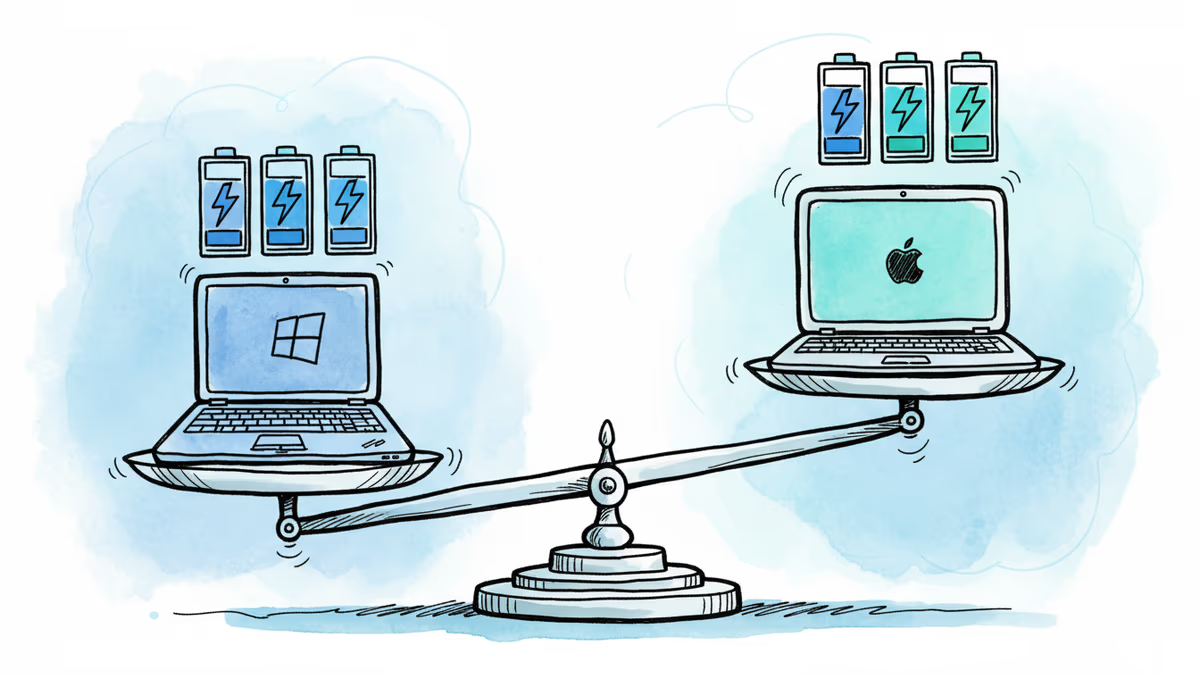
Windows Laptops Finally Match MacBooks on Battery Life
ARM-powered Windows laptops achieve 20-hour battery life, challenging Intel's dominance. Surface Laptop 7th Edition and Dell XPS 14 2026 lead the efficiency revolution.
20 Hours Without Plugging In—On Windows?
The Microsoft Surface Laptop 7th Edition just clocked 20 hours of continuous video playback. For a Windows machine, that's practically unheard of. Could this finally end the eternal hunt for power outlets that's plagued Windows users for decades?
The game-changer isn't better batteries—it's the Qualcomm Snapdragon X Elite chip. ARM architecture, proven in smartphones, is finally delivering desktop-class performance without the power hunger. The Dell XPS 14 2026 joins this efficiency revolution, also hitting that magical 20-hour mark.
The $700 Laptop That Doesn't Suck
Here's what might shock longtime Windows users: you can now get 16GB RAM and 1TB storage for under $750. The Dell 14 Plus regularly hits that price point, delivering specs that would've cost twice as much just two years ago.
But there's a catch. Not all Windows laptops are riding this wave. Intel-based models still hover around 8-10 hours of real-world usage. And ARM-based Windows machines, while efficient, come with compatibility trade-offs. Some professional software and games simply won't run—or run poorly.

Intel's Counterattack
Intel isn't sitting idle. The new Core Ultra Series 3 chips in the Dell XPS 14 2026 promise better integrated graphics—on par with discrete RTX 4050 performance without the battery drain. It's Intel's attempt to prove x86 can be efficient too.
Meanwhile, gaming laptops like the Razer Blade 16 double down on raw power. With RTX 5090 graphics, they're targeting creators and gamers who'll sacrifice battery life for performance. The laptop market is splitting into two distinct camps: efficiency-first ultrabooks and performance-first workstations.
The MacBook Threat Is Real
Apple's been enjoying a battery life advantage since the M1 chip launched in 2020. Windows OEMs are finally catching up, but at what cost? ARM-based Windows laptops often cost $1,200-$1,500—right in MacBook Air territory.
The value proposition becomes murkier when you factor in software compatibility. macOS users don't worry about their apps working. Windows ARM users still do.
Authors
Related Articles
Windows 11 reaches 1 billion users faster than Windows 10, yet online criticism persists. We explore the paradox of success without satisfaction in the OS market.

Five stories from late September, traced to where the paper trail stops: Korea's export record, Nvidia's Hugging Face 8-K, a US-China AI channel, the UN on AI, and rising births.

Huawei's CANN is open source under a license barring software for non-Ascend chips. Inside China's second CUDA, and the two links still outside it: pre-training compute and 5nm capacity.

Samsung Electronics' union branch revealed that 84% of survey respondents oppose the government's roughly $290 billion (₩400 trillion) semiconductor megaproject in Gwangju. Government, management, the union and shareholders are all reading the same national project in sharply different ways.
Windows 11 reaches 1 billion users faster than Windows 10, yet online criticism persists. We explore the paradox of success without satisfaction in the OS market.
Five stories from late September, traced to where the paper trail stops: Korea's export record, Nvidia's Hugging Face 8-K, a US-China AI channel, the UN on AI, and rising births.
Huawei's CANN is open source under a license barring software for non-Ascend chips. Inside China's second CUDA, and the two links still outside it: pre-training compute and 5nm capacity.
Samsung Electronics' union branch revealed that 84% of survey respondents oppose the government's roughly $290 billion (₩400 trillion) semiconductor megaproject in Gwangju. Government, management, the union and shareholders are all reading the same national project in sharply different ways.
Thoughts
Share your thoughts on this article
Sign in to join the conversation