
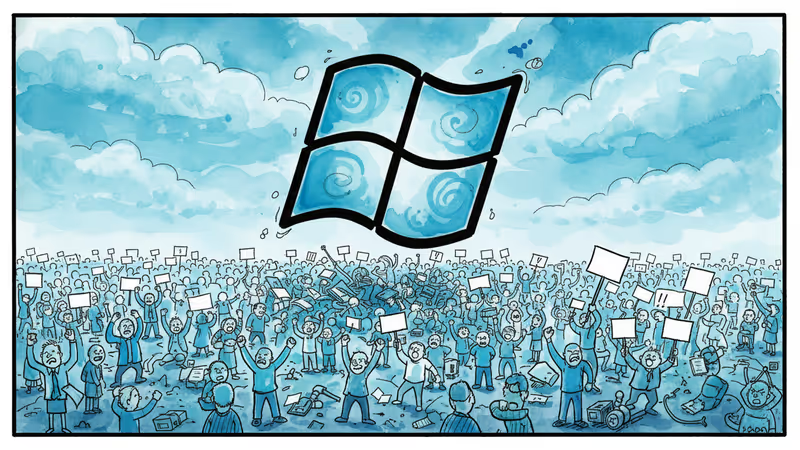
Windows 11 Hits 1 Billion Users, But Why Does Everyone Still Complain?
Windows 11 reaches 1 billion users faster than Windows 10, yet online criticism persists. We explore the paradox of success without satisfaction in the OS market.
What does it say about a product when 1 billion people use it, yet it's one of the most criticized pieces of software on the internet?
Microsoft CEO Satya Nadella recently announced that Windows 11 has crossed the 1 billion user milestone worldwide. The achievement came just 1,576 days after its October 5, 2021 launch—116 days faster than Windows 10 managed to reach the same milestone.
Yet scroll through any tech forum, and you'll find endless complaints about the OS, guides on "47 ways to make Windows 11 less annoying," and dramatic declarations about switching to Linux.
The Numbers Tell a Different Story
This paradox reveals something fascinating about the modern software landscape. The 1 billion figure isn't necessarily a vote of confidence—it's often a vote of necessity.
Most users didn't actively choose Windows 11. They got it when they bought a new computer, accepted it through automatic updates, or found themselves with no practical alternative. In the desktop OS market, choice is largely an illusion when Windows commands over 90% market share.
The speed of adoption compared to Windows 10 also reflects changed market dynamics. PC sales surged during the pandemic, and hardware manufacturers like Dell, HP, and Lenovo quickly standardized on the new OS. Users followed by default, not by design.
The Ecosystem Lock-In Effect
For businesses, the calculation is even simpler. Enterprise software, legacy applications, and established workflows create powerful switching costs. A mid-sized company might spend hundreds of thousands retraining staff and replacing software to move away from Windows.

Microsoft understands this dynamic perfectly. They're not just selling an operating system—they're maintaining an ecosystem that includes Office 365, Azure, Teams, and countless third-party applications that assume Windows compatibility.
This creates what economists call a "network effect." The more people use Windows, the more valuable it becomes, regardless of individual user satisfaction.
Success Without Satisfaction
The criticism isn't entirely unfair. Windows 11 introduced controversial changes: mandatory Microsoft account sign-ins, aggressive cloud integration, and interface modifications that many found unnecessary. Privacy advocates worry about increased data collection, while power users complain about reduced customization options.
But here's the thing: Microsoft can afford to ignore much of this criticism because they've built something more powerful than a great product—they've built an indispensable one.
Compare this to the smartphone market, where user dissatisfaction can drive real migration between iOS and Android. Desktop users don't have that luxury. macOS requires expensive hardware, Linux demands technical expertise most lack, and ChromeOS works only for basic tasks.
The Regulatory Question
This market dominance hasn't gone unnoticed by regulators. The European Union is increasingly scrutinizing Microsoft's bundling practices, while the US Department of Justice has renewed interest in big tech monopolies.
But regulatory action moves slowly, and Microsoft has learned from past antitrust battles. They're more careful about outright blocking competitors while still making Windows the path of least resistance.
The answer might reshape the entire computing landscape.
Authors
Related Articles
GitHub confirmed hackers stole data from 3,800 internal repositories via a poisoned VS Code extension. Here's why developer tools are now the most dangerous attack surface in tech.
Emails revealed in the Musk v. Altman trial show Microsoft executives were deeply skeptical of OpenAI in 2017–2018. What actually changed their minds?
Xbox hardware revenue dropped 33% in Q1 2026, yet Microsoft posted $82.9B in total revenue. What this tells us about the future of gaming—and who actually loses.
Microsoft is letting Windows users delay updates indefinitely — 35 days at a time, as many times as they want. A long-overdue fix, or a security risk hiding in plain sight?
GitHub confirmed hackers stole data from 3,800 internal repositories via a poisoned VS Code extension. Here's why developer tools are now the most dangerous attack surface in tech.
Emails revealed in the Musk v. Altman trial show Microsoft executives were deeply skeptical of OpenAI in 2017–2018. What actually changed their minds?
Xbox hardware revenue dropped 33% in Q1 2026, yet Microsoft posted $82.9B in total revenue. What this tells us about the future of gaming—and who actually loses.
Microsoft is letting Windows users delay updates indefinitely — 35 days at a time, as many times as they want. A long-overdue fix, or a security risk hiding in plain sight?
Thoughts
Share your thoughts on this article
Sign in to join the conversation